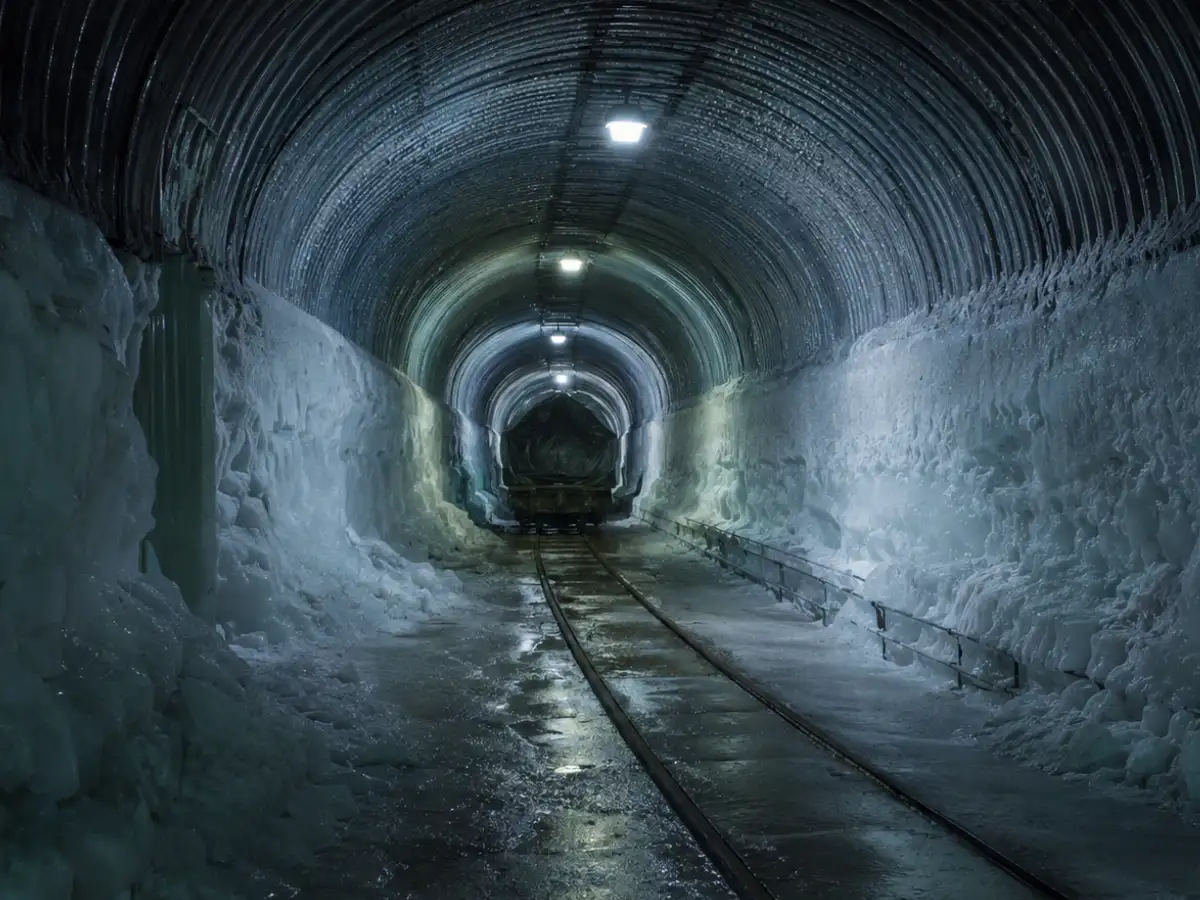
In 1959, the US Army started drilling into a glacier in Greenland. According to the Atomic Heritage Foundation's Nuclear Museum, what emerged from that dig was Camp Century, an underground base powered by a portable nuclear reactor, publicly sold as a research station. That was not all. It was a cover for a much larger plan, codenamed Project Iceworm.
If you grew up thinking Cold War missiles were mostly hidden in Kansas wheat fields, this story may surprise you.

An ice city with a barbershop and a hidden agenda
Camp Century looked like an engineering feat, on paper. According to the Atomic Heritage Foundation, soldiers lived in a network of 26 tunnels cut into the ice and roofed with steel arches, with dormitories, a hospital, a chapel and even a barbershop, all powered by a small nuclear reactor that ran 24 hours a day. Journalists came to visit, and the base appeared in the magazine’s May 1962 issue, as an engineering marvel, according to National Geographic’s retrospective on the site. The real purpose, known to almost nobody outside a small circle of Army planners, was to show that tunnels could be built inside a moving glacier and scaled up into a much larger system.
The photographs that later ran in National Geographic were taken during a period when the station was being framed as a triumph of polar engineering, even as the reactor leak had already exposed how fragile the setup was. By the time of the magazine’s May 1962 feature, the camp had 15 escape hatches, a cut-and-cover trench system, and the aura of a futuristic city built to normalize an otherwise classified military experiment.