Get all your news in one place.
100's of premium titles.
One app.
Start reading
Sports Illustrated
Sports Illustrated
Sport
Matt Verderame

The Top Five Biggest Pro Football Hall of Fame Snubs, Including Two Elite Coaches

LeRoy Butler can still remember the feeling. He can still see the scene in his mind.

After losing the 1995 NFC championship game to the Cowboys—the Packers’ third consecutive postseason exit at the hands of Dallas in Texas Stadium—Butler and the Green Bay traveling party stewed in silence, buckled in, waiting for the engines to fire.
Well, all but one.

Mike Holmgren, the 6'5" coach who was assuredly as devastated as the players in their undersized seats, didn’t show it. As the plane took off, Holmgren remained on his feet until the aircraft hit 10,000 feet. He had more important things on his mind.

“He had a big smile on his face,” says Butler, the team’s Hall of Fame safety from 1990 to 2001. “You know what he said? ‘Next year, we’re going to win it.’ He stopped at every row. ‘Next year, we’re going to win it. Next year, we’re going to win it.’ I thought he was going to throw us off the damn plane. We lost to the Cowboys again. But that’s the therapy thing. He didn’t want that to sink in our minds, carrying it over to next year. He was giving us a clean slate.”

The coach turned therapist was prescient. Green Bay roared to a 13–3 record the following year and won it all, beating the Patriots in Super Bowl XXXI to give Titletown its first championship since the 1967 season. For Holmgren, it was the first of three Super Bowl appearances, including the next year with the Packers and then in 2006 with the Seahawks.

Now 78 years old, Holmgren wasn’t just a great tactician who learned the West Coast offense under 49ers legend Bill Walsh. He was also the man who showed up at his players’ kids’ recitals and joked that any new family arrivals should be synced with the offseason. For Butler, the influence extended well beyond football.

“As a kid who grew up in the inner city, in a single-parent home, I love teachers,” Butler says. “I absolutely love teachers. I grew up without a father. Holmgren is a father-therapist. Let’s say grandfather because a grandfather doesn’t have a filter.

“He’d just say, ‘I’m not losing to San Francisco.’ I’d say, ‘Coach, wait. We’re playing, you’re just coaching.’ Uh-uh. ‘No, we’re in this thing together.’ He was a mentor.”

For Holmgren and everyone else associated with the NFL, the ultimate personal validation is a gold jacket and a bust in the Pro Football Hall of Fame. Thus far, that honor has eluded him. Holmgren and Bill Belichick are the only coaches with at least three Super Bowl appearances and a championship who have not been inducted. This summer, with the notable omission of Belichick—the former Patriots coach who led the team to six Super Bowl titles and also won two as a Giants’ assistant— looming over the inductions in Canton, Ohio, on Aug. 8, it seemed an appropriate time to take stock of who else hasn’t yet received the call despite having worthy credentials.

Sports Illustrated reached out to eight current voters and asked them to list the 10 biggest Hall of Fame omissions. The top choice was worth 10 points, the final choice was worth one. The ground rules were simple:

• Anyone could be included provided they have been eligible for at least five voting cycles. Coaches with a one-year waiting period needed to have been retired for at least five years. (So no Belichick or Eli Manning, who first became eligible in 2025.)

• Each omission had to be active in at least one Super Bowl-era year.

All told, 50 names earned at least one vote from our anonymous panelists. Of them, 45 were players, three were coaches and two were owners.

Here are the top five.

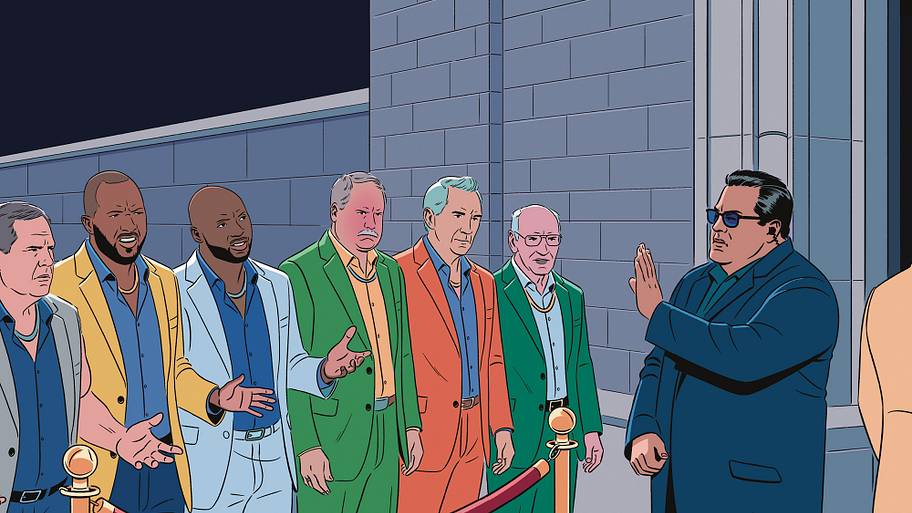
Pro Football Hall of Fame snubs
Illustration by Madison Ketcham

5. Torry Holt, WR (24 points)

Career: Rams (1999–2008), Jaguars (2009)

Holt is part of the abundance of receiving talent on the ballot. For this year’s class, three wideouts were among the 15 modern-era finalists, with only the Cardinals’ Larry Fitzgerald earning the 80% of votes necessary for enshrinement. In Holt’s case, he’s been agonizingly close, a finalist in each of the last seven voting cycles.

When Holt entered the league in 1999, only a few teams were throwing the ball as frequently as we see today. And while Holt benefited from playing on the Greatest Show on Turf with QB Kurt Warner, he was outshining his contemporaries. From 2000 to ’09, Holt led the NFL with 868 catches and 12,594 yards, outpacing others with gold jackets, including Randy Moss and Terrell Owens.

“He was ready to be an All-Pro when he showed up,” says Hall of Famer Dick Vermeil, who coached Holt as a rookie with the Super Bowl-champion Rams. “Our offensive players and staff did a great job with him. When you see what he produced from then on, here’s a guy with two seasons of 1,600-plus yards, six seasons over 1,300 yards and eight seasons of 1,100 yards or more. My God, he was spectacular.”

Holt played on the same offense as three Hall of Famers: running back Marshall Faulk, wide receiver Isaac Bruce and Warner. Even so, Holt—whose career numbers are comparable to Bruce’s—twice led the league in yards receiving and once in receptions, snagging 117 passes in 2003 to earn All-Pro honors.

“Every time he looked around, he saw a positive influence, somebody doing something right,” says Vermeil. “He came in after we spent two years investing in building that team from the bottom up. Hell, they had lost more games in the 1990s than any team in football. We did it the old-fashioned way. He stepped in when everything else was ready to go.”

All told, Holt ranks 17th all-time with 13,382 yards receiving, with all but seven of the names above him retiring after his career ended.


4. Maxie Baughan, LB (25 points)

Career: Eagles (1960–65), Rams (1966–70), Washington (1974)

For some, the wait is long. For some, the quest to reach football immortality stretches beyond their human mortality. Maxie Baughan, who died in 2023 at 85, won’t be around to see if he finally gets the ultimate honor. For 11 seasons, the Georgia Tech product was a machine in the middle of his team’s defense. From 1964 to ’69, Baughan was a six-time All-Pro, including first-team honors once. He totaled 24 ½ sacks (sacks weren’t an official stat until ’82) and 18 interceptions.

Still, Baughan never earned serious consideration from the Hall of Fame until 2025, when he was named a finalist for the first time. Now in the senior pool, Baughan is competing with scores of candidates dating back to the league’s founding in 1920.

“He wasn’t the biggest guy in the world, but he had a big heart and played very well,” says Dave Robinson, a Hall of Fame linebacker with Green Bay and Washington who was Baughan’s teammate in 1974. “He had a good mind. He was a very educated player, and he didn’t make many mistakes. If you were going to run a play, you had to figure out [where he was] definitely. I watched him and some of the things he did, I tried to emulate.”

After his playing days, Baughan stayed involved in the game as a coach, including stints as a defensive coordinator for the Colts (1975–79) and Lions (1980–82). Following a six-season run as Cornell’s head coach, which included an Ivy League title, Baughan served as linebackers coach with the Vikings (1990–91), Buccaneers (1992–95) and Ravens (1996–98), teaching the likes of Hall of Famers Derrick Brooks and Ray Lewis in their formative years.


Former Indianapolis Colts receiver Reggie Wayne
In 14 seasons with the Colts, Reggie Wayne compiled 14,345 yards receiving and 82 touchdowns. | USA TODAY Network via Reuters Connect

3. Reggie Wayne, WR (25 points)

Career: Colts (2001–14)

Much like Holt, Reggie Wayne has found himself overshadowed by his Hall of Fame teammates. With quarterback Peyton Manning and fellow wideout Marvin Harrison already in Canton, Wayne has been on the outside looking in, reaching the finalist stage each of the last seven years.

For Wayne, the numbers are there. He ranks 10th all-time with 14,345 yards receiving and 11th with 1,070 receptions. Only longtime Panthers receiver Steve Smith Sr. has more yardage and isn’t in the Hall of Fame. The three-time All-Pro also won Super Bowl XLI with the Colts.

“He just had a classic frame; he’s a big receiver, but still had the quickness and the athleticism,” says Tony Dungy, who coached the 6-foot, 203-pound Wayne from 2002 to ’08. “He wasn’t a burner, wasn’t a 4.3 guy, but he had speed and outstanding quickness in and out of the break. He had those great hands; he could catch it all kinds of ways. He had no fear, so throwing in traffic wasn’t a problem. He just felt like every ball was his.”

Still, Wayne has been locked out of the Hall largely due to the voting rules, which see him splitting votes with the likes of Holt and Smith. Then there’s the issue of how many players should come from a single team, something that has hampered the cases of Steelers defensive end L.C. Greenwood, Cowboys safety Darren Woodson and Holt. The Colts of the mid-2000s have defensive end Dwight Freeney, Manning and Harrison, along with Dungy and former GM Bill Polian already enshrined. For a group with one Super Bowl win, that’s a lot.

And yet, some of Wayne’s greatness came from that strength in numbers. “Part of it was him, but part of it was the group that he was with,” Dungy says. “When we’d be in defensive periods, Peyton would take the receivers and he’d have Reggie and Marvin doing things when they were supposed to rest. [Reggie] was practicing more than any receiver I can imagine.

“I remember he told me, ‘I’ve got to get Peyton’s trust. I’ve got to let him know that he can believe in me, do everything to show him I’m going to be his favorite receiver.’ Of course, you had Marvin there doing the same thing, so Reggie had to put in more time.”

Time is on Wayne’s side: He’s eligible for 13 more years. But each year lost adds to the agony of being so close, yet so far, from the ultimate honor.


Former Green Bay Packers and Seattle Seahawks coach Mike Holmgren
Former Packers coach Mike Holmgren returned the Lombardi Trophy to Titletown after winning Super Bowl XXXI. | USA TODAY Network via Reuters Connect

2. Mike Holmgren, coach (32 points)

Career: Packers (1992–98), Seahawks (1999–2008)

As previously noted, reaching three Super Bowls with at least one victory and not getting into the Hall of Fame is almost unheard of. Mike Holmgren also won 161 regular-season games, ranking 21st all-time. And he wasn’t a one-trick pony: Holmgren won 75 games in Green Bay and another 86 in Seattle, making six postseason trips with each team. (Only seven coaches in NFL history have reached the playoffs more often. Three—Paul Brown, Tom Landry and Don Shula—are in the Hall of Fame. The other four are Belichick, Andy Reid, Marty Schottenheimer and Mike Tomlin.) In both of his head coaching stops, Holmgren took over flailing franchises and turned them into winners.

Holmgren’s greatness extends to his days as an assistant in San Francisco. He spent 1986–91 as quarterbacks coach to Joe Montana and Steve Young, while serving as the offensive coordinator for the final three years. Those Niners won two championships, never missing a beat as they changed hands from Bill Walsh to defensive coordinator George Seifert following Walsh’s retirement after the ’88 season.

“Great teacher, great human,” says Brent Jones, the team’s tight end from 1987 to ’97. “He took Bill Walsh’s offense and stepped on the gas a little bit. I think a lot of that had to do with some of the talent that we had. When your backs and your tight end can catch the ball and be weapons, as well as all of your receiving positions, it gives you multiple options. He started blending some stuff probably from the BYU days [where Holmgren was an assistant from 1982 to ’85], where they threw the heck out of the ball. He would implement a few things. In terms of the West Coast offense, he took it to a new level. I remember being so depressed when he got the Packers job.”

Holmgren began to cultivate his football identity as a quarterback at USC, where he primarily played a backup role before being drafted by the Cardinals in 1970—despite throwing just 27 passes for the Trojans. Although he never played an NFL down, he knew what it was to be a player, and he learned the value of a coach beyond the chalkboard.

“He understood the relational side of things very deeply,” Jones says. “He was super connected to his guys. I know those personal relationships that he had as a head coach in Green Bay. I’ve talked to multiple players over the years, and they said he might have been a little bit tougher, but behind the scenes he still kind of was that big teddy bear.”

Holmgren was a finalist in 2020 and ’25 but has yet to receive the call. It’s one that Butler, someone who waited 16 years in his own right to get, is desperate to see for his coach. Harkening back to that plane ride home from Dallas, Butler says that while Holmgren was a master tactician, he was an even better molder of men. “How do I get 50 guys from age 21 to 31 and 34 to think the same thing?” Butler says. “That’s what we’re missing. He mended that gap. He closed the daylight."


Former Denver Broncos coach Mike Shanahan
Former Broncos coach Mike Shanahan is a two-time Super Bowl winner and still hasn't been voted into the Hall of Fame. | IMAGN IMAGES via Reuters Connect

1. Mike Shanahan, coach (36 points)

Career: Raiders (1988–89), Broncos (1995–2008), Washington (2010–13)

Mike Shanahan is the most confounding situation currently facing the Hall of Fame. The voters will assuredly induct Belichick into the Class of 2027. For Shanahan, there’s no end in sight; he’s never even reached the finalist stage.

It’s perplexing. Since Shanahan retired 13 years ago, 10 coaches have been finalists and six (Jimmy Johnson, Bill Cowher, Tom Flores, Don Coryell, Vermeil and Dungy) have been enshrined. Of those, only Johnson and Flores have two titles, and they won a combined 177 games. Shanahan, also a victor in two Super Bowls, won 170 by himself.

Much like Holmgren, Shanahan’s secret sauce was his ability to connect with players. It’s a trait that began during his days in the 1980s as QB coach and offensive coordinator with the Broncos, when Denver went to two Super Bowls. Then, in San Francisco, Shanahan replaced Holmgren as offensive coordinator in 1992. In his third season, Shanahan oversaw the league’s top-scoring offense on the 49ers’ way to a 49–26 rout of the Chargers in Super Bowl XXIX.

“Our team understood that everybody wanted the ball, but we put the team and winning first,” says Jones. “When Mike came in, he did something different. He spent time with each skill position player in the starting unit. And what he told me specifically was, ‘Brent, you might have a few less catches, but I guarantee you, you’re going to have more touchdowns, and this is the way we’re going to do the offense. There might be some times where I’m going to keep you in the block for max protection because we’ve got some things going on, and that’s going to give us the greatest chance for success.’

“Of course, as a player, you want more catches and more opportunities, but you want to win a Super Bowl. I respected the fact he said that, and he was dead on.”

In 1995, Shanahan took over the Broncos and helped revolutionize the sport with his zone-blocking scheme, something that remains prevalent across the league today. Behind Hall of Famer Terrell Davis, Denver’s offense took off. In 1998, Davis rushed for 2,008 yards, leading the Broncos to their second straight title, making Shanahan the fifth coach to win back-to-back Super Bowls.

Despite it all, Shanahan hasn’t sniffed the Hall of Fame, even with our panel suggesting he’s the most glaring omission of them all.

Others receiving votes:

(Total points in parentheses)

Albert Lewis (22)

Ken Anderson (17)

Robert Kraft (16)

George Kunz (16)

Otis Taylor (16)

Del Shofner (14)

Tom Coughlin (13)

L.C. Greenwood (13)

Bud Adams (10)

Lester Hayes (10)

Jim Marshall (10)

Steve Tasker (10)

Jim Tyrer (10)

Eddie Meador (9)

Doug Williams (9)

Steve Wisniewski (9)

Ed Budde (8)

Willie Anderson (7)

Darren Woodson (7)

Brian Mitchell (6)

Jake Scott (6)

Tom Sestak (6)

Bob Kuechenberg (5)

Clay Matthews Jr. (5)

Art Modell (5)

Everson Walls (5)

Steve Smith Sr. (4)

Rodney Harrison (3)

Ed White (3)

Cornell Green (2)

Henry Ellard (2)

Hines Ward (2)

Harvey Martin (1)

Steve McNair (1)

Richmond Webb (1)


More NFL from Sports Illustrated

MORE NFL FROM SPORTS ILLUSTRATED

Sign up to read this article
Read news from 100's of titles, curated specifically for you.
Already a member? Sign in here
Related Stories
Top stories on inkl right now
One subscription that gives you access to news from hundreds of sites
Already a member? Sign in here
Our Picks
Fourteen days free
Download the app
One app. One membership.
100+ trusted global sources.