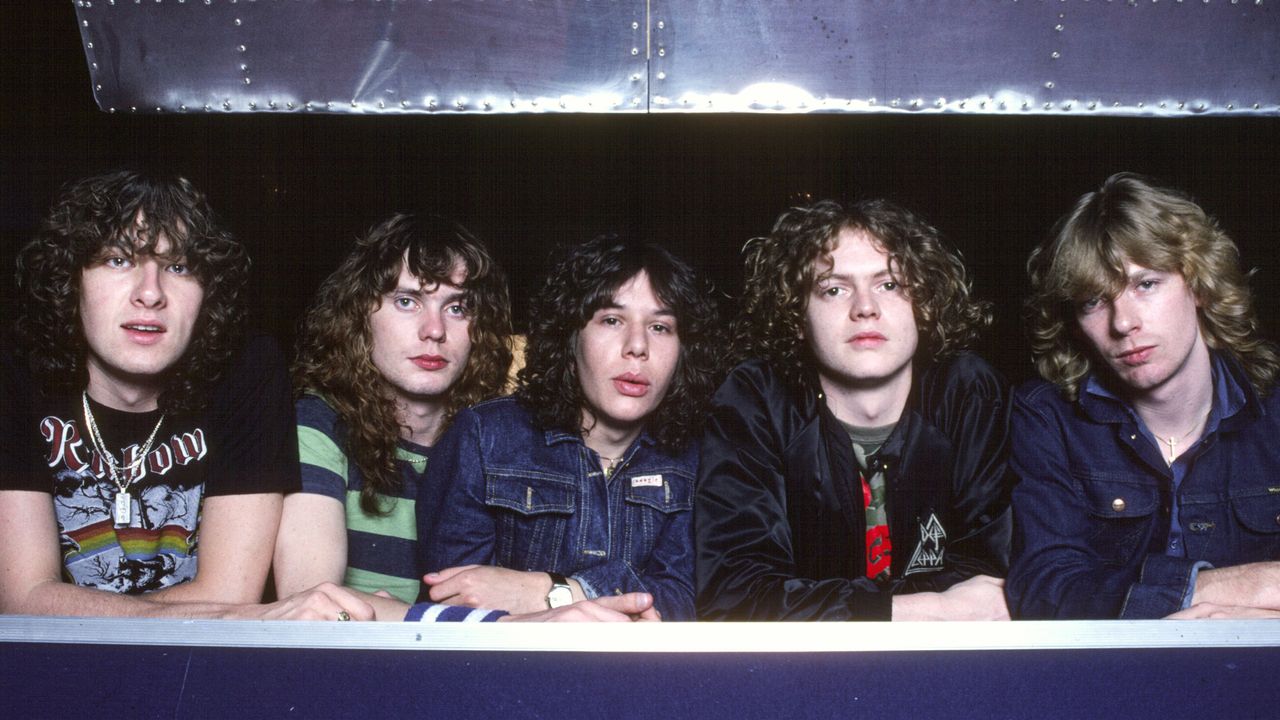
In November 1978, five young men traveled 60 miles from their hometown of Sheffield to Hull for their first recording session in a pro studio. The result was The Def Leppard EP – a three-track vinyl seven-inch that set the young band on the path to global stardom. But they couldn’t have done it without the generosity of their singer’s father.
Back in ’78, the price for a two-day session at Fairview Studios in Hull was £150. That was a lot of money for a working class family in the UK in those days. But Joe Elliott, Def Leppard’s singer, managed to persuade his father, Joe Elliott Sr, to give them the cash.
As Elliott recalled to Classic Rock: “My dad literally emptied out his bank account. That’s how much faith he had in his son, God bless him.”
Just a week before the band’s arrival at Fairview, there was trouble. With some reluctance, the band had fired their drummer Tony Kenning.
Bassist Rick Savage explained: “The band was everything to us, but Tony didn’t fancy doing this as much as we did. So a decision had to be made.”
With Kenning out of the picture, they asked a friend to step in at short notice. Frank Noon was the drummer for The Next Band, a power trio that had formed in Lincolnshire before relocating to Sheffield.
For a couple of days, Noon rehearsed with Elliott, Savage and guitarists Pete Willis and Steve Clark.
They arrived in Hull on a Friday night, checked into cheap bed-and-breakfast rooms, and promptly got drunk.
“We were pretty hungover on the Saturday morning,” Elliott said. “But as soon as we started recording, all of a sudden we felt great again.”
The three tracks they recorded were Ride Into The Sun, Getcha Rocks Off and The Overture.
“We wanted to show the different sides to the band,” Elliott said. “So we picked Ride Into The Sun, a pop song, Getcha Rocks Off, a full-on rock song, and The Overture, which was this mad seven-minute epic.”
By the end of the first day, with the band working well into the evening, they had everything recorded except for some lead vocals.
Rick Savage told Classic Rock: “My clearest memory is being in the control room and hearing a playback of the first ten seconds of Ride Into The Sun. I thought, this sounds amazing! It was a feeling I’ll never forget.”
The backing tracks for Getcha Rocks Off and The Overture were both done in just one take. But for the vocals, Joe Elliott needed a little more time than the other guys.
“I was a bit tipsy on the Saturday night and really giving it some,” Elliott said. “It was more difficult doing the scream in The Overture on the Sunday morning. I felt really self-conscious, but we flooded my vocals in echo and it was okay.”
The three tracks were mixed that afternoon, and at exactly 3.45pm – Elliott remembered every detail – the band exited Fairview with copies of the three tracks on two cassette tapes.
Elliott recalled: “The studio bill came to £148.50. So with the £1.50 in change we all bought a celebratory bag of fish and chips before we drove back to Sheffield.
“We were in two cars – the five of us and a couple of friends pretending to be roadies – and as we sat eating and listening to the tapes, we all kept saying the same thing: ‘We’ve made a bloody record!’”
Within 24 hours, Elliott had invited Frank Noon to join Def Leppard as a full, permanent member of the band. Noon turned down the offer out of loyalty to his mates in The Next Band – a decision he later described as “the biggest regret of my life”.
Rick Allen was promptly installed as Def Leppard’s new drummer, despite having only just turned 15. Allen said of Noon: “Frank could quite easily have stepped into Def Leppard, but the planets lined up for me.”
With the recordings completed, more money was needed to press 1000 copies on vinyl. Another £450, in fact. Elliott borrowed the money from someone his girlfriend worked with. He raised a further £62.50 for printing the card covers, which were glued by hand by Elliott and his mother. The illustration fore the cover was by Derek Jeffries, who worked with Elliott at an ironmongery company.
As an independent release, The Def Leppard EP was issued on the band’s own label Bludgeon Riffola.
That name was a little inside joke. After Leppard had played a gig at Sheffield club The Limit in September 1978 – as support act to another rising group from the city, electro-pop pioneers The Human League – a review in Record Mirror magazine had mocked Leppard’s music as ‘bludgeon riffola’, which sounded like canned Italian food to Pete Willis.
The Def Leppard EP was released in January 1979, and within a week, all 1000 copies sold out. A second pressing of 1500 also sold fast.
“We didn’t make any money out of it,” Elliott said, “but as a promotional exercise you couldn’t beat it.”
Eventually, a copy of the EP would reach Cliff Burnstein, the head of A&R at Mercury records in Chicago. Burnstein would ensure that Def Leppard signed with Mercury’s sister label in the UK, Vertigo. He also went on to co-manage the band with Peter Mensch.
In the shorter term, the promotional value in The Def Leppard EP was evident when the band had their first national radio airplay after Joe Elliott had ambushed John Peel, then one of the most famous and respected DJs in the UK.
“Peel did a Radio 1 event at Sheffield University one night,” Elliott recalled. “I jumped on stage – he must have thought I was going to attack him – then gave him the EP and said, ‘I’m in this band – play it!’
“He asked for my phone number and said he’d call me. The next day, around five in the afternoon, he called. He said, ‘I quite like it, so I’m going to play a song at half past seven tonight.’
“I was sitting with my mum and dad when it happened – John Peel playing Ride Into The Sun on Radio 1. Amazing!”
All across Sheffield, in their separate homes, the other members of Def Leppard shared in the experience.
“It was one of those moments when time stood still,” Rick Allen said. “I remember thinking, wow, this band is really something now…”