Get all your news in one place.
100’s of premium titles.
One app.
Start reading
The Independent UK
The Independent UK
Lifestyle
Jessie Thompson

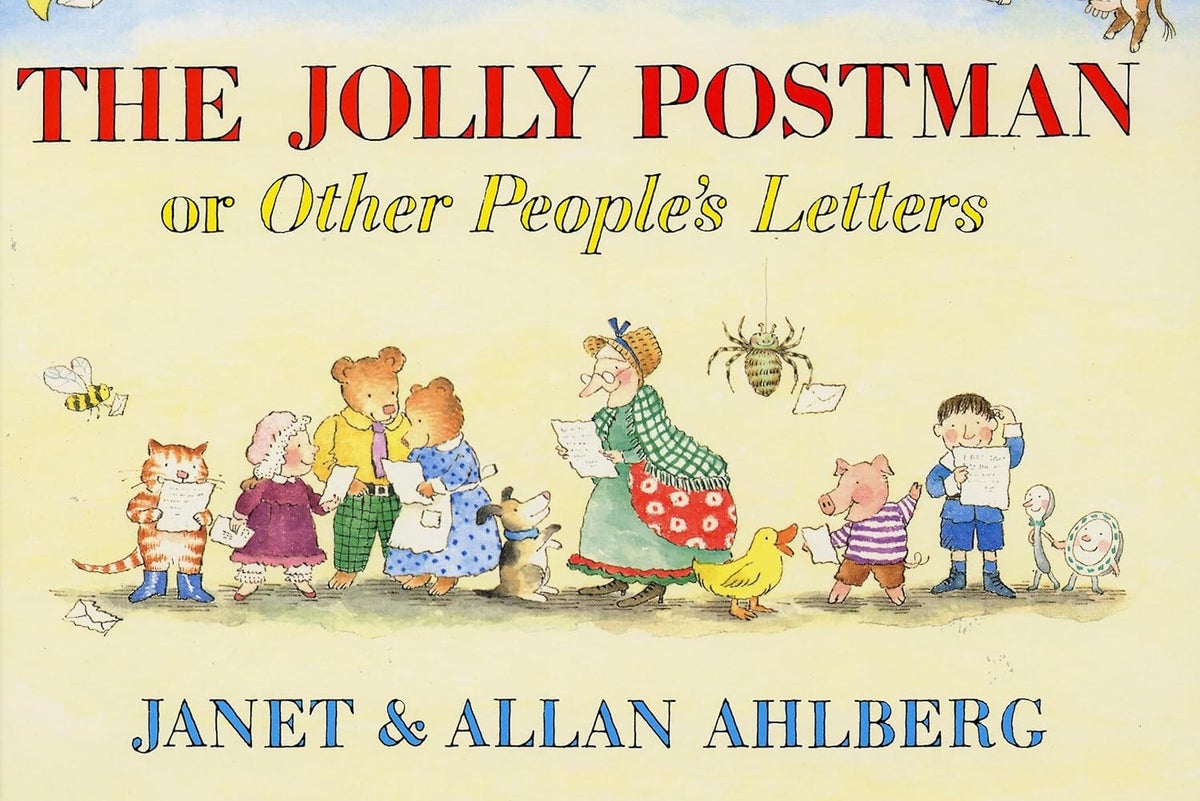
The story behind The Jolly Postman, the best book of your childhood

This year marks 40 years since the publication of ‘The Jolly Postman’ by Janet and Allan Ahlberg - (Puffin)

There are children’s books. And then there’s The Jolly Postman. Janet and Allan Ahlberg’s enchanting Eighties tale of a postman cheerily delivering letters to a village of fairytale characters – tiny letters that you, the reader, can pull from envelopes and actually read – is the Rolls-Royce of children’s books. They don’t make them like that any more. (Postmen don’t tend to pop in for a cuppa any more, either.)

“Once upon a bicycle, so they say, a Jolly Postman came one day.” So begins this children’s classic, and so begins our hero’s morning round, which sees him drinking industrially British quantities of tea, fixing a flat tyre on his bike, and then trying to ride it successfully after drinking champagne with some royals presumably quite early in the morning. And now, a new exhibition at the Postal Museum in London is marking 40 years of the best book of your childhood.

Running until early next year, it offers treats for little visitors and nostalgic adults alike: the Ahlbergs’ illustrations and notebooks are on display, many being shown for the first time, while the postman’s journey is brought to life with interactive exhibits. Everyone’s here: the black cat doing the witch’s washing up while she decides what to order from Hobgoblin Supplies Ltd; a repentant Goldilocks who feels bad about eating all the “porij”; the big bad wolf, grumpily reading a solicitor’s letter telling him to vacate the house of Miss Riding-Hood’s grandma.

The original artwork for the witch’s cottage, where the Jolly Postman avoids drinking a green cup of tea and a cat does the washing up (Janet and Allan Ahlberg)

Published in 1986, The Jolly Postman was the most audacious project yet for the experimental Ahlbergs, who five years earlier had turned a baby’s game of peekaboo into the beloved classic Peepo!, with a circular hole for peeking through cut into each page. Although it would prove to be a highly commercial prospect – it would go on to sell 6 million copies and pay for the Ahlbergs’ house – The Jolly Postman feels driven by a mix of creative ambition and warm personal feeling.

The book was inspired by the couple’s two-year-old daughter Jessica, who loved to play with letters and take them out of envelopes while she was in her highchair. (Their 1982 book The Baby’s Catalogue, which depicted 24 hours in the life of five different babies and unfussily depicted a breastfeeding mother on page one, had been prompted by baby Jessica’s love of the Mothercare catalogue.)

“He put his life into them – they both did. Our real lives,” says the now grown-up Jessica, who has two children of her own. “They really enjoyed the way of working they had at home, of saying things to bounce off each other and make each other laugh, and then one would go away and do a bit of work on the project to show the other, and they’d knock it back and forth.”

Janet Ahlberg’s concept designs for ‘The Jolly Postman’, on display as part of the Postal Museum’s exhibition (Janet and Allan Ahlberg)

But the Ahlbergs had a gift for mixing the mundane – a baby’s private game, a postman’s round – with the majestic. One of the reasons that The Jolly Postman is so enduring is that it builds an entire world in which the reader is an active participant, gripped by the delayed gratification of opening a letter. As a child, I felt let in on an adult world, recognising the different kinds of letter that came through the post: the ones with SHOUTY CAPS on the envelopes (very grown-up), the junk mail, the handwritten cards (hopefully with a £5 note inside if, like Goldilocks, it was your birthday).

Just because a book is tiny and its readers are little doesn’t mean it can’t be perfect. On its own scale, it can be as good as Tolstoy or Jane Austen

Allan Ahlberg

The Ahlbergs inhabited the story, too. They considered having Jessica write Goldilocks’ letter, to capture a real child’s handwriting, but in the end it was Janet who mimicked a childish scrawl. Allan signed off the solicitor’s letter from “H Meeney of Meeny, Miny, Mo & Co”, informing Mr Wolf that “all this huffing and puffing will get you nowhere”. The couple loved the densely packed jokes on the flyer that the witch receives so much that Janet made Allan a papier-mache bowl painted with designs from it, which is on display in the exhibition.

Janet Ahlberg emulated a child’s handwriting for Goldilocks’ letter of apology to the three bears (Janet and Allan Ahlberg)

As a child, I knew on a subliminal level that the authors of my favourite book understood my life. Weren’t we all made to write contrite letters of apology to people we had wronged in the playground, just like Goldilocks, where we’d float an (entirely sincere, of course) invitation to our birthday party as reparation? But decades on, I find even more jokes and references. A newlywed Cinderella is sent a copy of a book about her life for approval, published by The Peter Piper Press. But looking at the illustrations, I think: wait, isn’t that Princess Diana? “‘FAIRY-TALE PRINCESS’ the headlines proclaimed, which – on this occasion, it must be said – was really no exaggeration at all,” reads the mini-book’s final lines. “I’m sure that must have been from papers at the time, around the royal wedding,” Jessica says.

Crafted with the intricacy of a doll’s house, The Jolly Postman is a precious item as well as a book, and the Ahlbergs were exacting about making it perfect from a mechanical point of view as much as a literary one. “We drove our publishers nuts – wanting the right paper, the right print,” Allan once said. “I risk being pretentious, but just because a book is tiny and its readers are little doesn’t mean it can’t be perfect. On its own scale, it can be as good as Tolstoy or Jane Austen.”

The papier mache bowl designed by Janet Ahlberg for Allan using designs from the witch’s flyer (Janet and Allan Ahlberg courtesy of The Postal Museum)

Her father, says Jessica, was “driven by the artistry”, down to the position and size of the book’s barcode and whether it got in the way of the picture. But that counted for the words, too. “He loved to write in a way that didn’t close all the gaps in understanding,” she says. “Some of that understanding came through the illustrations, some was for the reader to put together themselves.”

After the book’s publication, the Ahlbergs would be inundated with letters from eager readers pleading for a sequel (which possibly made their own postman slightly less jolly). One day, an entire postbag arrived from a school in Colombia, lobbying for another book. “My dad said that had set him off,” Jessica says. “And then he found the covering letter from these children’s letters later on, explaining they had been tasked to write a persuasive letter!”

It worked. The Jolly Christmas Postman, which saw the postman delivering cards on Christmas Eve (and a jigsaw for Humpty Dumpty so he could put himself back together) was published in 1991. The subsequent Jolly Pocket Postman would be the most ambitious yet, packed with literary references and including a magnifying glass for every reader as the postman shrank down to Alice in Wonderland proportions. Published in 1995, it would be the final book that Janet worked on before her death from cancer at the age of 50. In total, the Ahlbergs created 37 books together, several of which remain essentials for every nursery, from Each Peach Pear Plum to Funnybones. Jessica would go on to make books with her dad, including intricate pop-up story The Goldilocks Variations.

Scenes from the ‘The Jolly Postman’ are brought to life at the Postal Museum’s exhibition (Louis Porter © The Postal Museum)

Is The Jolly Postman now a period piece? We’re far more likely to upload our smug holiday pictures to Instagram than bother buying a stamp to send a postcard, as Jack does to the giant from his magical carpet tour. We live in an age of instant digital communication, and our streets are full of Evri delivery vans. These days, the witch would probably have ordered her non-stick cauldron set on Amazon, an irony given that Allan, who died last year at the age of 87, once declined a lifetime achievement award in protest at its sponsorship by the online retailer.

“I suppose, in a way, it is a period piece from the heyday of letters in the 20th century,” Jessica says. But for all the innovations in children’s publishing since – books that make noises, books with fluffy patches – none have matched this particular piece of wizardry, the perfect combination of craft and storytelling.

“I’ve always wanted justification for spending my life doing what I’m doing,” Janet once said in an interview. “We know we’re not brain surgeons, or politicians. It is good to know that the struggle is worth it, that all the pestering and nit-picking we do is really for some good purpose.” Creating the best book of our childhood? It was worth it.

‘The Jolly Postman’ is at the Postal Museum until January 2027

Sign up to read this article
Read news from 100’s of titles, curated specifically for you.
Already a member? Sign in here
Related Stories
Top stories on inkl right now
One subscription that gives you access to news from hundreds of sites
Already a member? Sign in here
Our Picks
Fourteen days free
Download the app
One app. One membership.
100+ trusted global sources.