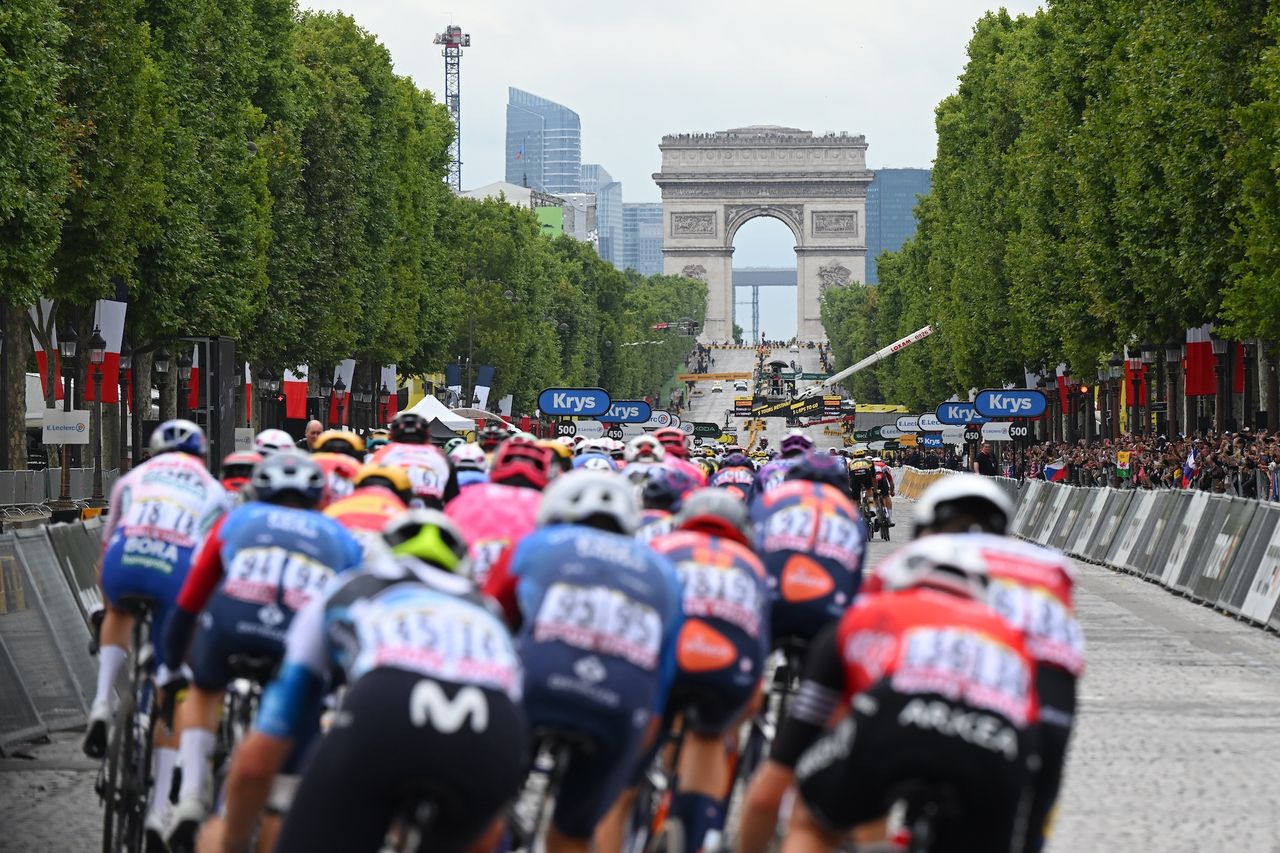
Can a sprinter, a Classics specialist or even a GC rider win the last stage of the Tour de France on Sunday? Last year's inclusion of the Butte Montmartre climb late on stage 21 sparked no end of debate, as the sprinters saw their traditional opportunity to shine on the Champs-Élysées all but evaporate, whilst others praised a radical shakeup to an ultra-predictable final day of racing.
The unprecedented introduction of the Cat.4 ascent – just 1 kilometre long but steep, cobbled and technical – in the flat finale ended with a victory for Wout van Aert (Visma-Lease a Bike). Times were also suspended for the GC riders for the last ascent of the Butte Montmartre, raising the intriguing idea that had Tadej Pogačar (UAE Team Emirates-XRG) been unlucky enough to fall and not complete the stage, he could yet have been considered the overall winner. Depending on the weather, the time suspension remains an option for stage 21.
Even beyond the last minute shortening to 88.7km, due to the demand on security resources amid wildfires in the nation, the route will be modified compared to 2025. An extra 4.2 kilometres has been added between the summit of the Montmartre and the finish for each of the three ascents on the last circuit.
While the total distance for the final circuit of 16 kilometres is just 700 metres shorter than in 2025, the final run-in to the line each time is increased, from 6.1kms to 10.3kms
"I think at least compared to last year, you still have a chance as a sprinter to go for the win if you have the legs," Tom Steels, the 1998 Champs Elysées winner and head sports director at Soudal-QuickStep, tells Cyclingnews.
"It's a technical climb, it's narrow, but if you can always keep position and don't lose too much time, maybe it's possible."
In terms of whom those changes might favour, Steels argues that the sprinters who climb the best will have a good chance, but so, too, could those who also double up as Classics specialists.
"I think guys like [Mads] Pedersen (Lidl-Trek) will survive but it all depends also on the weather. If it's rainy, for sure it will be tricky, but he'll have a bigger chance, that's for sure. Maybe 40 or 50 riders will get to the finish line together."
Mathieu van der Poel (Alpecin-Premier Tech) is also a huge favourite, given his status as a one-day specialist on the cobbles and his innate speed.
"It's a bit like a Flemish Classic where you always have to keep position, because as soon as you're at the top you go fast down. So then you have to be in position, at the back, riders start to get dropped," Steels says
"For guys who do the GC it's a horrible stage if they don't take the times [for the overall] before they go up the Montmartre, you can lose everything."
Alexandr Vinokourov, team manager of XDS-Astana and the stage winner in Paris in 2005 with a late break, also has a clear favourite for Sunday.
"Four kilometres might change things but if it's Mathieu van der Poel who gets away over the climb it doesn't matter if you add four kilometres or not. The sprinters will need a teammate, at least one, to get him back, otherwise nobody's going to work to do that," he tells Cyclingnews.
"We've got our own goals, with [Davide] Ballerini, who did well there last year" – finishing second behind Van Aert, at 19 seconds – "Max Kanter and even [Aaron] Gate, maybe. We'll try to go for the stage, but that'll be hard."
"On top of that, it's not a GC day, but if Pogačar tries for something, that'll become even more difficult to succeed."
There is an argument that without the Butte Montmartre, the sprinters had an extra incentive to go all the way to the finish. Both Steels and Vinokourov think that the change of route has added to the interest, and that with the extra distance at the end, more riders will have their opportunity.
"Of course, it's always a pity for the sprinters, now the other riders have a big chance," Steels adds.
"Perhaps if they alternate the route, it would be nice for the sprinters to have a chance, maybe three or four times in ten years, say."
"But the Butte de Montmartre was spectacular last year, with all the public on each side as they were coming up the climb. I think it's a better look for the race."
"It's still going to be a magic finish, and in my opinion, the riders who are the Classics specialists are still going to be the favourites, and it could be a sprint as well. That all depends on the weather, though, that changes things a lot."
Vinokourov himself remembers what it meant to win on the Champs-Élysées, fending off the sprinters with a gutsy last kilometre attack. Up until Wout van Aert won in 2025, it was the last victory of a non-sprinter on the last stage of the Tour.
"That day, you had to believe. If you don't, it'll never happen. I had tried in previous years, it'd never worked, and that year I was motivated for the bonus to get the top five on GC, too," VInokourov said.
"But it's also true that I got so worked up in the attack I completely forgot about the bonus, and it was only afterwards that somebody told me I'd got the 20 seconds and moved into the top five as well. Winning on the Champs was magnificent, one of my most beautiful victories."
The world’s biggest bike race deserves world-class coverage. Subscribe to Cyclingnews for unlimited access to our unrivalled reporting of the 2026 Tour de France. From Barcelona through to Paris, our experienced team will bring you breaking news, expert insight, and in-depth coverage from every stage as the battle for the yellow jersey plays out. Plus, access the Cyclingnews app to follow the action on the go! Find out more.