Get all your news in one place.
100's of premium titles.
One app.
Start reading
The Independent UK
The Independent UK
Andrew Griffin

The solar system could be destroyed much sooner than we thought, scientists say

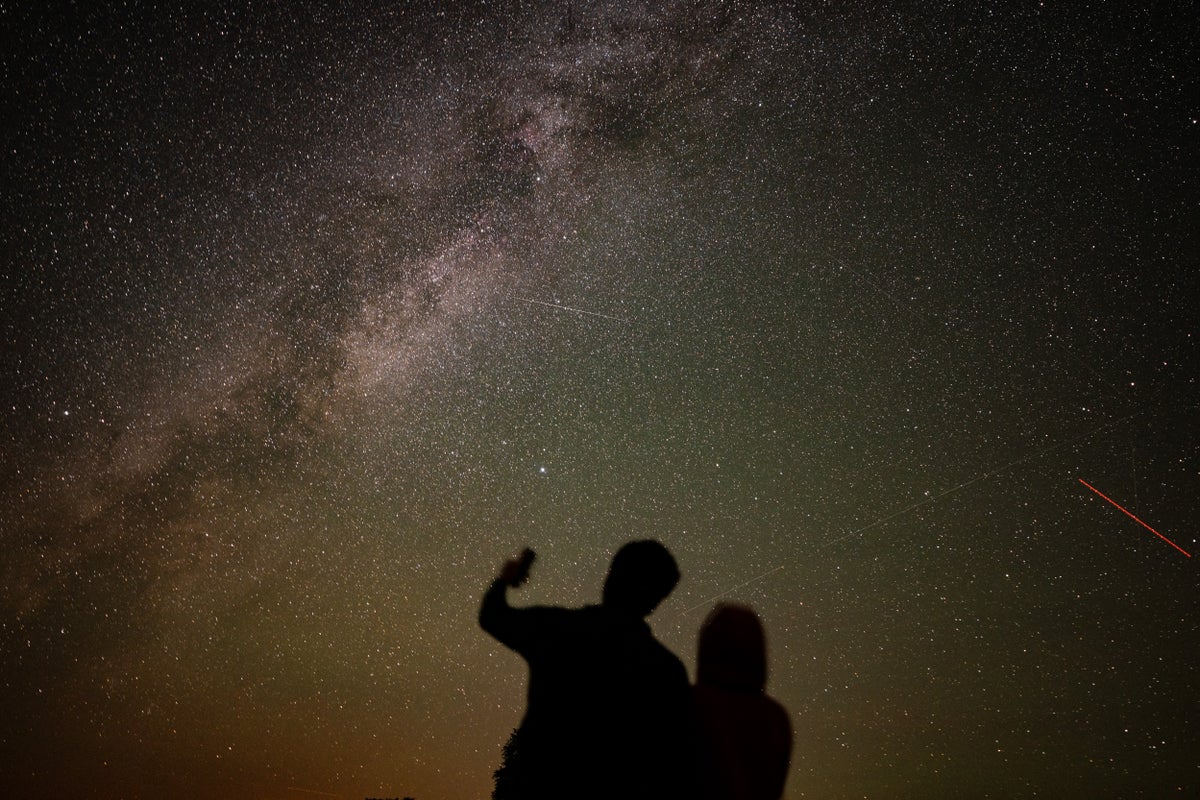
Night view of two human silhouettes beneath the Milky Way during the Perseid meteor shower in Dienne, Cantal, Auvergne-Rhone-Alpes, France on August 12, 2026 - (AFP/Getty)

Our solar system’s life appears to have been dramatically cut short by a major new study.

The outer solar system – which includes planets such as Jupiter and Saturn – could be thrown into disorder relatively quickly after our Sun turns into a white dwarf, the new research suggests.
For centuries, scientists including Isaac Newton thought that the finely balanced gravitational pull between Jupiter and the Sun would eventually unravel the stability of the solar system. Recent research has suggested that could be wrong, however, and that both the inner and outer planets are relatively safe in their position.

That seemed to be a particularly safe bet for those outer planets on the edge of our solar system. Recent research has suggested that the most distant planet, Uranus, would stay stable for a quintillion years – largely theoretical since something else would almost certainly happen to undo the solar system first.

A new study complicates that picture, however, and suggests that the solar system could be destabilised far sooner. The new work suggests that our solar system would last not for a billion billion years after our Sun becomes a white dwarf – but a relatively mere one billion years.

When our Sun becomes a white dwarf, in about eight billion years, it will rapidly cool and shrink down to almost half of its current mass. Researchers had previously thought that it would largely survive that process, with their orbits remaining stable for longer even than the universe is expected to last.

But those estimates were based on the idea that the Sun would lose its mass in a smooth way. The new study suggests that is not the case – and that it could have dramatic consequences for the life of our solar system.

Instead of losing its mass in a consistent way, it will probably throw them out in ejections that are random in both time and direction, the new research suggests. That creates “kicks” that can dramatically change the orbit of the planets.

If that happens, then it would be much more likely to destabilise the orbits of the outer planets, the researchers say. That would lead to the solar system coming apart much earlier than expected.

It might even happen before the Sun actually becomes a white dwarf: in 40 per cent of simulations, the planets were disrupted or scattered while the Sun was still in its earlier, red giant phase. Even if the solar system survives that process, the work reduces the estimated lifespan of the solar system after our Sun becomes a white dwarf by a billion times.

In the paper, researchers note that the discovery actually suggests that centuries-old suggestions such as those from Isaac Newton that the neat order of our solar system would break down are actually more correct than more recent work. “Our results return the solar system’s dissolution to astrophysically familiar territory, and relocate its cause: not the slow seep of chaos, nor the chance encounter with a passing star, but the Sun itself, which in dying does not merely enlarge the planetary system it built – it shakes it, and more often than not, spills it,” the authors write.

The findings are unlikely to make any significant difference to any humans or anything else that is still living on the Earth in the far future. Before the Sun becomes a white dwarf, it will first turn into a red giant, becoming so bright and hot that it would make all life extinct, and it may eventually swallow our planet.

The work is reported in a new study, ‘Terminal Instability of the Solar System Triggered by Stochastic Solar Mass Loss’, published in The Astrophysical Journal Letters.

Sign up to read this article
Read news from 100's of titles, curated specifically for you.
Already a member? Sign in here
Related Stories
Top stories on inkl right now
One subscription that gives you access to news from hundreds of sites
Already a member? Sign in here
Our Picks
Fourteen days free
Download the app
One app. One membership.
100+ trusted global sources.