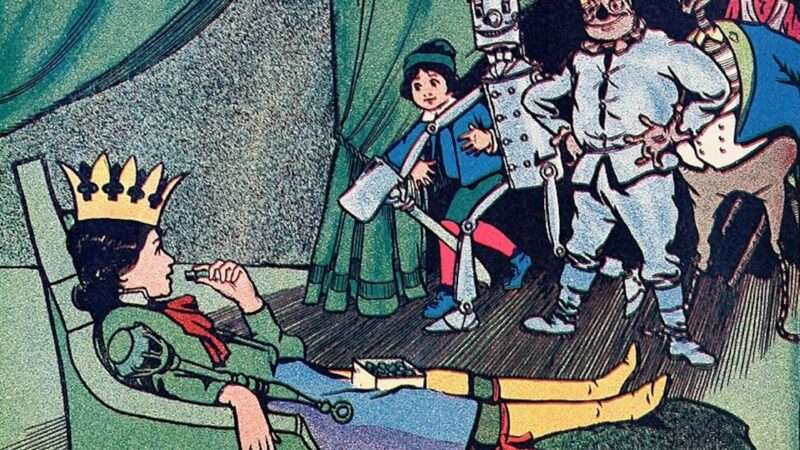
Long before Wicked reimagined the Witch of the West as a dissident resisting fascism, Oz was a hotbed of political commentary. No, I'm not referring to that dubious old tale that L. Frank Baum wrote The Wonderful Wizard of Oz as an allegory about the evils of the gold standard. As Michael Patrick Hearn pointed out long ago, the creator of Oz once published a poem endorsing the gold-backed dollar—"We will gain the world's respect/When it knows our coin's 'correct'/And McKinley's in the chair!"—which makes it unlikely that he'd produce a Populist parable. And while that leaves open the possibility, championed by the historian Quentin P. Taylor, that Baum was approaching the issue from a more gold-friendly angle, I don't want to get lost just yet in the weeds of alleged symbolism. There's plenty of overt commentary in Baum's world to chew on before we start trying to decode things.
For example: In 1902, two years after The Wonderful Wizard of Oz appeared, Baum and some collaborators loosely adapted it into a musical filled with topical jokes. At one point in the play, the Wizard offers the Scarecrow the brain of Republican powerbroker Mark Hanna; at another, the Scarecrow cracks that he might be related to Secretary of State John Hay. One character is an anarchist annoyed that his bargain-sale bombs don't work.