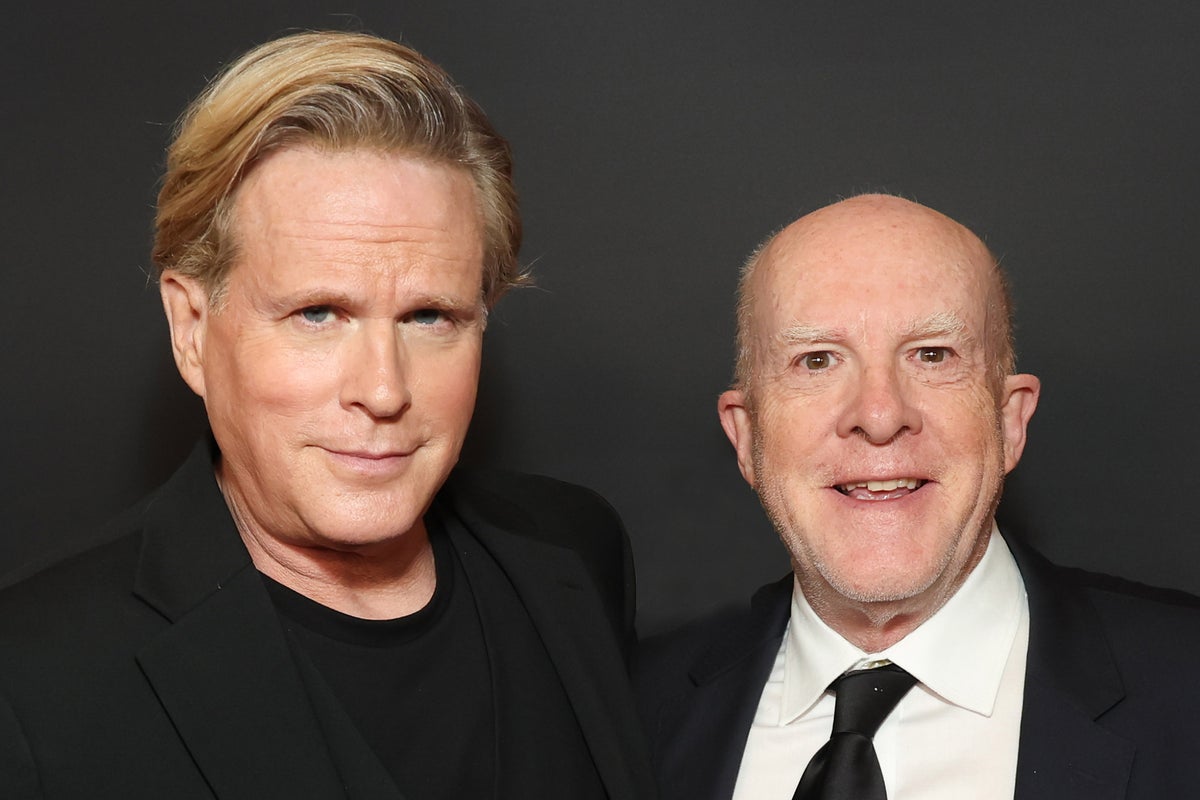
When Cary Elwes arrived on the Louisville, Kentucky set of Dead Man’s Wire last January, he was carrying only a paper bag. It contained, more or less, everything he owned. Days earlier, the wildfires tearing through Los Angeles had destroyed his Malibu home – clothes, furniture, a lifetime of possessions, gone. His brother Cassian, producing the film, had ensured Cary’s hotel room was next door to his own. “I tried to be a support system to him,” says the 66-year-old.
Their costume designer Peggy Schnitzer – the Coen brothers’ trusted collaborator, who had volunteered for the project simply to work with its director, Gus Van Sant – had quietly gone out and bought him jeans, T-shirts, the basics. “She went out and bought a whole wardrobe for me,” Cary, 63, says. “I was very touched by that.” Being on set, he adds, “actually took my mind off of it. I saw that as a blessing.” The brothers, Cassian recalls, would go out for dinner every night. “It was just the most phenomenal bonding experience for the two of us.”
Van Sant’s first feature in seven years, Dead Man’s Wire is a true-crime suspense thriller shot through with vim and the lawless spirit of post-Watergate America in a way that feels uncomfortably of the moment. At its centre is Bill Skarsgård as Tony Kiritsis, the Indianapolis businessman who in 1977 took mortgage broker Richard Hall (Dacre Montgomery) hostage with a sawn-off shotgun wired to his captive’s neck. Van Sant and cinematographer Arnaud Potier shoot the whole thing with considerable chutzpah – on real streets and in real interiors, in clothes that look like they’ve been hanging in closets for years. Every frame throbs with the faded, yellowish grain of the late Seventies.

The performances are uniformly excellent, Skarsgård’s especially. And somewhere beneath a bushy beard, shaggy brown hair and a terracotta rollneck is Cary Elwes, barely recognisable as Detective Mike Grable, the cop who knew Kiritsis from their local bar, and faced with the task of bringing him down. “No one really offers me those kinds of roles,” says Cary, who next stars as a Miami private investigator in the new nine-part thriller MIA, out in May. “I really wanted to stretch myself.”
The film very nearly didn’t exist. Earlier in 2024, Cassian had been deep in pre-production with a director and lead actor who both walked away at the last minute, leaving him with a great deal of money spent, nothing to show for it, and an investor demanding it all back by Christmas. He was, by his own admission, in despair. Then, over coffee at Soho House, he looked up and saw Gus Van Sant walking across the room. “I was like, 'It’s a message from God.’” He ran over. Three days later, Van Sant was on a plane to Kentucky. The whole film was shot in 20 days.
Cary had been pushing his brother to get him a meeting with Van Sant, but Cassian was reluctant – not wanting to put his former client in an awkward spot by asking if his brother could have a role. He eventually relented, and Van Sant’s response surprised him: far from being put out, the director was a fan of Cary’s work but assumed someone of his stature wouldn’t want the part. “Turns out he really liked my work,” Cary says.

The Elwes brothers grew up in London dreaming of films – grabbing an 8mm camera, messing around, imagining a future in the industry. Even by Hollywood standards, the family backstory was extraordinary: their parents had eloped to Havana in 1957, married in a civil ceremony as guests of organised crime boss Meyer Lansky, and fled Cuba on a raft as Castro’s revolution swept in. Their father Dominick was a portrait painter to the Clermont Set – the circle of high-society gamblers that included Lord Lucan, Ian Fleming and the financier James Goldsmith. The Elweses’ stepfather was Elliott Kastner, the Hollywood producer behind Where Eagles Dare (1968) and The Long Goodbye (1973), who kept a base at Pinewood Studios, in Buckinghamshire. It was through Kastner that a 15-year-old Cary found himself spending a week as Marlon Brando’s personal assistant on the set of Superman at Shepperton.
Both brothers moved to Los Angeles in the 1980s – Cassian first, arriving with no money and very little experience, making films for $200,000 or $300,000, learning the craft from the ground up, until the William Morris Agency came calling in 1993 and appointed him head of their new independent film division. From there came Sling Blade (1996), Billy Bob Thornton’s Oscar-winning Southern gothic; Monster’s Ball (2001), which won Halle Berry her Academy Award; Dallas Buyers Club (2013), Matthew McConaughey’s career-defining AIDS drama; and Mudbound (2017), Dee Rees’s acclaimed Mississippi epic. Cary followed his brother west and built a parallel career across four decades. They had worked together before – Cary starred in Cassian’s Leather Jackets (1992) and took a cameo in The Chase (1994), the character’s name from which he still occasionally uses to check into hotels – but nothing of this size.
With its portrait of a man pushed to the edge by a system rigged against him, Dead Man's Wire has real echoes of Dog Day Afternoon (1975). The casting of Al Pacino – that film’s star, here playing the punchably bumptious ML Hall, the hostage’s father – was no coincidence. “Cary and I both saw Dog Day Afternoon when we were kids,” Cassian says, “and it left a lasting impression.” Pacino didn’t need much convincing to work with Van Sant, Cassian adds.
Pacino has a more personal role in Cary’s story too. After Rob Reiner’s 1987 cult fantasy The Princess Bride flopped on release, Cary found himself out of work for a year. Spotting Pacino in a New York restaurant, Cary introduced himself – and Pacino told him to go back to acting school. He auditioned for the Lee Strasberg Institute, got in, and his career took off – Glory (1989), Edward Zwick’s searing Civil War drama; Robin Hood: Men in Tights (1993), Mel Brooks’s gleeful Sherwood Forest spoof; Twister (1996), Jan de Bont’s tornado blockbuster; and eventually Saw (2004), the micro-budget horror that grossed $100m worldwide. “He was very helpful and instrumental early on,” Cary says of Pacino.

Keen though he is not to reflect too much on the past, Cary will speak about Reiner, whose murder in December, and that of his wife Michele, shocked the industry to its core. Cary was among those on the Oscars stage last month paying tribute. “I like to celebrate him rather than focus on the tragedy,” he says. He first met Reiner in Berlin, where he was shooting the film Maschenka, when his London agent called to say Reiner was flying out to meet him. “I knew Rob from All in the Family, obviously. I watched that show (based on the long-running BBC sitcom Till Death Us Do Part), and I’d seen This is Spinal Tap, of course, which I thought was just brilliant. I’d read the book of The Princess Bride when I was 13 and loved it. And Rob was just as warm and lovely and friendly as I’d hoped he would be.” He pauses. “It’s still very hard to reconcile what happened. But I think he was just one of the great filmmakers. We need to celebrate that.” After a tumultuous couple of years, bookended by tragedies, Cary Elwes is looking towards the light.
‘Dead Man’s Wire’ is in cinemas now