
Get all your news in one place.
100's of premium titles.
One app.
Start reading
The Independent UK
The Independent UK
Sport
Jack Rathborn

The rise of heat training for marathons: Can hot baths help you at London?

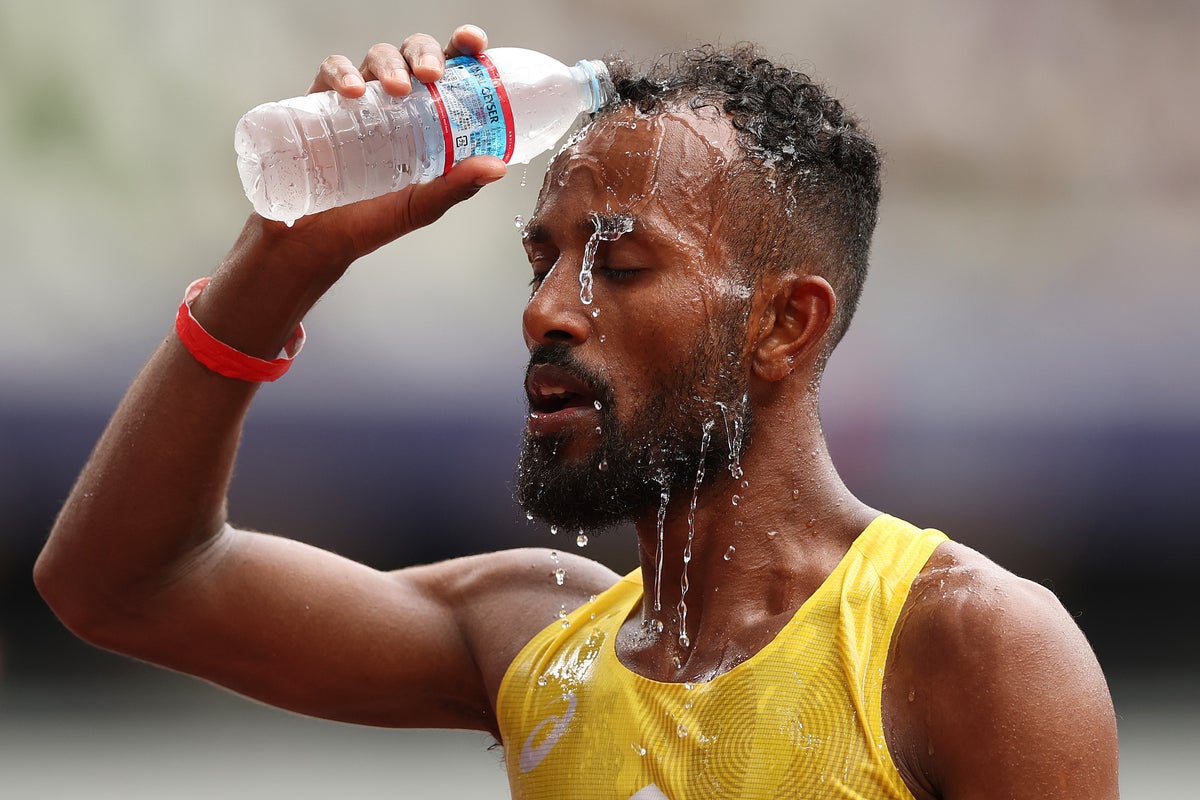
Omar Hassan of Athlete Refugee Team pours water on his head at the World Athletics Championships Tokyo 2025 - (Getty Images)

The marathon can often feel like a never-ending puzzle with amateur runners experimenting throughout their lives in the hope of discovering the perfect formula to combat 26.2 miles.

The shoes matter, of course, but we are deep into the super-shoe era, meaning most runners have adequate technology to combat the gruelling distance. Moreover, fuelling has come a long way, too, with runners able to consume greater quantities of carbohydrates in the form of gels and drinks, while Precision Fuel and Hydration even offer amateurs a chance at a sweat test to further dial in the science to race day performance.

The next trend in recent months has been heat training, and while you can find the elite runners in training camps in Iten, Kenya, or Flagstaff, Arizona, which famously offer the benefits of altitude, too, most runners can’t afford such trips in terms of time or money, leading to a much more convenient method.

Dr. Lindsey Hunt, the Senior Sports Scientist at leading sports nutrition company Precision Fuel & Hydration, advocates the use of heat training, ideally inside a heat chamber, which this runner experienced at its Dorset HQ. But the benefits can be gained without a world-class facility, too, both in the shape of multiple layers during training, or even a hot bath in the comfort of your own home.

“Most people forget, marathons at 20c or 18c, it might not feel that warm, but if you’re racing as hard as you can, your body temperature is getting hot, so if you do some heat training, you’ll feel better at racing at 39.5c, that particular body temperature that you sit at during the race,” explains Dr. Hunt, having spent eight years researching thermal physiology at the University of Sydney, where he completed his MSc and PhD in Environmental Physiologytells.

Duhaeng Lee of Korea pours water over his head the London 2012 Olympic Games (Getty Images)

“Even if the environment isn’t that hot, you, yourself, get hot during the race, that’s where the benefits sit for the general runner.

“If you do two to three weeks of heat training, you can see some benefits, across cool to hot conditions, you can get a four percent improvement in haemoglobin mass from three weeks of training on average, which is the same as altitude. For a lot less cost. This has been seen with heat chamber studies, with passive heat training: hot water immersion baths, sauna usage and clothes while on the bike or outside running, for example. They all have different protocols to get the same job done.”

Runners can add an extra t-shirt and jumper, which will elevate their heart rate up to 75 percent of their maximum heart rate to experience benefits over the course of a comfortable pace for an hour.

“There are a few variables,” Dr Hunt adds. “Once you do it a few times, you practice and understand how it feels. That’s the benefit of coming to a lab, you come to do a session, understand how it feels, what it takes to get hot, do that outside.”

The variety of heat training also comes in the shape of a sauna, which is accessible for many at local gyms.

“You can use a saunas for 40-60 minutes, say, stay in there for at least 10 minutes at a time, pop out for 30 seconds to a minute,” Dr Hunt explains. “Most people can’t tolerate hot water baths for more than 20 minutes at a time, but you need 40 minutes, and it needs to be at 40-42c, so it’s pretty warm.”

Runners can experience the benefits by cycling in versions of heat training three to five times per week over two to three weeks, then you can reduce the frequency to retain the effect.

Richard Ringer of Germany splashes water over himself at the the Olympic Games Paris 2024 (Getty Images)

Then, Dr Hunt advises, a week before the race, runners only require one main session, outside or on a treadmill or bike, alongside one passive session, in a bath or sauna, perhaps earlier in the week on a Tuesday before Sunday’s race.

Heat training can impact your sleep, meaning it is advised to fit this type of training into the morning routine when possible.

Last year London Marathon reached temperatures of 22C (72F), elevating the risks of runners experiencing health problems and wrecking their hopes of a personal best.

“The risk that it might be hotter on race day, there have been many years when races are 10c hotter than expected,” Dr Hunt explains. “If you were doing London Marathon, and you’ve done five heat sessions, your race will be so much better. Leaps and bounds, you’ll feel so much better.

“The first phase is too much heat storage, if you go out at target pace, but it’s too hot, you’ll have a big storage of heat, from 37-39c quickly. If the sweat required to keep you cool is more than you can sweat, your body temperature will keep rising. It’ll either lead to a leaky gut, and you start having gut bacteria, or leaking from the intestines into the bloodstream, high body temperatures, above 40c temperatures, which can be quite dangerous.

“Then there’s dehydration; if you don’t bring up your fluid intake alongside the increased sweat loss in hotter conditions, you’re at high risk of dehydration, which has risks of nausea, high heart rate.”

Runners can benefit from heat training, while also pre-empting the rising body temperatures with the help of dousing through the water provided on the course.

“It’s probably the most effective cooling strategy you can do,” Dr Hunt advises when talking about splashing water on your head and neck.

“Our bodies only sweat as much as we need to keep the same body temperature, if we run at 39c, our bodies are sweating to keep us at that, it’s not trying to get us back down. If you put additional fluid onto you, it’s an additional cooling capacity you wouldn’t have outside of sweating.

“It’s really helpful, it needs to happen when you’re storing body temperature, it’s most effective early on in a race. It can help when you’re in trouble, but the best way, water dousing, is in the first phase of the marathon, when you don’t think you’ll need it.

“The goal is to limit the rise of body temperature, that happens in the first 15-30 minutes of a race.”

Find out more about Precision Fuel & Hydration and a personalised fuel and hydration plan here.

Sign up to read this article
Read news from 100's of titles, curated specifically for you.
Already a member? Sign in here
Related Stories
Top stories on inkl right now
One subscription that gives you access to news from hundreds of sites
Already a member? Sign in here
Our Picks
Fourteen days free
Download the app
One app. One membership.
100+ trusted global sources.







