Get all your news in one place.
100’s of premium titles.
One app.
Start reading
Times Life
Times Life
Nidhi

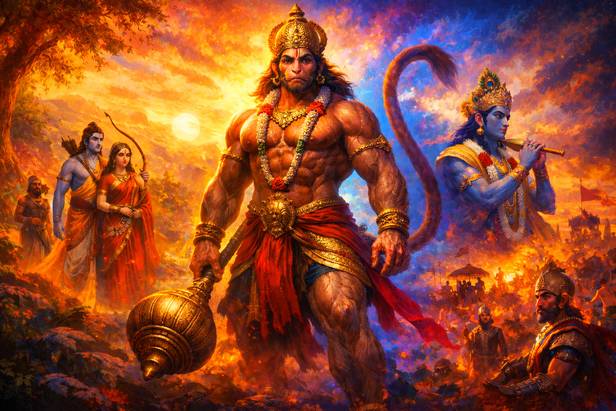
The Real Reason Hanuman Appears in Both the Ramayana and the Mahabharata

“यत्र यत्र रघुनाथकीर्तनं

तत्र तत्र कृतमस्तकाञ्जलिम्।”

Wherever righteousness is remembered, Hanuman is believed to be present.

This verse is not poetic exaggeration. It quietly explains why Hanuman cannot be confined to a single epic, a single war, or a single generation.

Most characters in Indian epics are born, rise, fulfill their purpose, and fade with their story. Hanuman does not. He belongs fully to the Ramayana, and yet appears again in the Mahabharata, an entirely different age with different moral struggles. This is not a storytelling accident. It is a deliberate philosophical choice rooted in how Indian tradition understands dharma, devotion, and continuity.

1. Hanuman Represents Dharma That Does Not Change With Time

Silent Strength of Hanuman
Hanuman could lift mountains,

The Ramayana belongs to Treta Yuga, an age where dharma is relatively straightforward. Right and wrong are clear. Rama is the ideal king, ideal son, ideal human. The conflict is between righteousness and open evil.

The Mahabharata belongs to Dvapara Yuga, where dharma becomes layered and uncomfortable. Everyone believes they are right. Moral decisions depend on context, intent, and consequence. Even Krishna allows morally grey actions to restore balance.

Hanuman’s presence across both epics shows that while methods of dharma change, its foundation does not. Truth, humility, loyalty, restraint, and responsibility remain constant. Hanuman embodies these timeless principles. That is why his relevance survives the shift from idealism to complexity.

2. Hanuman Is the Purest Example of Nishkama Karma

Ancient Indian philosophy repeatedly emphasizes nishkama karma, action without desire for personal reward. Hanuman is its most complete embodiment.

In the Ramayana, he does not act to gain recognition, power, or status. Even after performing feats no one else could, he consistently deflects credit back to Rama. His sense of self is rooted entirely in duty.

By the time of the Mahabharata, ambition dominates human behavior. Kings fight for land. Warriors seek legacy. Even righteous leaders struggle with ego. Hanuman’s reappearance serves as a reminder of what selfless action looks like in a world driven by outcomes.

This is not symbolic nostalgia. It is philosophical intervention.

3. Hanuman’s Immortality Has a Purpose, Not a Reward

What is Hanuman Chalisa

Hanuman is one of the Chiranjeevis, beings granted immortality. In Indian texts, immortality is never portrayed as a blessing for enjoyment. It is a responsibility.

Hanuman’s immortality ensures that someone who has seen pure dharma continues to exist when dharma becomes distorted. He carries memory across ages. Memory of humility. Memory of restraint. Memory of devotion without ego.

In the Mahabharata, where even noble figures struggle to identify the righteous path, the presence of such a witness becomes essential.

4. Hanuman Is Loyal to Dharma, Not Just to Rama

A common misconception is that Hanuman’s identity is limited to his devotion to Rama. In reality, his devotion is to Vishnu’s cosmic purpose, not one incarnation.

Rama and Krishna are different responses to different crises. Rama upholds order through personal conduct. Krishna restores balance through strategy, diplomacy, and sometimes moral compromise.

Hanuman’s allegiance follows the principle, not the personality. That is why his appearance in Krishna’s era feels natural rather than forced.

5. Hanuman Exists Beyond Personal Desire or Narrative Closure

Hanuman Ji Temple Rituals
Devotees perform rituals like reciting the Hanuman Chalisa, lighting mustard oil lamps, offering sindoor and flowers, and fasting on Tuesdays and Saturdays to seek Hanumans blessings for strength, discipline, and protection.

Most epic characters are driven by personal journeys. Arjuna seeks clarity. Karna seeks recognition. Bhima seeks justice. Their stories must end because their desires must resolve.

Hanuman has no unresolved desire. He does not seek liberation, recognition, or dominance. His identity is complete in service itself.

This makes him uniquely transferable across narratives. Characters who want something must finish their story. A character who wants nothing never truly ends.

6. Hanuman Connects Bhakti and Karma Traditions

The Ramayana emphasizes bhakti, devotion as surrender. The Mahabharata emphasizes karma, action within complexity. Indian philosophy never treats these paths as separate, but humans often do.

Hanuman unites them. He is deeply devotional yet relentlessly active. He meditates, but he also fights. He surrenders, but he never withdraws from responsibility.

His presence across both epics reinforces an essential teaching. Devotion without action becomes escapism. Action without devotion becomes arrogance.

7. Hanuman Serves as a Moral Benchmark, Not a Heroic Competitor

In the Mahabharata, Hanuman does not arrive to replace heroes or fight wars. His role is corrective and grounding. He humbles excessive pride, particularly strength without wisdom.

This reflects a deeper idea. As ages progress, humans grow more powerful but less grounded. Hanuman’s role is to remind them of proportion. Strength must kneel before purpose.

He is not there to win battles, but to prevent moral collapse.

8. Hanuman’s Presence Reflects the Continuity of Bhakti in Kali Yuga

Later texts and devotional traditions consistently place Hanuman as an accessible deity in Kali Yuga. This belief grows from his cross-epic presence.

While divine kings and complex avatars may feel distant, Hanuman remains close to human struggles. His devotion is simple. His values are practical. His faith is active.

By carrying him across epics, tradition subtly prepares him for relevance in later ages.


Sign up to read this article
Read news from 100’s of titles, curated specifically for you.
Already a member? Sign in here
Related Stories
Top stories on inkl right now
One subscription that gives you access to news from hundreds of sites
Already a member? Sign in here
Our Picks
Fourteen days free
Download the app
One app. One membership.
100+ trusted global sources.