NEW YORK — Two hours before game time last week, under a fine mist, a dozen Yankees pitchers lined up at the mound and took turns doing groundball drills. The opposing Blue Jays looked on and chuckled: The night before, New York had botched a bunt play, which led to the winning run.
But that wasn’t why the Yankees were taking PFPs, or pitchers fielding practice.

Pitching coach Matt Blake grinned at the watching Blue Jays hitters. “We have the Rays this weekend,” he explained.
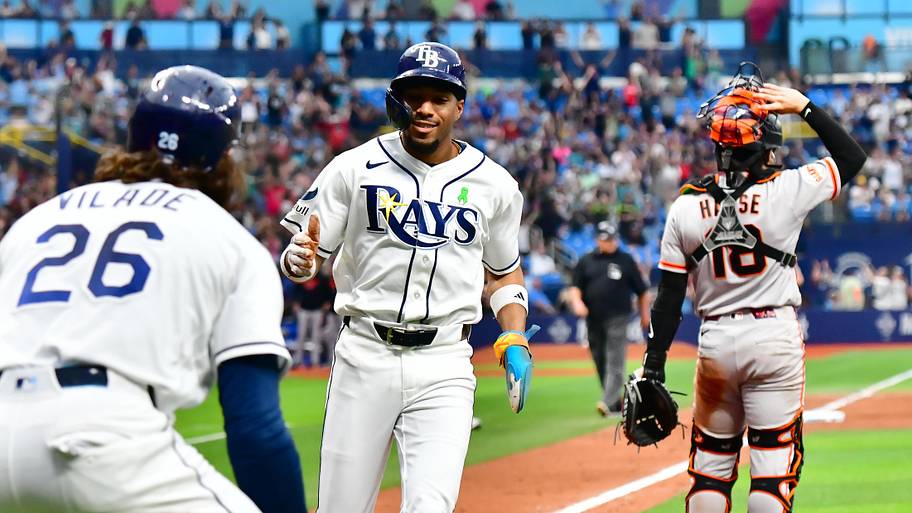
Twenty-eight hours later, Tampa Bay rendered all the preparation worthless. Down 1–0, speedster Chandler Simpson led off the eighth inning with a grounder that Yankees shortstop José Caballero flubbed. Simpson took third on a routine single by Junior Caminero and scored on a double. Pitcher Tim Hill intentionally walked Yandy Díaz to load the bases and set up a double play. Hill got the chopper he wanted—but couldn’t make the play. Neither could second baseman Jazz Chisholm Jr. Caminero scampered home with the go-ahead run. The Rays won 2–1.
The Rays rank No. 28 in home runs. But they lead the majors in the standings in part because they lead the majors in innings like that.
“Hitting a homer or a pitcher striking out a bunch of hitters, it’s cool and it’s very macho and manly and whatever,” says right fielder Jonny DeLuca. “But I think as baseball players we know the chess game behind this game, and that’s the fun part—stealing a run by doing a hit-and-run or a double steal, it’s kind of funny how the other teams react.”
In the other teams’ defense, most of them have never seen anything like this. Even the Rays have never seen anything like this.
“The thing that amazes me the most is our ability to, on the days we don’t hit home runs, still score runs,” says Rays starter Drew Rasmussen, who debuted in 2020. “Shoot, baseball at the major league level my entire time has been striking guys out and watching guys hit homers.
“To see a team that has the ability to score without needing to run the ball out of the yard, it’s really refreshing. But also, I do think it can lead to more sustainability. Teams that are dependent on homers are just that—dependent on homers to put up big innings. Yes, we’ll always take them, and I’m definitely excited to see us hit some more, but it is really cool that our athleticism has the ability to put us in ball games.”
Their 83.1% contact rate is the highest by a team since the 2014 Yankees’ 83.4%. Just 30 active pitchers played that season. You have to go back even farther than that, to 1998, to top their .127 batting average on balls to the infield. (Remarkably, that year 21 teams beat that number.) Just 159 active pitchers were alive that season. And it’s only May. You can expect those figures to improve as the weather warms.
(Meanwhile, the Rays’ pitchers are engaged in their own nostalgiafest, pitching to contact more than any other good team—they rank third in contact rate; the next team with an ERA under 3.75 ranks 12th.)
Hitting coach Chad Mottola laughs at all the commotion surrounding his team. “We’re just playing baseball,” he says. “We’re not doing crazy things. We’re just playing baseball.”
Still, he acknowledges that for so many kids these days, plying their wares on the showcase circuit, trying to compile a highlight reel to show colleges and major league organizations, this is not what baseball looks like.
“Growing up now it’s such an individual [sport],” Mottola says. “Playing with your tournament team—there’s no team anymore. It’s all ‘How hard can I hit the ball?’, which is everything I'm trying to strip away. It doesn’t matter how hard you hit the ball. It’s about moving the baseball forward and making quality contact, and then you will start hitting the ball hard more often, but that’s not the goal. I know that’s what got you here, but now how do we actually teach you how to play baseball?”
It starts with the personnel, everyone agrees. You have to seek out players with good bat-to-ball skills. Then you tell them not to chase launch angle—and you stick with them even if the power numbers are disappointing. And then you ask them to police one another.
Simpson is a good example of their process: He fell to the second round of the 2022 draft despite having led Division I with a .433 batting average the year before because he has less power than your average bat boy; the Rays happily scooped him up. They gave him separate scouting reports on pitchers’ tendencies, knowing he would be able to exploit different tells than his teammates. And they told him this was who they wanted him to be. Simpson has never left the yard as a pro. But 39% of the time he reaches base, he scores—15th best in baseball. And his teammates love what he brings.
“Playing hard is contagious,” says Simpson. “It spreads throughout the clubhouse, spreads throughout the team.”
Says starter Steven Matz, a 12-year veteran on his fifth team (but still not old enough to have faced the 2014 Yankees), “It’s a hustle team. Everyone knows the team’s identity.”
They believe this style of baseball sets them up well for the playoffs, where runs are harder to come by and the opposing defense is under more pressure to make every play. And Matz says he hopes their success “opens a lot of eyes across the league to guys like Chandler getting more opportunities.”
In the meantime, they’re happy to dream smaller. They just want the scouting reports to read, says center fielder Cedric Mullins: “They play hard.”