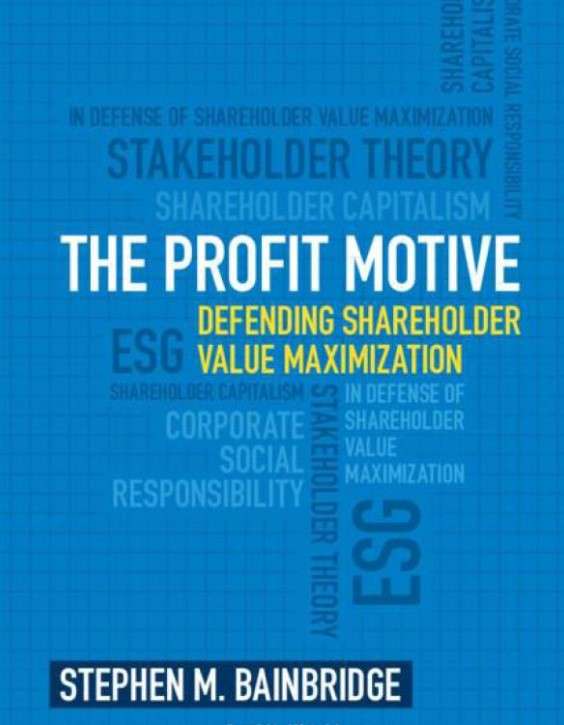
I asked Prof. Bainbridge whether I could cross-post this from Corporate Finance Lab, and he kindly agreed:
What is the purpose of a corporation? Is it, as Nobel Economics laureate Milton Friedman famously claimed, "to increase its profits"?[1] Or is it, as the Business Roundtable—a group of approximately 200 mostly USA corporate CEOs— claimed in 2019, "generating good jobs, a strong and sustainable economy, innovation, a healthy environment and economic opportunity for all."[2]
In the academic sphere, the weight of scholarly opinion has tilted substantially towards stakeholder capitalism in recent years.[3] The late law professor Lynn Stout dismissed shareholder value maximization as a mere myth, albeit a powerful one she claimed "causes companies to indulge in reckless, sociopathic, and socially irresponsible behaviors."[4] Canadian law professor Joel Bakan went even further by condemning the business corporation itself as a "pathological institution" whose relentless pursuit of profit has psychopathic attributes.[5] In making such arguments, they reflect a widely shared narrative that "corporations are powerful, evil, malevolent, bad-actors intent on profit-making at the expense of the health, safety, and well-being of individuals."[6]
In the investing world, there long have been so-called socially responsible investors, who structured their portfolios using various social justice filters that excluded companies believed to have negative social and environmental impacts. Although it was claimed that socially responsible investing was a profitable strategy, it was primarily justified by moral and ethical arguments.
Today, however, as investor interest in ESG metrics has grown, there has been a distinct shift in recent years from moral and ethical justifications to financial justifications. Although many ESG investors likely are still motivated by traditional socially responsible investor concerns, ESG investing is explicitly premised on the belief that ESG oriented portfolios provide superior risk-adjusted returns to traditional portfolios lacking ESG or social responsibility filters. Hence, for example, the three largest institutional investors—asset managers BlackRock, State Street, and Vanguard—all claim to have embraced ESG because they believe that ESG factors are positively correlated with firm performance. They offer investment funds that supposedly invest exclusively in firms that score highly in ESG measures and that exercise their voting rights as shareholders to support ESG policies. ESG-focused investors thus are supposedly pushing both asset managers and portfolio companies to be more ESG friendly.
In light of these developments, what the present moment requires is a defense of shareholder value maximization that takes those developments into account. Or, to paraphrase William F. Buckley, what the moment needs is for someone to stand athwart the tracks of corporate governance and yell "stop" as the stakeholder capitalism train pulls out of the station.
Which is precisely what my new book, The Profit Motive: In Defense of Shareholder Value Maximization, does.