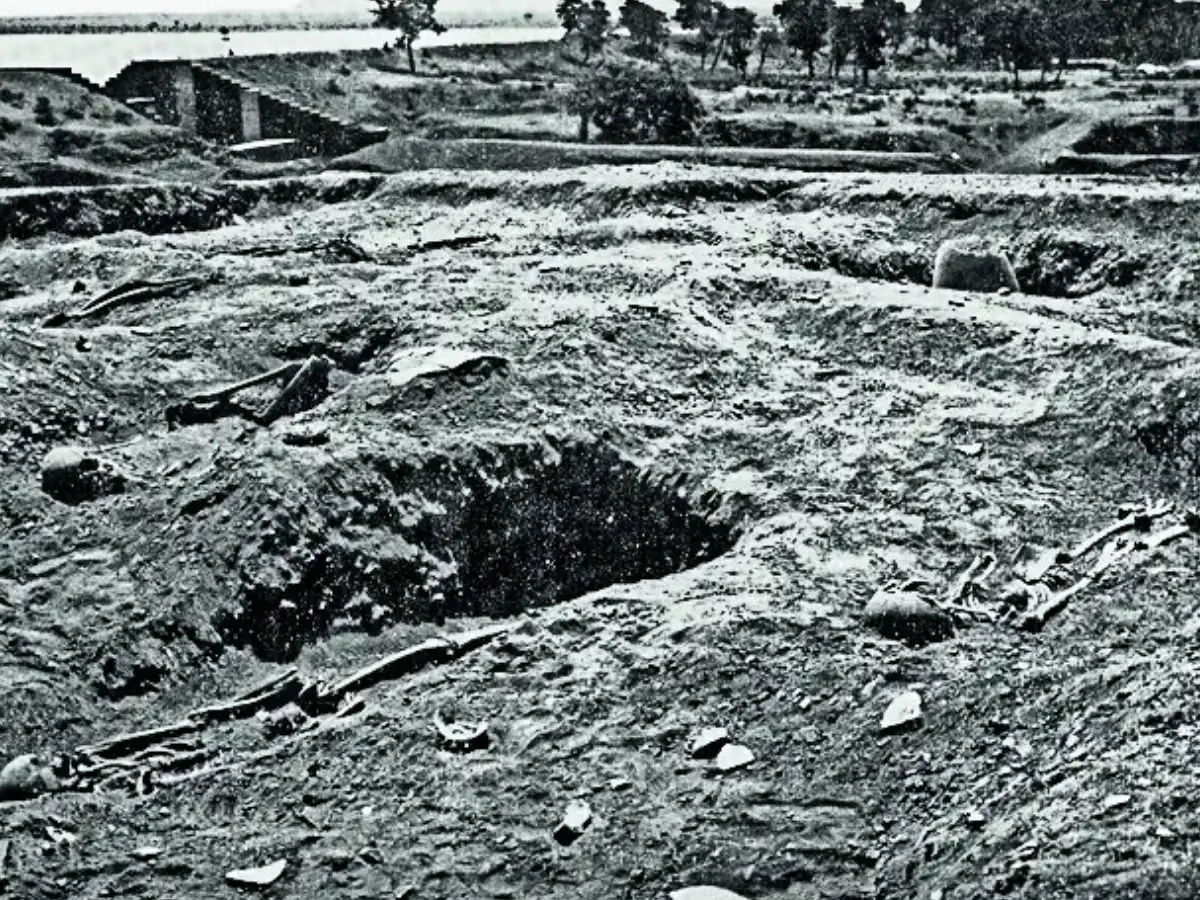
At Kumhar Tekri in Ujjain, a hillock in western Madhya Pradesh, 42 skeletons discovered nearly nine decades ago continue to pose an archaeological mystery. The human remains, comprising adults and children, males and females were found in strikingly diverse positions: face down, on their backs, seated, twisted, and with legs raised and folded. While some individuals were buried, others were cremated.
Unearthed during a 1938–39 trial excavation by the Gwalior State's archaeological department under British rule, the site features shell jewellery, urns filled with ashes and bones, as well as cups and dishes scattered among the remains. The site is estimated to date back to around the 3rd century BC, though an earlier origin remains possible.

The better-preserved skeletons were originally dispatched for anthropological analysis and are currently held by the Archaeological Survey of India (ASI) in Kolkata. To uncover missing historical context, ASI’s regional office has requested permission from its headquarters to excavate the neighboring Vaishya Tekri, situated roughly 2 km from Kumhar Tekri (Potters' Hill). Vaishya Tekri houses a stupa nearly three times the diameter of the Sanchi stupa, which experts believe could yield vital clues about the burials.
Also read: Stones thrown at minor CJP activist's house hours after arrest of Swatantra Bhardwaj
Veena Mushrif-Tripathy, an associate professor of biological anthropology at Deccan College Post-Graduate and Research Institute in Pune who examined the remains in 2007–08, advocates for applying modern scientific methods—including AMS (advanced radiocarbon) dating, DNA testing, and isotope analysis—to determine the individuals' age, sex, ancestry, and dietary habits. Advanced study of their distinct morphological traits and shell ornaments could also evaluate the original researchers' hypothesis that the location belonged to a distinct population group.
“It is difficult to confirm cultural identity just from burial positions, most probably, these were people from different groups or communities,” she noted, pointing out that the simultaneous presence of both burial and cremation practices at a single site reinforces this likelihood.
Dr. Shivakant Bajpai, superintending archaeologist at ASI’s Bhopal circle, emphasized that excavating Vaishya Tekri could frame the Kumhar Tekri skeletons within a broader archaeological setting, ultimately helping researchers ascertain the identity of these ancient people.
(With inputs from TOI)