Get all your news in one place.
100's of premium titles.
One app.
Start reading

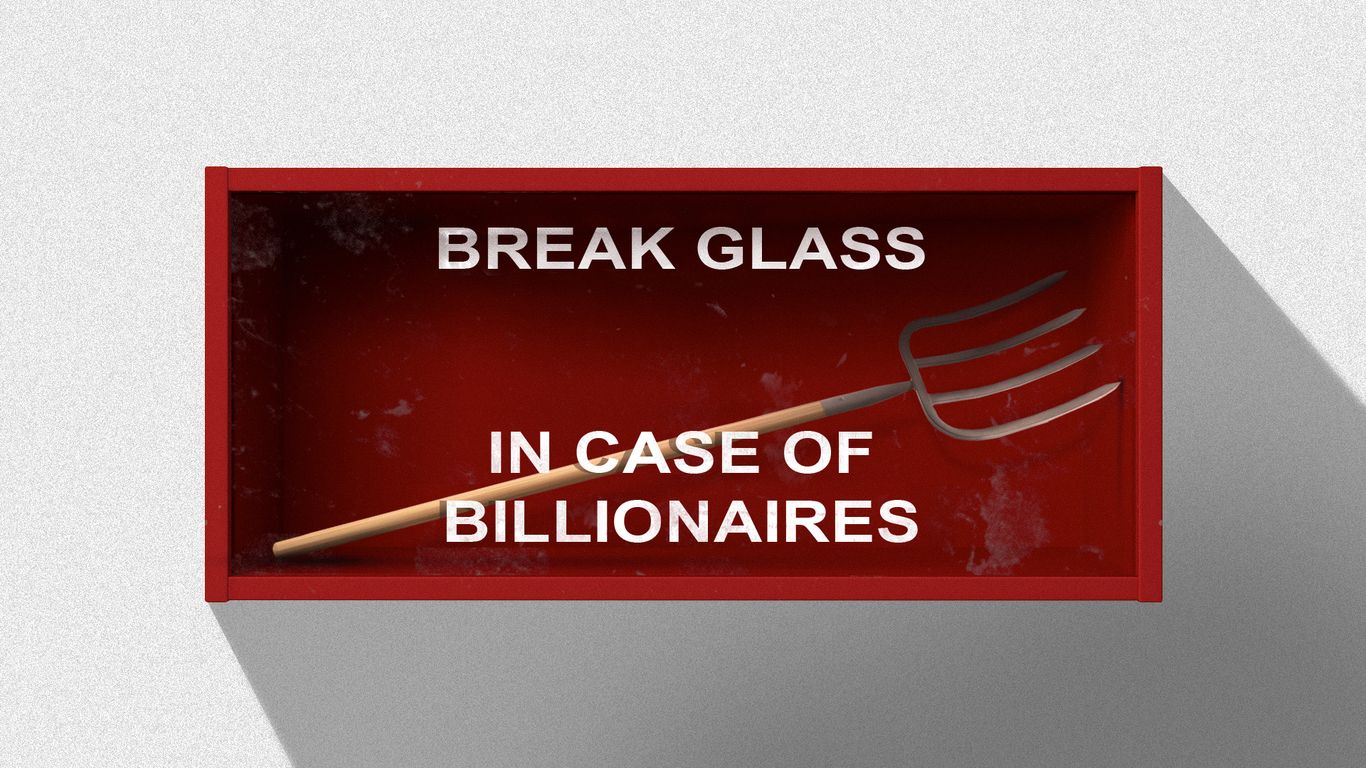
"The pitchforks are here": Billionaires work to contain AI's populist revolt

America's billionaires are developing their own prescriptions for AI-fueled inequality, anxious to defuse a populist revolt aimed at their ballooning fortunes.

Why it matters: The AI boom has dramatically raised the stakes of the wealth-tax debate, unleashing a technology that could wipe out millions of jobs while minting the world's first trillionaires.



  • Populist politicians, particularly on the left, have cast this as capitalism's next great reckoning : an even deeper concentration of wealth and power in an economy already rigged for the elite.

Zoom in: Some of the richest men in tech have warned for years AI could destabilize the economy. Many suggest the answer is not deceleration or wealth taxes, but shared abundance.

  • Jeff Bezos, the world's fourth-richest man, said on CNBC last week that the bottom 50% of earners should pay zero federal income tax. "You could double the taxes I pay and it's not going to help that teacher in Queens," the Amazon founder argued.
  • Sam Altman, the CEO of OpenAI and a longtime proponent of universal basic income , now favors "universal basic compute" — giving people access to AI's productive power instead of a fixed cash payment. OpenAI went further in April with a New Deal-style social contract that proposed a public wealth fund, taxes on AI-driven returns and automated labor, and a four-day workweek.
  • Elon Musk, whose SpaceX IPO could help make him the world's first trillionaire, has called for "universal HIGH INCOME" checks from the federal government — arguing robots will drive so much growth that inflation won't follow.

Between the lines: The billionaires and AI leaders floating these ideas are keenly aware that the politics of extreme wealth could turn dangerous fast.

  • In a January essay , Anthropic CEO Dario Amodei made what he called "a pragmatic argument" for billionaires to support higher taxes on AI wealth. "If they don't support a good version," Amodei wrote, "they'll inevitably get a bad version designed by a mob."
  • OpenAI named the same risk in its April policy blueprint , warning that AI could leave "power and wealth becoming more concentrated instead of more widely shared." Its foundation put money behind that anxiety Wednesday, committing $250 million to help workers and communities weather the disruption — and to test new ways to share AI's gains before the backlash hardens.

The big picture: Anti-billionaire politics has become an organizing principle for the Democratic Party, which remains in search of a durable post-Trump identity.

  • In Congress, Sen. Elizabeth Warren (D-Mass.) called Wednesday for overhauling the tax code , including new taxes on wealth and data centers, to ensure Americans share in the economic gains of AI. Warren — who is being courted by potential 2028 presidential candidates — cited Silicon Valley's own warnings about a "permanent underclass" displaced by AI.
  • In New York City, state lawmakers this week passed Mayor Zohran Mamdani's pied-à-terre tax on luxury second homes above $5 million — a measure he controversially promoted in a video outside hedge-fund billionaire Ken Griffin's $238 million Manhattan penthouse.
  • In Maine, Democratic Senate frontrunner Graham Platner launched his campaign by declaring that "the enemy is the oligarchy." He's backed by Sen. Bernie Sanders (I-Vt.) and Rep. Alexandria Ocasio-Cortez (D-N.Y.), who are more than a year into their nationwide "Fighting Oligarchy" tour.
  • In California, unions say they have gathered more than 1.5 million signatures to put a one-time 5% billionaire wealth tax on the November ballot, aiming to fund health care, education and food assistance programs.

The intrigue: Former hedge fund manager Tom Steyer, who is running for governor as a progressive, has endorsed the measure, casting himself as "the billionaire who wants to tax other billionaires."

  • California Gov. Gavin Newsom, a likely 2028 presidential candidate, opposes the measure — but has urged Democrats not to ignore the populist forces it represents.
  • "The pitchforks [are] here, they're not just coming," Newsom said last week , warning that resentment toward billionaires and AI-driven automation will dominate the 2026 and 2028 elections.

The bottom line: The billionaire tax fight is becoming a test of whether AI creates shared prosperity — or a level of wealth concentration that Amodei warns could "break society."

Sign up to read this article
Read news from 100's of titles, curated specifically for you.
Already a member? Sign in here
Related Stories
Top stories on inkl right now
One subscription that gives you access to news from hundreds of sites
Already a member? Sign in here
Our Picks
Fourteen days free
Download the app
One app. One membership.
100+ trusted global sources.