शिवाय नमस्तुभ्यं शान्ताय करुणात्मने।
नमो देवादिदेवाय त्रैलोक्यनाथाय ते नमः॥
Salutations to Shiva, the embodiment of peace and compassion, the Lord of all worlds.
After the devastating war of the Mahabharata, the victors were not celebrating. The Pandavas, despite reclaiming their kingdom, carried the unbearable weight of killing their own kin. According to traditions preserved in the Skanda Purana, they sought Lord Shiva to absolve them of the sin of fratricide and Brahmahatya.
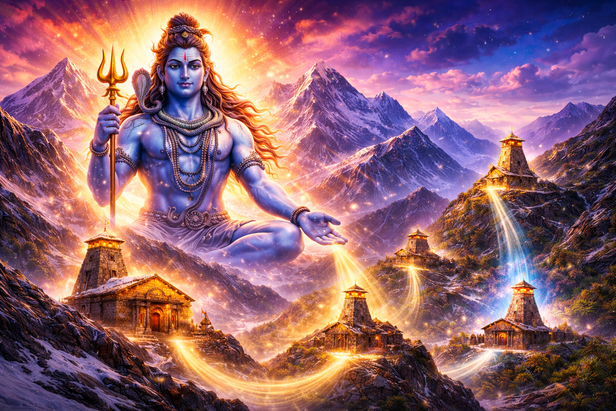
But Shiva did not appear before them easily. Instead, he vanished into the Himalayas. What followed is one of the most mysterious episodes in Hindu tradition. Shiva’s body manifested in five different places in Uttarakhand. These sacred shrines are today known as the Panch Kedar.
Why did Shiva divide himself? Why did his body emerge in fragments? The answers lie deep within theology, symbolism, geography, and spiritual psychology.
1. The Weight of Dharma After Kurukshetra
The Kurukshetra war was fought for righteousness, yet it involved the destruction of entire generations. The Pandavas were bound by dharma, but dharma itself is complex.
Scriptural traditions describe that even a just war carries karmic consequences. Killing relatives, teachers, and elders creates spiritual impurity. The Pandavas realized that victory does not erase moral responsibility. Their pilgrimage to seek Shiva’s forgiveness reflects the ancient understanding that action and consequence are inseparable.
The story emphasizes that righteousness does not exempt anyone from accountability.
2. Why Shiva Avoided the Pandavas
Shiva is known as Ashutosh, the one who fulfills wishes quickly. Yet in this narrative, he withdraws.
Texts and oral traditions state that Shiva was displeased with the scale of destruction. He chose not to grant easy absolution. Instead, he disguised himself as a bull and hid in the Garhwal Himalayas.
The bull form is symbolically significant. It represents Dharma itself. By becoming a bull, Shiva embodies the moral law the Pandavas struggled to uphold. His disappearance signals that forgiveness requires effort and penance, not mere prayer.
3. The Divine Bull and the Fragmented Body
According to legend, Bhima recognized the unusual bull and attempted to seize it. The bull dove into the earth.
At that moment, different parts of Shiva’s body reappeared at five locations:
- The hump emerged at Kedarnath Temple
- The arms appeared at Tungnath Temple
- The face manifested at Rudranath Temple
- The navel and stomach appeared at Madhyamaheshwar Temple
- The hair emerged at Kalpeshwar Temple
These five sites together form the Panch Kedar circuit.
The fragmentation is not accidental mythology. It carries layered meaning. Shiva, as the cosmic consciousness, is indivisible. Yet his appearance in parts suggests that divine grace unfolds gradually and through effort.
4. The Geography of Penance
All five temples are located in the high Himalayas of Uttarakhand. Reaching them requires physical endurance. Historically, pilgrims walked for days through treacherous terrain.
This geographic placement reinforces the spiritual message. Forgiveness is not granted at ground level comfort. It demands ascent, discipline, and surrender.
Kedarnath, situated at over 11,000 feet, is particularly symbolic. The hump of the bull represents stability and endurance. It becomes the focal point of repentance.
The Himalayas in Hindu cosmology are not merely mountains. They represent spiritual elevation and detachment from worldly illusion.
5. Theological Symbolism of the Body Parts
Each body part corresponds to a deeper philosophical idea.
The hump at Kedarnath symbolizes strength and burden bearing. It reflects the weight of karma.
The arms at Tungnath represent action. Human beings act constantly, but those actions shape destiny.
The face at Rudranath signifies identity and truth. One must confront one’s true self to seek redemption.
The navel at Madhyamaheshwar symbolizes life force and balance. It connects creation and sustenance.
The hair at Kalpeshwar reflects asceticism and renunciation.
Together, these manifestations suggest that spiritual cleansing involves the entire being. No single ritual can erase collective consequences. Transformation must be holistic.
6. Scriptural and Historical Anchors
The Panch Kedar narrative is referenced in sections of the Skanda Purana, particularly the Kedarkhand.
Historically, the temples gained prominence during the early medieval period. Adi Shankaracharya is believed to have revived pilgrimage routes in the 8th century, strengthening their theological significance.
Archaeological studies indicate that the present structures date to roughly the first millennium CE, though oral traditions predate these constructions.
Thus, while the mythic origins belong to epic time, the temples stand as enduring historical markers of devotional continuity.
7. Why Shiva Appeared in Pieces
The central mystery remains. Why fragmentation?
In Hindu philosophy, Shiva represents both destruction and renewal. After the Mahabharata war, the world required healing.
The division of Shiva’s form can be interpreted as a mirror of the fractured society after Kurukshetra. Kingdoms were shattered. Families were broken. Dharma was shaken.
By appearing in fragments, Shiva reflects the broken state of humanity. The Pandavas had to journey to each site to experience wholeness again.
Forgiveness was not instantaneous. It required pilgrimage, humility, and recognition of responsibility.
The story conveys a profound spiritual principle. Redemption unfolds step by step.
8. Panch Kedar as a Pilgrimage of Inner Repair
Today, thousands undertake the Panch Kedar yatra. For many, it is not merely tourism. It is symbolic reenactment.
Pilgrims walk through rugged landscapes, just as the Pandavas once did. Each temple visit becomes a meditation on action, guilt, endurance, and renewal.
In this way, the myth lives on as a psychological and ethical journey.