When deciding which game engine to use to make a game, especially one that feels experimental and handmade like Mixtape, there are different factors to weigh up, such as the features available and whether it's compatible with the scope of your project. And then there can also be a financial incentive. Beethoven & Dinosaur's creative director, Johnny Galvatron, tells me he owes a great debt to Unreal Engine for kickstarting his indie game dev career.
The studio's debut game, The Artful Escape, was made with Unreal Engine, but it was initially just an in-engine video that Galvatron sent to the engine's representatives, which was enough for him to receive a cheque for AU$25,000. "I was so poor, and it changed my life," he tells me. "So I've stayed on Unreal because they paid me!"

Not that it's the only reason the studio's upcoming game uses Unreal Engine. After all, while The Artful Escape was a 2D game, Mixtape sees the team move to 3D, and Unreal Engine 5 offers features that can help them tackle the new challenges they encounter. "As a bunch of artists making something in a new medium, we wanted to get better, we wanted to move forward, make bigger games, and so the decision was made pretty early on to go into third person and 3D," he explains.
"Unreal 5 has heaps of amazing tooling," adds technical director Roman Maksymshyn, who cites the engine's tools for filmmaking as being equally beneficial for making games. "We've been able to leverage a lot of that with tools like Sequencer for both cinematics and gameplay. You can make all your internal shots separately, then cut them into an external sequence to reframe it all and time it perfectly, and adjust digital cameras."

Exploring Mixtape's stylisation
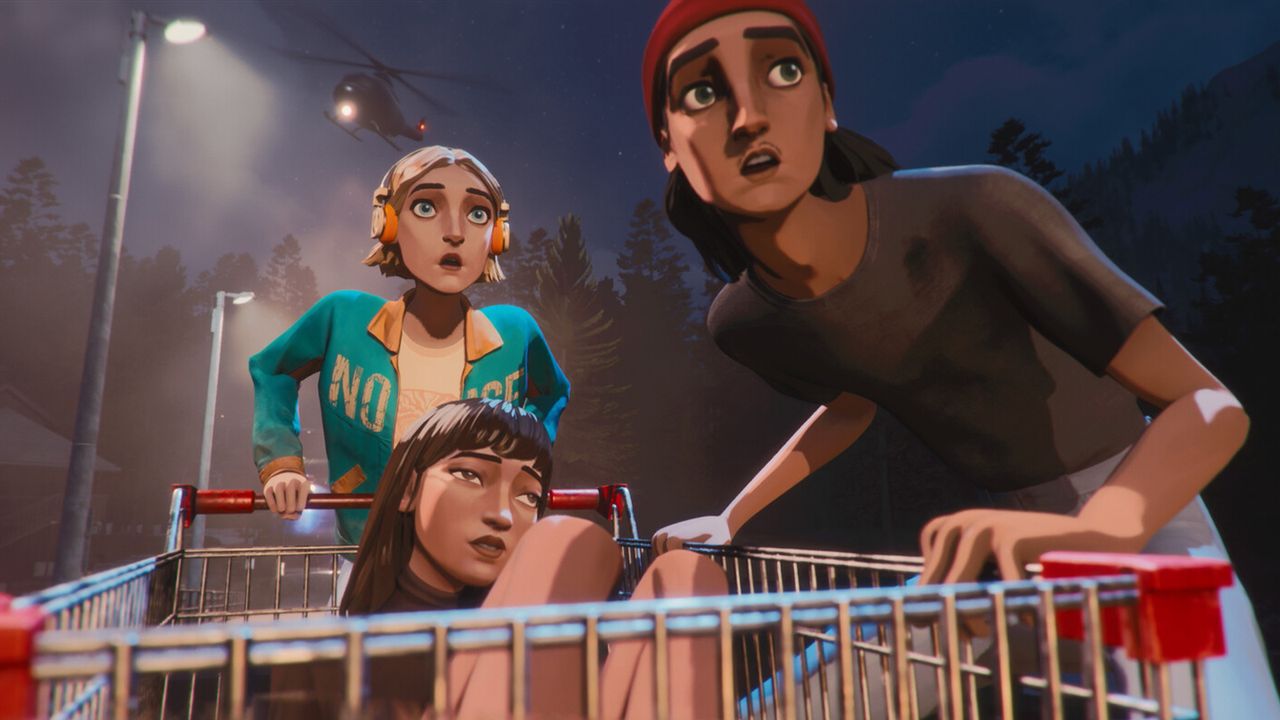
Having a filmic quality is certainly important for Mixtape, with a story centring on three teenagers spending their last night together, reminiscent of the formative coming-of-age movies by John Hughes from the '80s. But while the studio's previous game, The Artful Escape, eschewed folk music traditions for something more colourfully psychedelic, Mixtape also embraces a stylised presentation that fits a structure in which these three friends relive their best teenage years through dreamlike reenactments.
"The step animation done by our incredible hand-animators has that sort of claymation vibe that gives it a nostalgic feeling," Maksymshyn explains. "It was a creative and technical challenge, as we had to build custom rendering systems to stick at the 3D characters as if it was a 2D image. I think that was a good opportunity to bring a visual element that evokes the right feeling while also pushing the boundary of what Unreal can do."

The game feels suitably on-trend with the new-found love of cassette players, and the soundtrack feels as nostalgic as the animation, and includes songs by Joy Division, Smashing Pumpkins, The Cure, Siouxsie and the Banshees, and Iggy Pop, was crucial to informing the game, though the most important is Galvatron's all-time favourite song, DEVO's 'That's Good'.
"We wanted to basically start with, 'How can we make a game around 'That's Good'," he says. "We'd make a playlist, lay it out end-to-end and then try to figure out the cinematic pacing that ran through this playlist, then we'd rearrange it and see how it felt, see where it would get heavy or light, and we moved it around until we got something we liked."

Game design as concept album
Unlike the game dev norm of then building a vertical slice, essentially creating a whole level that demonstrates the core mechanics of a game, the team instead went with making a 'horizontal slice'. "We really wanted to take a holistic approach and sketch out the game in its entirety and treat it more like an album," Maksymshyn explains.
The clue is in the title, as Galvatron describes Mixtape's structure as being "heavily influenced by kind of midnight MTV, which was just a mishmash of different music and aesthetics. Even the characters seem to be from different eras, and they live in this town that's almost like a classic radio station."
I'm conscious I don't actually learn anything specific on just what it is you do in each of Mixtape's vignettes, though I suppose that would perhaps also spoil the surprises, as Galvatron teases that the gameplay is informed by the meaning of a song. ("What should you be doing while you're listening to 'Atmosphere' by Joy Division?")
Even the largely 80s soundtrack doesn't strictly define the exact period the game is set in. "While some of these other [coming-of-age] stories are steeped in nostalgia, we really try hard not to be like, 'Hey, remember this thing?'," Maksymyshyn says. "It's much more about remembering being a teenager, how that felt, and so even if it's not necessarily from your generation, it will be relatable."

The opposite of AI slop
There's perhaps also intent behind the physical act of creating a mixtape (or CD), or in the handmade aesthetics that make this game a deliberate counter to the slick polish of modern assets, which might have us immediately questioning whether any AI was involved.
"I think our game is like the total opposite of AI slop - like every conversation you see is lip-synced by animators by hand," Maksymyshyn concludes. "You'll see when you play just how much love everyone's put into it. So I think that really comes across in the soul of the game."
Mixtape is coming to PC, PS5, Xbox Series X/S (including Xbox Game Pass), and Switch 2 on 7 May.