Get all your news in one place.
100's of premium titles.
One app.
Start reading
The Conversation
The Conversation
Environment
Peter de Menocal, Director, Woods Hole Oceanographic Institution

The ocean twilight zone could store vast amounts of carbon captured from the atmosphere – but first we need to build a 4D system to track what's going on down there

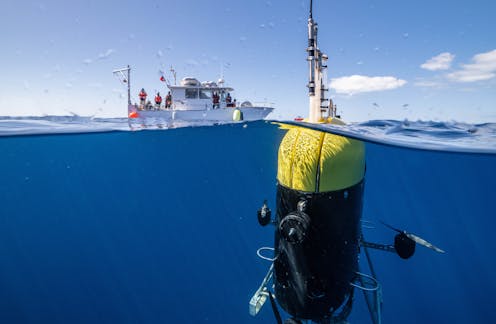
A large robot, loaded with sensors and cameras, designed to explore the ocean twilight zone. Marine Imaging Technologies, LLC © Woods Hole Oceanographic Institution

Deep below the ocean surface, the light fades into a twilight zone where whales and fish migrate and dead algae and zooplankton rain down from above. This is the heart of the ocean’s carbon pump, part of the natural ocean processes that capture about a third of all human-produced carbon dioxide and sink it into the deep sea, where it remains for hundreds of years.

There may be ways to enhance these processes so the ocean pulls more carbon out of the atmosphere to help slow climate change. Yet little is known about the consequences.

Sign up to read this article
Read news from 100's of titles, curated specifically for you.
Already a member? Sign in here
Related Stories
Top stories on inkl right now
One subscription that gives you access to news from hundreds of sites
Already a member? Sign in here
Our Picks
Fourteen days free
Download the app
One app. One membership.
100+ trusted global sources.