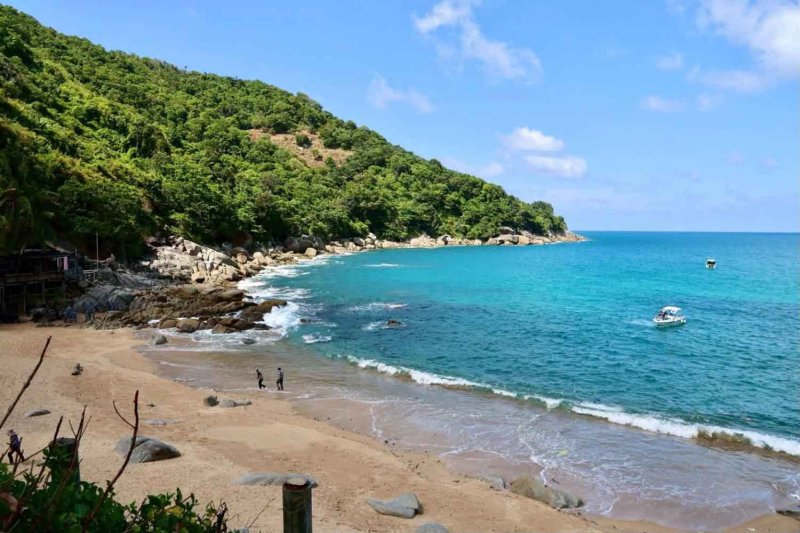
More than a decade after the courts ruled that the land at Nui Beach belonged to the state, authorities on Monday returned to the popular Phuket beach to demolish 50 illegal structures built by encroachers.
About 400 officials from the Royal Forest Department and related agencies took part in the operation, marking the second demolition attempt since the Supreme Court in 2014 ordered the revocation of Nor Sor 3 land documents covering plots within the Khao Nak Kerd National Reserved Forest.

The court ruled that any plots lacking valid title documents would be treated as forest land. Authorities later found the Nor Sor 3 documents had changed hands.
In 2015, authorities found that Phuket Swing Co and Water Beach Phuket Co were operating restaurants at Nui Beach. The companies were later linked to the so-called "zero-dollar" tour business, in which Chinese-owned operators brought Chinese tourists to Chinese-owned businesses, leaving local operators with little share of tourism revenue.
In 2018, authorities launched an operation to seize restaurants and hotels on the site. The landowner, described as an influential figure, was prosecuted and sentenced by the Phuket Provincial Court in 2024 to four years in prison. He appealed the ruling to the Supreme Court.
In a separate case, the landowner was found in 2019 to have committed another act of encroachment. The Phuket Provincial Court ordered him to pay 600,000 baht in compensation to the Royal Forest Department and sentenced him to two years in prison. That ruling was also appealed to the Supreme Court.
Despite the legal disputes, the Royal Forest Department began demolishing 19 structures in 2020 under Section 25 of the National Reserved Forest Act.
A total of 13 buildings were demolished before the operation was halted after the landowner petitioned the Administrative Court to suspend it.
In 2024, forest officials found the encroacher had rebuilt the demolished structures and added new ones, bringing the total number of illegal buildings on the beach to 50.
Natural Resources and Environment Minister Suchart Chomklin, who visited Nui Beach in May, said the landscape had been extensively altered to cater to tourists and pledged to restore the beach as a public area.
Returning to the site on Monday, Mr Suchart urged officials to carry out their duties without fear, saying their actions were fully backed by the law.
He said his ministry would work with the Interior Ministry under the "Phuket Model" to tackle illegal land occupation. The initiative has already led to legal action in about 300 forest encroachment cases.
"We are not sure if our duties can be completed within the government's four-year term," he said. "One bureaucrat may have to spend an entire career fighting encroachers."
Critics say forest officials are often reluctant to act before court proceedings conclude because they risk legal retaliation. As a result, authorities usually wait for final rulings before taking enforcement action, allowing encroachers to continue profiting from illegally occupied land while cases remain pending.
"From now on, we will x-ray the island for forest encroachment," Mr Suchart said. "If any officials are unhappy with this, I can transfer them elsewhere."
He added that the Anti-Money Laundering Office would be asked to investigate possible money laundering linked to the land, which is estimated to be worth nearly 2 billion baht.
For years, the encroacher has also charged tourists a 600-baht entrance fee to access Nui Beach.
Royal Forest Department chief Nikorn Sirarotchananon said the reclaimed area would be converted into a recreational forest, with work expected to be completed next month.
More than 300 rai will be opened to the public free of charge. The department also plans to seek the return of some land from the Agricultural Land Reform Office after finding it had been improperly designated for farming on the mountaintop.
The Khao Nak Kerd National Reserved Forest covers more than 30,000 rai, of which over 10,000 rai have been transferred to the Agricultural Land Reform Office.