
Get all your news in one place.
100's of premium titles.
One app.
Start reading
Space
Space
Science
Anthony Wood

The moon will 'swallow' a star on May 23. But will you be able to see it?

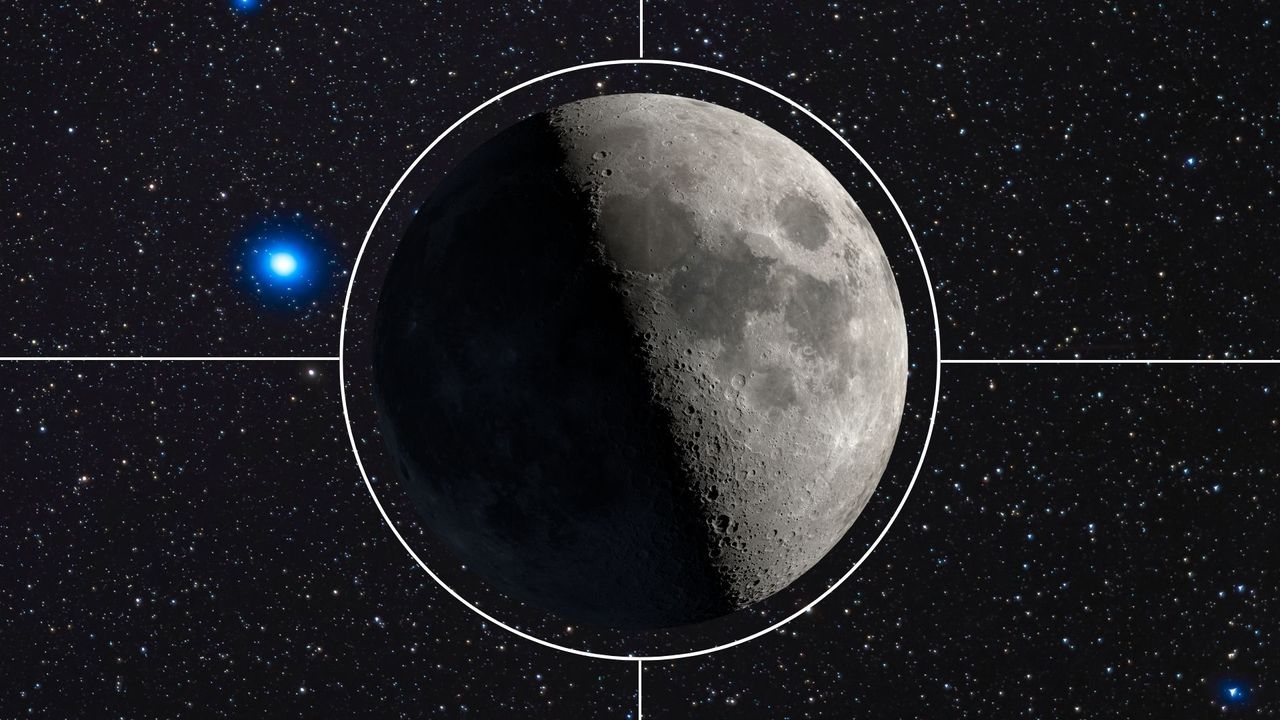
The moon is pictured with its right half lit and its left lost in shadow, surrounded by a white circle with four lines branching outward. A bright blue star is visble to the left of the lunar disk.

Skywatchers across parts of the Pacific will see the moon pass in front of the bright star Regulus on May 23, temporarily blocking its light in a celestial event known as a lunar occultation. Elsewhere, viewers will watch the star pass extremely close to the lunar disk as the pair drift through the constellation Leo.

Why can't everyone see the moon occult Regulus?

The moon orbits Earth at an average distance of just 238,855 miles (384,400 kilometers), close enough for an effect called "parallax viewing" to occur, where an object appears to be in a subtly different position against its backdrop based on where you view it from. The parallax effect can cause the moon's position to vary by as much as 2 degrees depending on where you are on Earth, according to NASA.

Who will see the moon occult Regulus?

Stargazers in Fiji, Samoa, Tonga and a host of other Pacific island nations will see the shadowed side of the half-lit moon pass in front of Regulus during the early hours of May 23, blocking its light entirely, according to the astronomy guide In-The-Sky.

From Sydney, Australia, the blue-white light of Regulus will appear to graze the top of the lunar disk after sunset, before skirting around its sunlit side to set beneath the moon shortly before midnight.

TOP TELESCOPE PICK:

(Image credit: Amazon)

The Celestron NexStar 4SE is ideal for beginners wanting quality, reliable and quick views of the moon and other night sky targets. Read our Celestron NexStar 4SE review for more!

U.S. viewers will get their best view of the cosmic duo overnight on May 22-23, as the moon advances towards Regulus through the late-spring sky. The moon and Regulus will be separated by roughly 1 degree, about the width of your little finger held at arm's length, by the time they set on the western horizon in the early hours of May 23, though the occultation itself won't be visible.

Don't forget, you can simulate exactly what the occultation will look like from your location by using a smartphone astronomy app, such as Stellarium or Sky Safari 7 Pro.

Editor's Note: If you capture an image of the moon with Regulus and want to share it with Space.com's readers, then please send your photo(s), comments, and your name and location to spacephotos@space.com.

Sign up to read this article
Read news from 100's of titles, curated specifically for you.
Already a member? Sign in here
Related Stories
Top stories on inkl right now
One subscription that gives you access to news from hundreds of sites
Already a member? Sign in here
Our Picks
Fourteen days free
Download the app
One app. One membership.
100+ trusted global sources.