
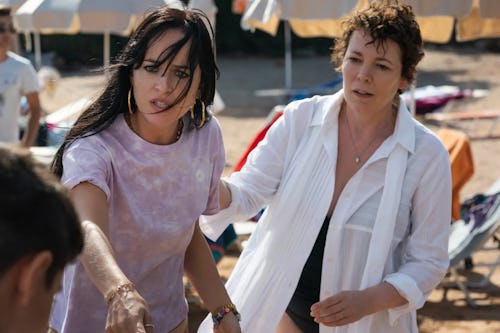
From the moment The Lost Daughter begins, with Leda (Olivia Coleman) arriving to her Grecian holiday bungalow, feelings of both palpable disease and pervasive uneasiness are inescapable. Fog horns blow in the night, the fruit molds, a child gets soap in her eyes, a boat zips in and out too closely to swimmers, a cicada molts atop the bed pillows, and a centipede crawls out of a doll’s mouth. As if the name of the movie wasn’t implication enough, there is an insistence that something bad is going to happen. The film takes its time meandering through uncomfortable interactions, making the wait for Chekov’s metaphorical gun to go off excruciating for the viewer. We follow Leda on her vacation as she obsesses about a young mother, flashes back to her past, and ruffles the feathers of everyone around her; but in terms of the latter, we can’t seem to understand why — nor does she, really. Her dirty jokes never land, and she’s always saying the wrong thing. But Leda’s awkwardness isn’t the only uncomfortable thing about the film. The beach where most of the movie occurs feels like a cesspool of charged situations about to boil over. But they never really do — because The Lost Daughter seems unconcerned with what’s happening in real time. Rather, it feels more like a depiction of what happens to women slowly over time in society.
With her directorial debut, Maggie Gyllenhaal makes it clear that she’s here to tell stories her own way — and The Lost Daughter’s dark, unsettling meditation on the lives of women is undeniably unique. The story is an adaptation of the 2006 novel by Elena Ferrante of the same name. On-screen, though, it’s its own beast, given that it tells a female-centric story in a format that often takes narratives about women less seriously than those about men. The Lost Daughter basically takes the Bechdel Test — a measure of female inclusion in fiction which requires two named women to speak to one another about something other than a man — and flips it on its head. Men in The Lost Daughter are completely secondary — and downright perfunctory — in this world of complicated and anguished women.