Get all your news in one place.
100's of premium titles.
One app.
Start reading
Cycling News
Cycling News
Sport
Zach Nehr

The lost art of time trialing – Is the Tour de France slowly phasing out the race against the clock?

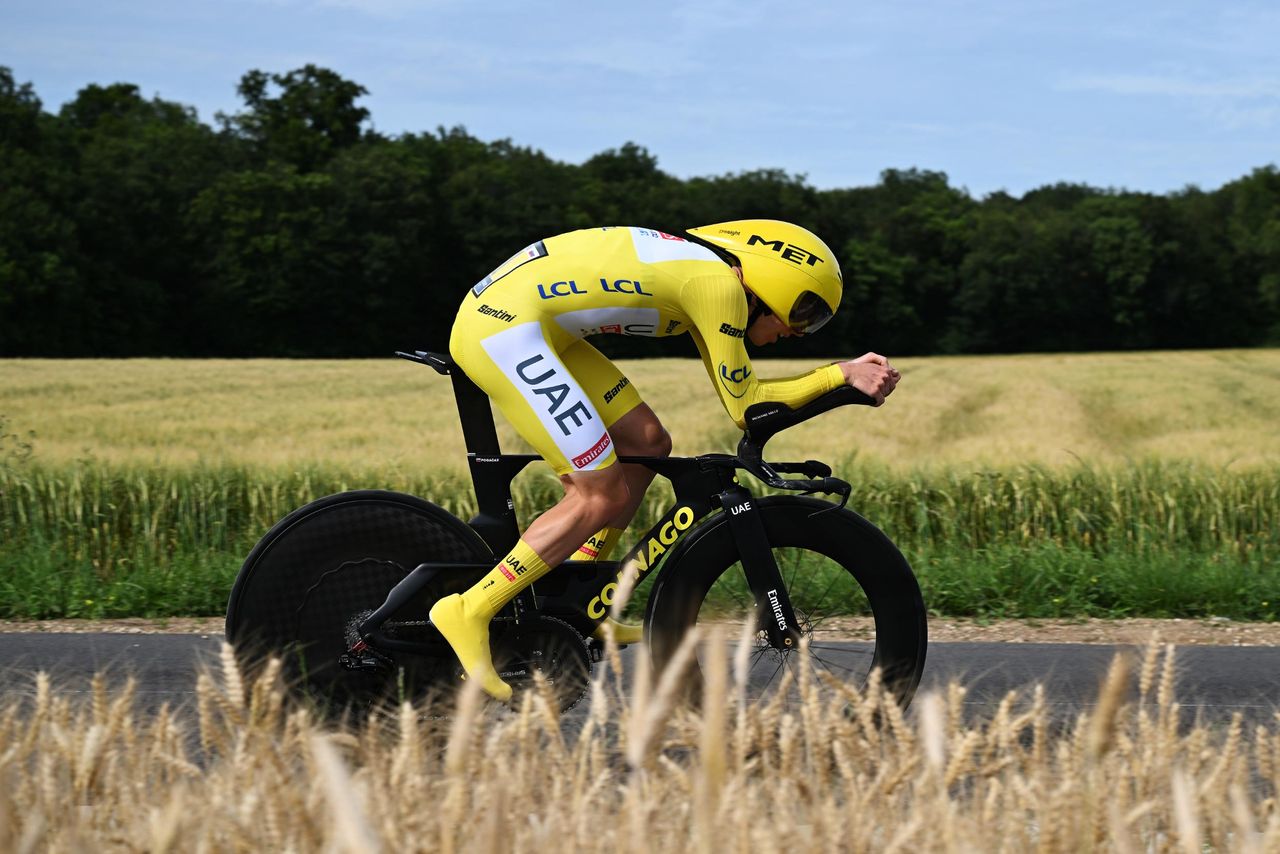
Tadej Pogačar, in the yellow jersey, rides a time trial during the 2024 Tour de France.

The 1984 Tour de France had 191km of time trialling, while the 2026 Tour de France includes just 46km. That is a 76% reduction of time trial distance in just over 40 years. Of course, not all changes are bad – Tour riders used to smoke and race without helmets, for example – but this shift caught my eye.

We've seen a dramatic shift in the focus and importance of time trialling in professional cycling, and in this piece, I set out to explore why. The further back you go, the crazier things get. So let's start as far back as the 1930s when Gino Bartali won his first Tour de France.
How much time trials have changed

In the 1938 Tour de France, there were only 69km of time trialling, not too dissimilar from what we see in modern cycling. But there were also much longer stages throughout the Tour, including a 279km finale on stage 21 which Antonin Magne won in a time of eight hours, 54 minutes and 50 seconds. While the TT kilometres seem sparse, things change when you start to zoom in.

TT in this year's Tour

Stage 20b of the 1938 Tour was a 42km individual time trial. It was the kind of stage that you wouldn't be shocked to see in a Grand Tour once every few years. But take a closer look at the stage name: 20b. This 42km ITT was one of three stages ridden that day. On July 30, 1938, the Tour de France peloton raced 48km on stage 20a, then 42km on stage 20b, and finally 107km on stage 20c. By the way, there wasn't even a rest day between stage 20a, b, and c and the nine-hour finale to Paris for stage 21.

Professional cycling was a different sport back then, that much is clear. But things began to evolve as the sport modernised and became one of the biggest sporting events in the world.

By the 1960s, race organisers began running shorter time trials. Instead of hour-long slogs, time trials became short, explosive efforts. Some were only eight kilometres long, and then came the introduction of the prologue: ultra-short time trials were often given at the beginning of a Grand Tour. But that didn't take away from other time trial stages.

The 1970 Tour de France included not one, not two, but six time trials over the course of three weeks. That is unfathomable in this day and age. Most Grand Tours only include two time trials, with the rare edition including three. Something needed to change... and change they did.

By the 1980s, race organisers had fallen in love with the idea of long time trials. These weren't 20, 30, or even 40-minute efforts. These were 60 to 90-minute individual time trials in the middle of the Tour de France. The 1984 Tour began with a 5km prologue, followed by a 51km team time trial on stage 3, and a 67km individual time trial on stage 7. That is a total of 123km of time trialling in the first week of the Tour.

If that wasn't enough, there was a 22km mountain TT on stage 16, and a 51km TT on the penultimate day of the race. If you were the best time triallist in the race, you could afford to lose a minute on every mountain stage and still win the yellow jersey.

The monster-length TT trend continued into the 2000s, and in the first Tour of the 21st century, there were 145km of time trialling spread across two ITTs and one TTT. While the opening TTT of the 2026 Tour was certainly exciting, it was only 20 kilometres long. Yet, there were still significant time gaps. The TTT in the 2000 Tour de France was 70km in length, which ONCE won in a time of just under one hour and 26 minutes. It's difficult to imagine what this kind of time trial would look like in modern cycling, but as we ponder the question, answers emerge as to why race organisers might be doing this.

Why are race organisers shortening time trials?

The tide began to turn in the early 2000s, and by 2010, time trialling kilometres in Grand Tours had been cut by more than 60%, according to ProCyclingStats.

We've even seen a few Tours de France where the total number of time trial kilometres was less than 1% of the total length of the race: the 2023 Tour included only 22.4km of time trials, which was 0.7% of the overall race length.

Professional cycling has seen a number of positive advancements over the years, including the introduction of a number of safety and rider-tracking measures. But shifting the focus away from time trials is hotly debated.

Time trialling is at the core of the sport: may the fastest rider win. But in 2026, it also rewards the big-budget teams with access to wind tunnel testing, 3D-printed aero bars, and a number of other equipment upgrades. Time trials don't necessarily reward the strongest rider in the race – they reward the fastest rider. And that can be about a lot more than just strength.

In a 40km time trial, you could have one rider holding 350w while another is holding 400w. But if the first rider is significantly more aerodynamic, they could beat the second rider by more than a minute. This seems just if the rider has worked hard to improve their aero position, but what if the differences are entirely mechanical? If one rider's team can afford a faster time trial set-up, is that fair to both riders?

The difference between a rider like TT World Champion Remco Evenepoel and someone on a small ProTeam is vast (Image credit: Getty Images)

This discussion gets even bigger when you talk about measuring up the lower budget teams with the big-budget super teams. Reducing time trial kilometres is one of many ways that race organisers can close the gap, especially by using fewer team time trials. The TTT is becoming a lost art, but it has certainly shortened the GC gaps in Grand Tours.

Reducing TT kilometres also changes the GC picture entirely. Imagine that the 2027 Tour de France included 191 kilometres of time trialling like the 1984 edition. How many minutes could Remco Evenepoel gain on his GC rivals with that much time on the TT rig? We are talking about five to 10-minute gaps, maybe even more depending on the TT profiles. It would change the race, for better or worse, depending on what kind of rider you want to see win the Tour de France.

A final point that race organizers must consider is the viewer experience. It's no secret that time trials can be boring to spectate. Even for the avid cycling viewer, it's hard to sit down and watch an individual time trial for two to three hours. Throw in a few mountains or a breakaway stage at the Tour, and the viewer's experience changes completely. The opening TTT in Barcelona was thrilling, and that could be the blueprint for keeping time trials in Grand Tours.

Where do we go from here?

Love them or hate them, time trials are an integral part of cycling's history. They have changed quite dramatically over the years, but so has the sport as a whole. The future of time trials is uncertain, but it's difficult to imagine them being phased out completely. Many of us have pondered whether we want to see more or less time trialling in Grand Tours.

What it really comes down to is what we want to see as the future of cycling. Do we want to see time trial specialists rewarded with multi-minute advantages in Grand Tours? Or do we want the climbers and best all-rounders to have the best chance at winning the race? I'm not sure there is a correct answer here, but there is one more factor to consider.

Time trialing is still an important part of the sport (Image credit: Getty Images)

Outside of the WorldTour, cycling is a massive sport. In fact, it is not only a sport, but indeed a way of life for millions of people around the world. The Tour de France means more than just the yellow jersey – it inspires the next generation of cyclists to explore this beautiful sport.

The brute fact is that time trial bikes are not accessible for the majority of cyclists around the world. TT bikes and gear are incredibly expensive, even more so at the professional level. We are talking about tens of thousands of Euros being spent on a TT rig that gets used a few times per year. Not only is the gap between the low and high-budget WorldTour teams widening, so is the gap between professional cycling and the rest of the world.

My idea? I will say it straight up: time trials in stage races should be ridden on road bikes. We can save the TT rigs for Worlds and National Championships where the time trial specialists are rewarded for their aero-focused efforts. But in stage races and Grand Tours, we would solve many problems by having TTs done on road bikes.

It makes more sense to the casual viewer, it rewards the fastest rider of the day, and it makes cycling more accessible for millions of people around the world. While I don't think we need to go back to 80km ITTs in the Tour, I do think we need to hold onto bike racing in its purest form: save the time trial.

The world’s biggest bike race deserves world-class coverage. Subscribe to Cyclingnews for unlimited access to our unrivalled reporting of the 2026 Tour de France. From Barcelona through to Paris, our experienced team will bring you breaking news, expert insight, and in-depth coverage from every stage as the battle for the yellow jersey plays out. Plus, access the Cyclingnews app to follow the action on the go! Find out more.

Sign up to read this article
Read news from 100's of titles, curated specifically for you.
Already a member? Sign in here
Related Stories
Top stories on inkl right now
One subscription that gives you access to news from hundreds of sites
Already a member? Sign in here
Our Picks
Fourteen days free
Download the app
One app. One membership.
100+ trusted global sources.