
"I’m not sure it’s clear enough from the photos how important the bath is to the entire flat," says the architect Micah Sarut. "It’s right in the middle of it." This central bathroom has three different windows looking out into the living room, dining area and bedroom. "You can be in the bath having a conversation with somebody sitting on the sofa, for example."
Better still, you can invite everyone to join in. The bath, measuring a meter by almost two meters, was inspired by Japanese communal bathing, and with its efficient water-reheating and -recycling system, always stays the same temperature. "You can keep it going for a couple of days," says Micah.

Indeed, Japanese design principles were the key inspiration for the renovation of this Grade-II listed, fifth-floor apartment siting right on Silicon Roundabout in East London — the client is "very familiar" with its culture, and Micah lived and studied there. But they were keen "not to produce something that was overtly Japanese," he adds. "It’s more, ‘If you know you know’ — though the way everything is put together is really quite Japanese."

For example, the toilet is not in the bathroom but on the other side of the flat, in accordance with Japanese architectural rules. The hallway, meanwhile, is designed for taking shoes off, with a designated shoe cupboard. The circular window into the bedroom is a reference to moongates, the arched passageways found in Chinese and Japanese gardens, while the moss green paint used throughout the flat references Japan's traditional moss gardens.
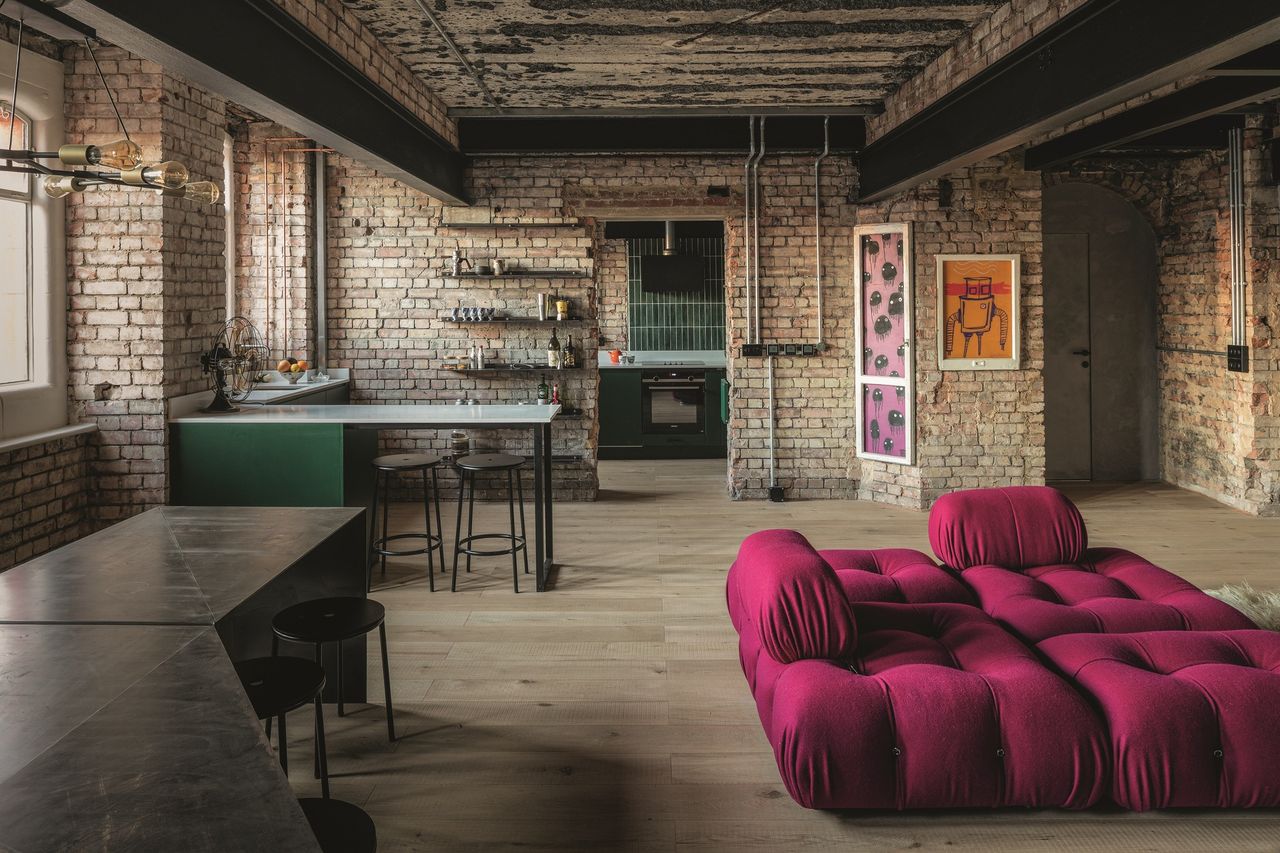
A shock of magenta is the unexpected color combination that makes this scheme feel elevated.

And, Micah adds, "traditional Japanese houses have a flow that’s very fluid." To achieve this in an open-plan space, and avoid it "feeling like an aeroplane hangar", Micah used modular furniture. With the B&B Italia sofa, you can completely change its orientation with "a quick snap of the wrist"; the custom dining table, meanwhile, comprises four separate triangular pieces: "You’re going to finish all the wine before you get through all the possible combinations," says Micah. The effect, he adds, is that in one room, "you've got 17 different experiences happening."

But surely the coolest feature is a pill-shaped internal door that references the vintage anime series Doraemon, where Micah explains, "a big blue cat — a cultural icon in Japan — travels through time to aid a boy. He had something called the "Go anywhere door", a secret door that took him anywhere he wanted; a portal into a very different world.”
Micah’s interpretation of the secret door leads off the living space into a forest-green relaxation room with tatami, with a steaming bath in the room beyond.

In stark contrast to all the mindful Japanese touches is the visible scarring of WW1 and WW2 bomb damage, of which Micah has made a virtue. "We peeled back the plasterboards from a very cheap conversion to expose the true nature of the building, and got very excited by its history and roughness."
Although between the bombings and rebuilds over the years, "there is very little of the original style left,” he notes, “there are lots of really interesting structural features", such as the clinker concrete ceilings and steelwork. "Originally, the interior would have been very utilitarian," he adds, "so it was about bringing that back a bit; this shell is actually the soul of the building."