
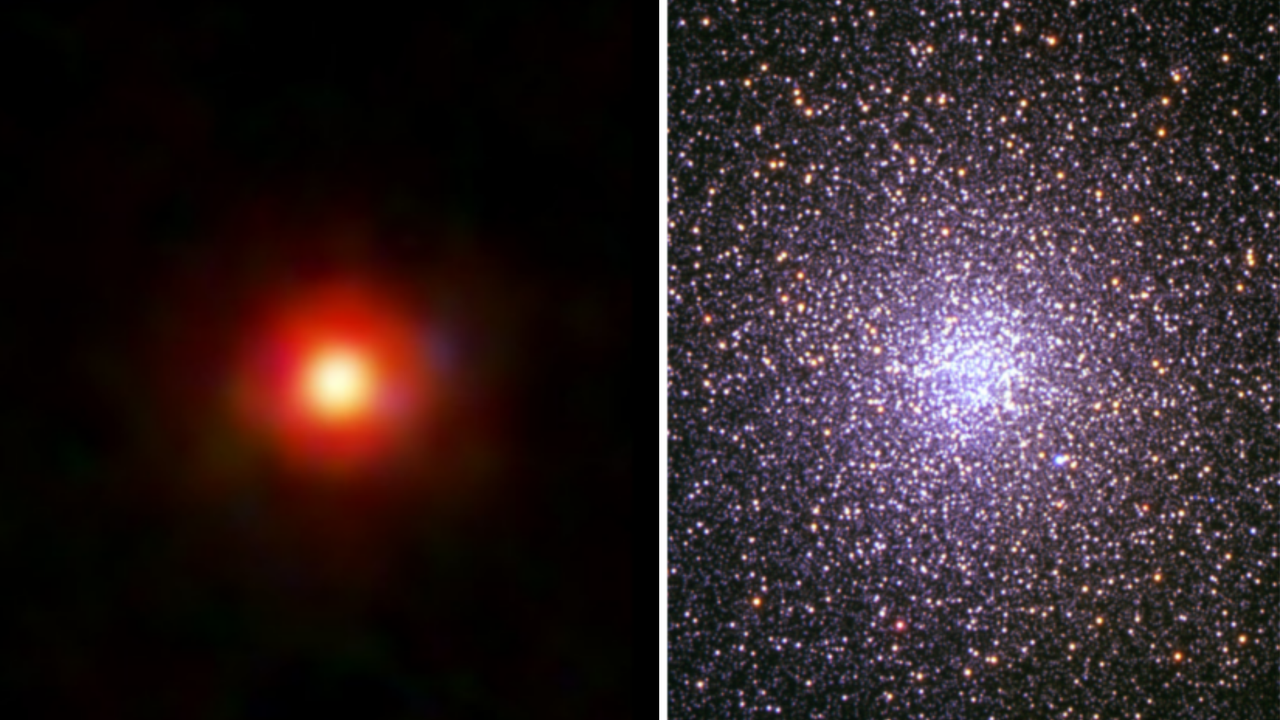
Paleontologists now know that many of the dinosaurs didn't disappear but instead evolved into modern birds, and new research suggests that "cosmic dinosaurs" observed by the James Webb Space Telescope (JWST) didn't go extinct either. Rather, they may have evolved into familiar sights in the modern universe: vast conglomerations of densely packed stars called "globular clusters."
Little Red Dots became quite the puzzle for astronomers in 2022, when the JWST began to routinely spot them in abundance around 600 million years after the Big Bang. That is because these objects seemingly disappear before the cosmos gets to around 2 billion years old.
Astronomers have proposed many different explanations for Little Red Dots, including the suggestion that they could be "black hole stars," or black holes wrapped in vast shrouds of dense gas and dust. This team theorizes that a forming globular cluster with a supermassive star, a hypothetical short-lived stellar body with between 1,000 and 10,000 times the mass of the sun, would also look a lot like a Little Red Dot at its heart.












