
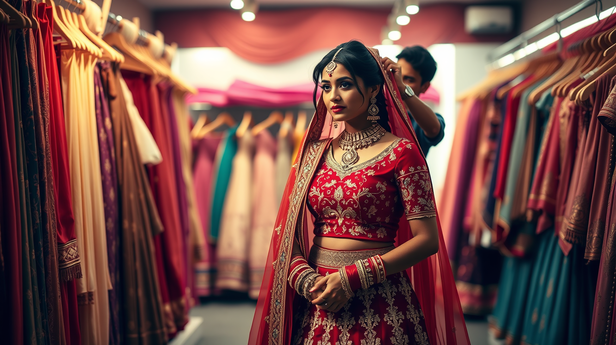
The appointment that doesn't feel like an appointment
You walk into a store in Chandni Chowk or Banjara Hills or a mall in Pune with what feels like a clear idea. A colour. A silhouette. Maybe a reference photo saved on your phone for three months. The salesperson smiles, pulls out a bolt of fabric, and within twenty minutes you are sitting in a cloud of tissue-wrapped lehengas you did not ask for, holding a glass of water you didn't want, while your mother is already on the phone to your maasi about the one in the corner. The appointment was supposed to take two hours. You leave four hours later with nothing decided and a vague sense that your opinion was the least important thing in the room.

This is the beginning. There are at least six more visits to go.
When the opinions arrive before you do
The bridal outfit process in India is never a solo exercise. That is not a complaint, it is a structural fact. Your mother has been thinking about this lehenga since before you were engaged. Your future mother-in-law has a colour preference she will mention once, lightly, and then again at every subsequent fitting. Your best friend has a Pinterest board. Your father has a budget that shifts depending on who is in the room. Every person who loves you arrives with a vision of how you should look, and those visions do not agree with each other, and none of them are exactly yours.
The bride, in the middle of this, is making a decision that will be photographed, framed, and referenced for decades. The pressure is not imagined. The dupatta has to fall at a specific angle. The blouse has to account for the fact that you will be sitting, standing, and bending for fourteen hours. The embroidery has to read well in candlelight and in the harsh flash of a phone camera at noon. These are real constraints. Nobody warned you that managing them would feel like project management.
The fittings that multiply
One fitting is never one fitting. The first is the pinning. The second is the correction. The third reveals that the correction created a new problem at the waist. The fourth is the one where you stand in the shop for forty minutes while the tailor and your mother discuss the fall of the hem in a dialect of Gujarati or Tamil or Punjabi you can follow but not interrupt. By the fifth fitting you have stopped having feelings about the outfit and started having feelings about the process itself.
The trousseau compounds this. The wedding outfit is one garment, or three, if you count the mehendi and the reception separately, which everyone does. Each one has its own timeline, its own tailor, its own set of opinions. The shopping for the trousseau begins months before the wedding and does not end until the week of. You are making aesthetic decisions while simultaneously managing a guest list, a caterer, and a family that has opinions about both.
What it costs that isn't money
The financial cost of bridal shopping is documented and discussed. The other cost is not. Every fitting is time off work or time rearranged. Every shopping trip is a negotiation between what you want and what the room will accept. Every time you say "I love this one" and watch the energy in the room go flat, you make a small internal calculation about whether to hold the line or let it go. Most brides let some things go. The wedding outfit ends up being a compromise, not a bad one, often a beautiful one, but a compromise. The bride who walks down the aisle in her lehenga has already done the hardest work: she has survived the process of getting it on her body.
The wedding itself, by comparison, is the easy part. You show up. People cry. Someone hands you flowers. The decisions are already made.







