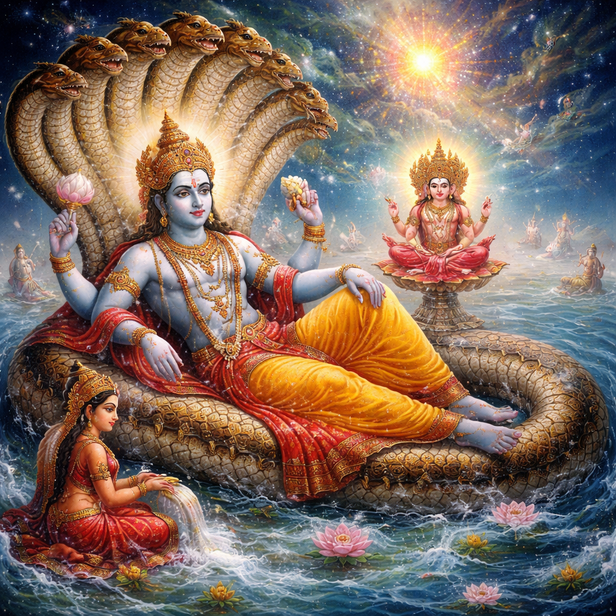
What if the universe we live in is not the only one? What if billions of universes exist, each with its own cosmic order and laws? Surprisingly, this idea is not entirely new. Ancient Hindu texts described something remarkably similar thousands of years ago. According to sacred cosmology, the multiverse emerges from the breath of Mahavishnu. With every breath, countless cosmic bubbles appear, and each bubble becomes a complete universe. Within every universe, Vishnu manifests to maintain balance and sustain life, revealing a fascinating and mysterious vision of cosmic creation.

The Cosmic Ocean of Mahavishnu
According to ancient cosmology, Mahavishnu resides in a vast spiritual ocean beyond time and space. This sacred ocean symbolizes infinite cosmic potential and the beginning of all creation. From Mahavishnu, countless universes are believed to originate and expand. Unlike the idea of a single creation event, Hindu cosmology describes an endless cycle where universes continuously emerge and dissolve. Each cosmic cycle unfolds like a rhythm of existence. This vision presents reality as far greater than human imagination, suggesting that creation is not a one-time occurrence but a timeless process unfolding across infinite universes.
When One Breath Creates Universes
Ancient texts describe a remarkable cosmic vision. When Mahavishnu exhales, countless universes emerge like tiny bubbles from his pores. Each bubble becomes a complete universe with its own galaxies, stars, and cosmic laws. When he inhales again, those universes dissolve back into the divine source. This poetic description presents a cyclical understanding of creation where universes continuously appear and disappear in an endless cosmic rhythm. It suggests that reality is far more vast and mysterious than a single universe, revealing a dynamic cosmos that expands beyond ordinary human imagination.
Vishnu Inside Every Universe
Once a universe forms, another divine presence appears within it. That presence is Vishnu, who maintains cosmic order and balance. From him emerges Brahma, the deity responsible for shaping life, worlds, and creation. This is why Hindu cosmology clearly distinguishes between Mahavishnu and Vishnu. Mahavishnu represents the ultimate source from which countless universes originate, while Vishnu acts as the preserver within each universe. Together, they illustrate different levels of cosmic reality, showing how creation, preservation, and balance operate across the vast and mysterious structure of the multiverse.
Ancient Cosmology and Modern Curiosity
Modern cosmology sometimes explores the idea that our universe may be only one among many. Interestingly, ancient Hindu philosophy described a similar vision long ago through concepts involving Mahavishnu. Renowned astronomer Carl Sagan often appreciated the vast cosmic imagination present in Indian philosophical traditions. While science relies on observation and mathematics, spirituality expresses these ideas through symbolism and mythology. Yet both attempt to answer the same profound question: how vast is reality? This intriguing connection continues to inspire curiosity among those exploring parallels between ancient wisdom and modern theories about the cosmos.
Unlock insightful tips and inspiration on personal growth, productivity, and well-being. Stay motivated and updated with the latest at My Life XP.
Frequently Asked Questions (FAQs)1. Who is Mahavishnu in Hindu cosmology?
Mahavishnu is described as the supreme cosmic source in many Hindu philosophical traditions. According to ancient texts, he exists beyond time and space and is believed to generate countless universes through his divine breath.
2. What is the difference between Vishnu and Mahavishnu?
Mahavishnu is considered the origin of multiple universes. Inside each universe, Vishnu appears to maintain balance and sustain cosmic order.
3. Who creates life inside each universe?
In Hindu cosmology, Brahma is believed to emerge from Vishnu and is responsible for creating life, planets, and different worlds within a universe.
4. Does Hindu philosophy talk about multiple universes?
Yes. Many ancient texts describe the idea of countless universes emerging from Mahavishnu, which resembles the modern concept of a multiverse.
5. Did scientists ever comment on these ideas?
Famous astronomer Carl Sagan often appreciated the vast cosmic imagination found in Indian philosophy, noting how ancient cultures explored ideas about the universe long before modern science.