
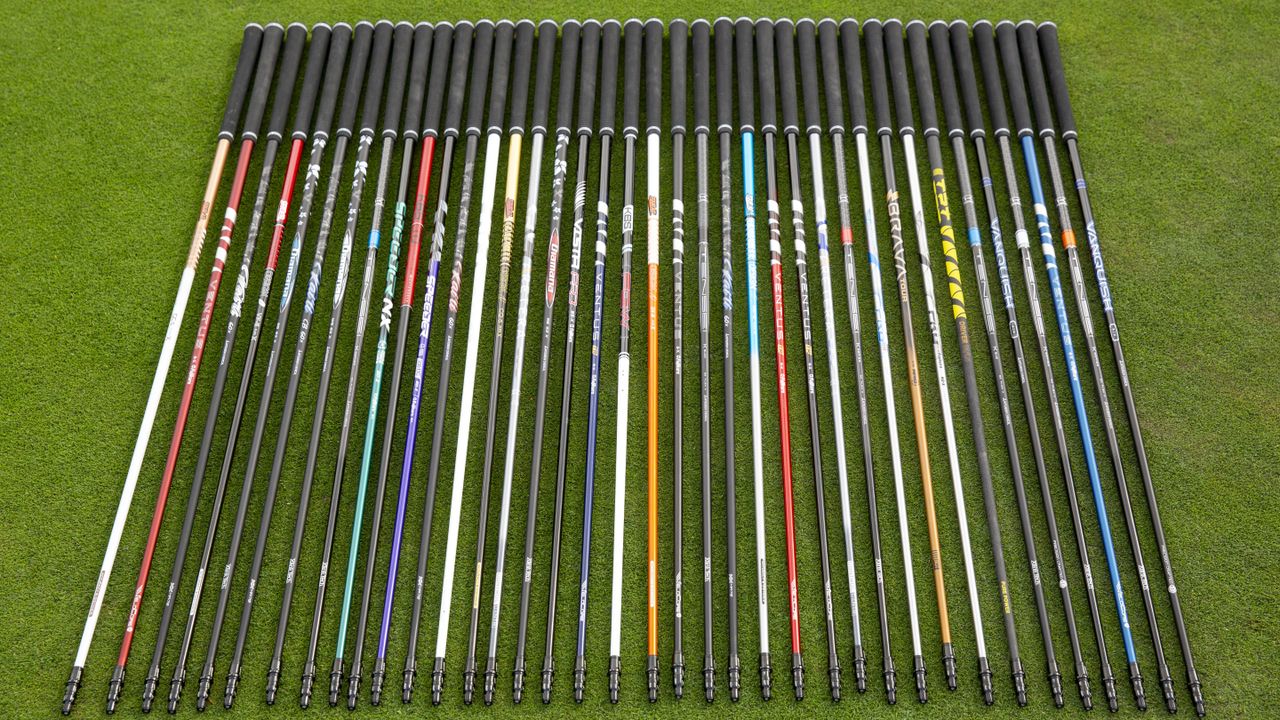
If you have been paying attention to the recent rumblings in the golf equipment space, you might have caught wind of a fascinating shift in how premium shaft manufacturer Mitsubishi is approaching shaft fitting.
As highlighted in a recent MyGolfSpy article, they are boldly telling golfers to forget everything they think they know about shaft fitting, moving away from traditional "launch and spin" labels in favour of a system built around impact location and start lines.

If this sounds familiar, it should. I have been talking about this on the Kick Point podcast for the best part of two years now!
For decades, the golf industry has relied on easily digestible marketing. I understand why; all manufacturers are trying their best to make complex concepts easy to understand for the everyday consumer.
We have all heard the standard rules of thumb: high launch or low launch shafts, toe hang putters for players with more arc in their stroke, or the assumption that lighter shafts will automatically make you swing faster, and so on.
The problem? Frankly, a lot of the time, they simply aren't true.
Yes, these simplified concepts will be accurate for some players, but they can have the exact opposite effect for others. For me, categorising shafts strictly by launch and spin falls right into the middle of this mess. It creates a false expectation that a piece of graphite will magically correct a golfer's launch window, completely independent of their unique swing mechanics.
Instead of treating the shaft as an ‘engine’ that dictates trajectory, I have long advocated players viewing shafts as a pure timing mechanism for finding a centred strike. When you find a profile that matches your tempo and transition, your impact location becomes more consistent. Hitting the center of the face optimises ball speed, launch, and spin far better than any targeted "low-spin" shaft ever could.
Seeing brands like Mitsubishi acknowledge this is very welcome news and makes it feel as though the shaft industry may finally be shifting its narrative.
To understand why the old way is flawed, we have to look at the downswing. The comfortable and accepted theory is, very basically (there are other nuances, of course), that softer tip shafts will 'kick' more through impact, thus adding dynamic loft and increasing launch.
However, in just as many instances in my experience as a fitter, these shafts can have the precise opposite effect depending on how and where a player releases the club in their downswing. For many golfers, a softer tip doesn't kick forward; instead, the player's release pattern leaves the clubhead lagging behind the shaft at impact.
This actually decreases dynamic loft and drives the ball flight lower, often leaving players and fitters scratching their heads as they stare at launch monitor data that directly contradicts the label on the shaft.
This phenomenon isn't exclusive to weekend warriors; it happens at the absolute highest tiers of the sport. I saw the exact same thing at the elite level when watching LIV player Tom McKibbin testing Fujikura shafts. Despite what the colour-coded profiles would suggest, he consistently launched and spun the red (high launch/spin) profile a degree lower and around 100rpm less than the black profile (low launch/spin) of the Ventus range.
When delivery dynamics meet shaft deflection, the conventional "rules" go out the window. So, if the old rulebook is out the window, where should you actually start when searching for the right shaft?
Every fitter has their own take on shaft fitting, but my core philosophy is dead simple: find a shaft that feels good and comfortable to swing, and pick the profile that delivers the center of the face most consistently to the ball. That’s it.
Once you're reliably finding the sweet spot, leave the trajectory tweaks to the clubhead itself - grabbing an adjustment wrench to tune loft and CG will make a far more predictable and significant impact on ball flight than chasing a shaft label ever will.
If you want a practical tip to take into your next fitting, my advice would be to pay close attention to your strike pattern:
Low or Heel Strikes: If your miss is consistently low or heel-side (a club I belong to myself!), try experimenting with a softer tip section. The slight increase in shaft droop through impact can help align the center of the face with the ball.
High or Toe Strikes: If you tend to catch it high on the toe, look toward a stiffer tip section to reduce droop and pull that impact point back into the middle.
To be clear, none of this is a knock on the incredible work of the shaft manufacturers themselves.
I am a huge champion of how critical the correct shaft is for every player, and having seen it firsthand, I have immense respect for the mind-blowing research, design, and manufacturing coming out of elite brands like Fujikura, Mitsubishi, KBS, and Graphite Design. The engineering is world-class.
My critique isn’t about the quality of these phenomenal products - it is merely a commentary that the messaging is wrong. The traditional industry narrative has outgrown its current labels, and it is time for a wholesale change in how shaft performance is communicated to golfers.
As I said, this is indicative of a lot of the narrative in the golf equipment space. I don't envy manufacturers in terms of the need to educate customers on the very nuanced world of shaft performance, putter torque profiles, and all the rest of it. It is an incredibly difficult task to simplify physics for a mass audience without losing the truth in the process.
But with the money this stuff costs today, I think it is time we all demanded better. It is time to move past the marketing myths and focus on what actually helps us find the centre of the clubface.