Get all your news in one place.
100's of premium titles.
One app.
Start reading
The Times of India
The Times of India
World
TOI World Desk

The ‘Gate to Hell’: Why this burning crater in Turkmenistan still possesses a hidden threat

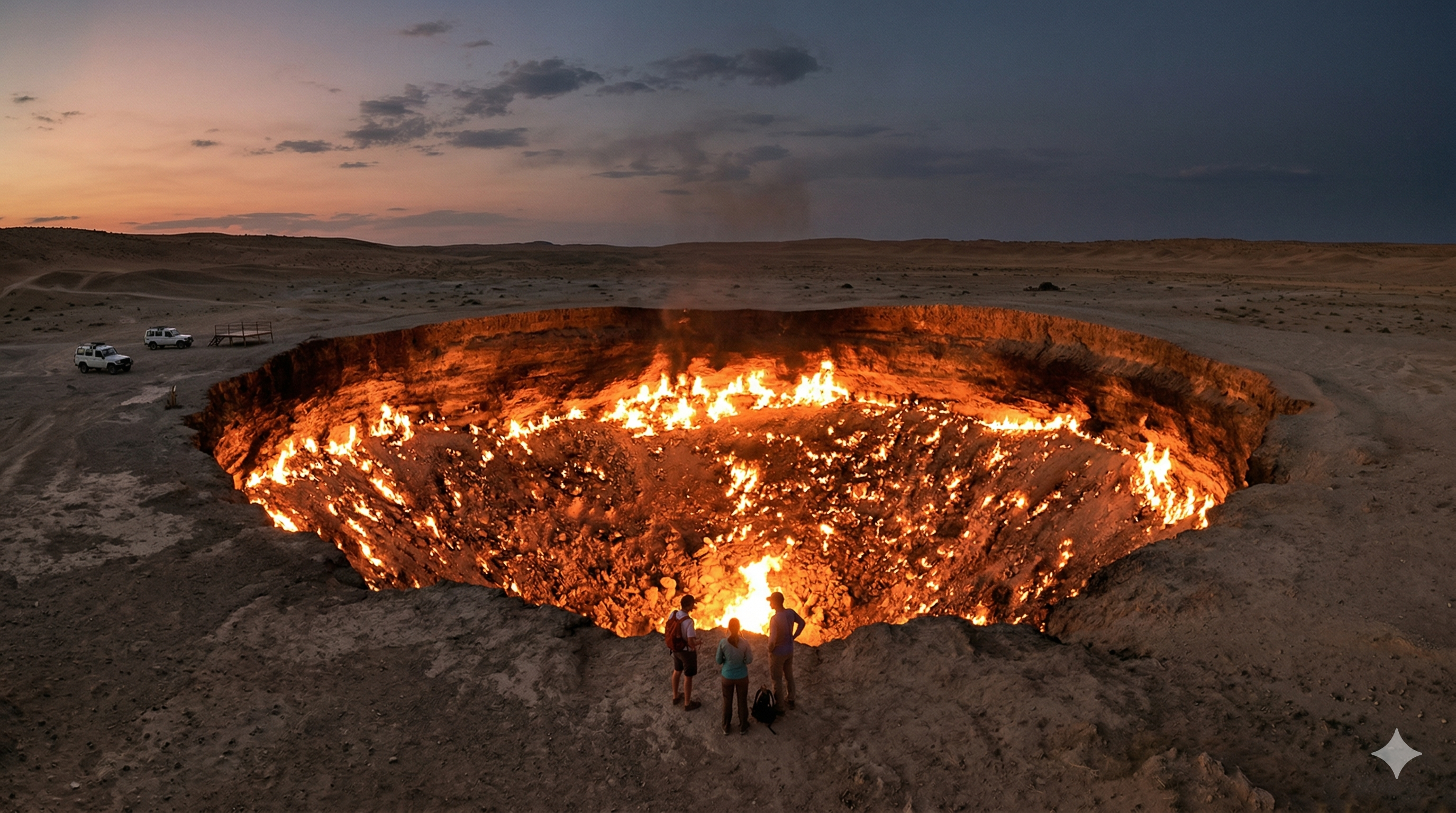
In the middle of the Karakum Desert in Turkmenistan, there is one of the most surreal sights on our planet, a giant crater that has been burning for decades. Dubbed the ‘Gate to Hell,’ this burning crater was never meant to be in this state. What started as a scientific blunder in the 1970s has turned into a long-standing environmental issue. While the burning is quite intriguing, scientists say that the actual problem lies beneath the burning crater. The burning crater in the Karakum Desert of north-central Turkmenistan, where thousands of flames fueled by seeping natural gas have been burning for decades, is a manifestation of a much larger problem related to natural gas reserves.

What is the ‘Gate to Hell’ crater

The Darvaza gas crater, which is commonly known as the "Gate to Hell," was likely formed in the 1970s when Soviet geologists accidentally drilled into a cavern filled with natural gas. The ground gave way, and a huge crater was created.

To prevent the emission of toxic methane gas, scientists reportedly decided to set the crater on fire, thinking it would be extinguished in a matter of days. But over 50 years later, the fire is still burning.

According to the United States Geological Survey, methane is a highly flammable gas and a key component of natural gas.

Why has the crater been burning for so long

This continuous fire is fueled by the constant supply of methane gas being released from the underground reservoirs. The Karakum Desert is situated over large deposits of natural gas, thus ensuring a constant supply of fuel.

Studies by the Research Institute of Water and Environmental Engineering (IIAMA), amongst others, have shown that methane gas released from underground gas deposits has the potential to burn for long periods, depending on how effectively it is contained.

Simply put, this crater is not just a fire; it is actually a release valve for a much larger gas supply. As long as the methane is being released, the fire is sure to continue.

The bigger threat beneath the surface

Although the burning crater is impressive, scientists are more concerned with what is beneath the surface. Methane is a potent greenhouse gas that has a much higher global warming potential than carbon dioxide in short-term periods.

The Intergovernmental Panel on Climate Change states that methane is causing a large amount of global warming. Additionally, scientists note that if methane is leaked excessively, it may speed up global warming.

The Darvaza crater is leaking methane into the environment nonstop. While some of it is being burned off, some of it is not being completely converted to other substances; hence, dangerous gases are still being leaked.

Furthermore, the large amount of gas reserves beneath the surface is causing concern for:

  • Further ground instability
  • Potential expansion of the crater
  • Long-term environmental impact

Scientific interest and ongoing research

The crater has also drawn the attention of scientists across the globe who focus on extreme environments and gas emissions. In 2022, studies were done to help scientists understand the flow and burning patterns of the methane gas. The studies help in answering essential queries such as:

  • How much gas is still being released?
  • Is it safe to extinguish the fire?
  • What environmental effects will be seen in the future?

These studies are essential in helping to control similar gas leaks across the globe.

Fiery landmark with a deeper sign

The ‘Gate to Hell’ may appear to be a natural wonder, but in essence, it is a man-made phenomenon that points to the dangers of resource exploration. What was once a short-term solution has become a decades-long environmental problem.

Aside from its sheer spectacle, the ‘Gate to Hell’ also points to the importance of what is hidden beneath the earth’s surface. This burning pit is a testament to the importance of environmental studies and the effects of energy on the earth.

Sign up to read this article
Read news from 100's of titles, curated specifically for you.
Already a member? Sign in here
Related Stories
Top stories on inkl right now
One subscription that gives you access to news from hundreds of sites
Already a member? Sign in here
Our Picks
Fourteen days free
Download the app
One app. One membership.
100+ trusted global sources.