
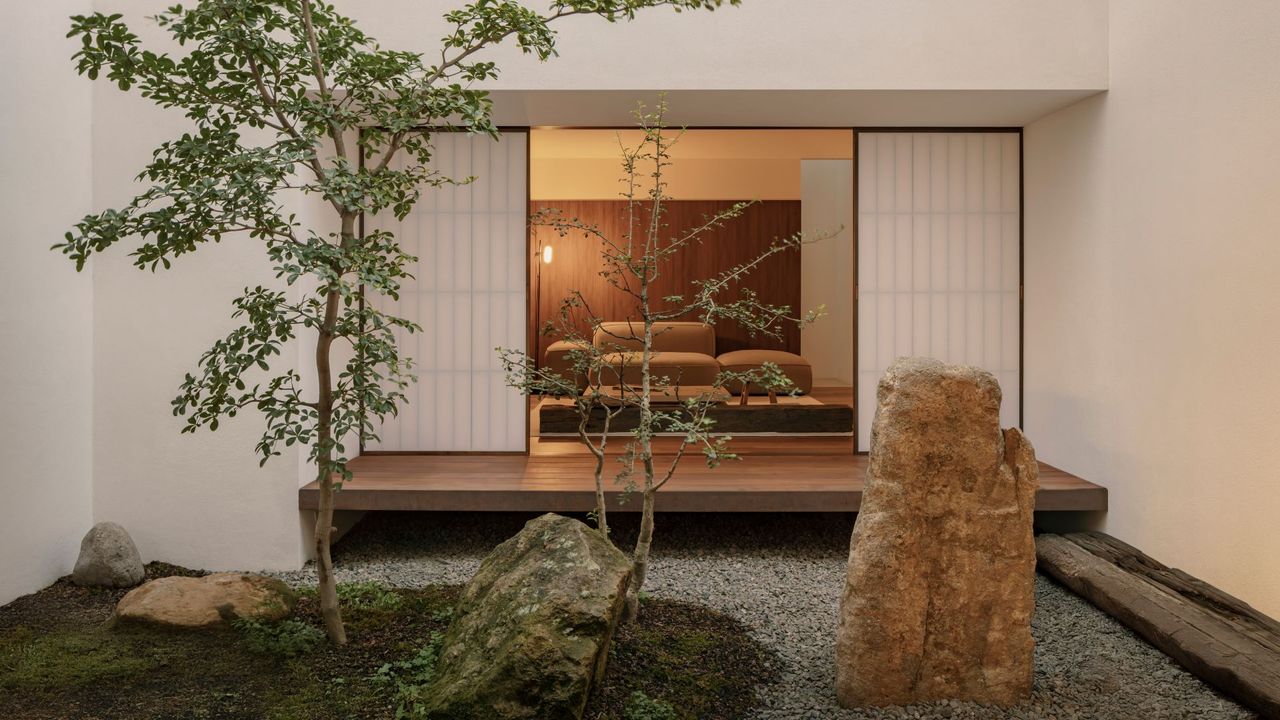
The one trait tied to Zen Japanese gardens designed around soothing interior spaces is their effortless extension. Unlike many Western homes where the garden is boundaried in a way that feels distinct from its interior counterpart, Japanese homes blur the lines almost seamlessly. And that's simply because "the garden is not a separate project," says designer Yoko Kloeden.
Typically, Japanese garden ideas are drawn up right alongside the moodboards for indoor spaces. This way, the two zones weave into each other without fighting to feel out of bounds from each other.

If you're wondering why this is a cornerstone of Japanese design, here's what happens when you neglect your garden. And how to achieve the same effect in an urban home.
What Makes a Japanese Garden Feel Connected to the Home?
"The Japanese word for garden, niwa (庭), originally meant a sacred 'place of earth'. A cleared ground for enshrining divine spirits. It was never a separate possession but an intermediary space between the built and the natural world," says interior designer Yoko Kloeden.
"This distinction runs deep. Traditional Japanese houses are designed around the garden first. This outdoor space is positioned, the house is then constructed to face it, and sliding shoji screens allow entire walls to open so that the boundary between inside and outside dissolves entirely."
Yoko explains that nature is not a backdrop you simply look at through a window. "It's an active presence woven into daily life, shaping how light enters, how air moves, and what you see from every room," she adds.
"Where the Western tradition has historically treated the garden as controlled ornament — a thing to be admired from inside — the Japanese tradition treats it as the organizing principle of the whole home."
What Do You Lose When Garden Design Is Treated as an Afterthought?
"In contemporary practice, architecture, interior design, and landscape design are typically commissioned as separate disciplines, often on different timelines and by different professionals who rarely coordinate. The garden is what happens after the budget is spent," Yoko explains.
"The result is a familiar scenario. Think a rear extension with beautiful glazing that opens onto an unconsidered garden, or planting that bears no relationship to what you see from the kitchen or the dining table. And truth be told, the problems go beyond aesthetics."
When disciplines do not talk to each other, Yoko finds that practical failures follow and indoor-outdoor living divorces. "Be it in the form of floor levels that create a step where there should be a flush threshold, drainage that pools at the back door, or planting that blocks light in winter or causes overheating in summer," she says. "The connection between home and garden is lost not through intention but through a process that never treated them as one thing."
How Can You Incorporate Japanese Garden Design in Modern Urban Homes?
The first rule to designing a garden that flows from inside to outside? Timing. "Garden design should begin at the same moment as interior planning, not be appended afterwards. When both are on the table from the outset, decisions reinforce each other," she says.
"Flush thresholds, recessing door tracks and aligning internal and external floor levels, soften the physical boundary so the space reads as continuous. Cohesive material palettes, such as running the same stone from the kitchen floor to the rear terrace, extend the interior visually into the garden."
Yoko also recommends aligning your landscaping ideas with interior sight lines."What will you see from the sofa, the worktop, or the bath? In one project, levelling a kitchen extension floor with the rear terrace and carrying materials through made a compact west London courtyard feel like a natural continuation of the living space," she recounts.
"And contrary to what you might think, you do not need a large garden. Even a modest London courtyard or a narrow side return transforms when it's conceived as part of the home's spatial composition, not as what is left over outside the back door."

This minimalist side table softens the room and can switch between a garden accessory and indoor decor at a moment's notice.

This vintage stone planter from 1stDibs would make a beautiful base for Japanese garden plants and dwarfed trees.

Speaking of garden decor that blurs the boundary with its multi-use, this rechargeable lamp from H&M is a simple statement.

The ebbing ambient sound and ombre allure of this water feature is another way to make your garden feel considered.

What's an idyllic garden without a spot to take it in from? This garden chair feels like a classic choice.

Channel the charm of wabi-sabi with this patinaed outdoor planter from West Elm.
Now, as a method of returning the favor to help your interiors feel just as much a part of your home's lush landscape, the Japanese principle of nagame will help you frame the rewards of your green efforts.
And keep your finger on the pulse of global design by subscribing to the Livingetc newsletter.







