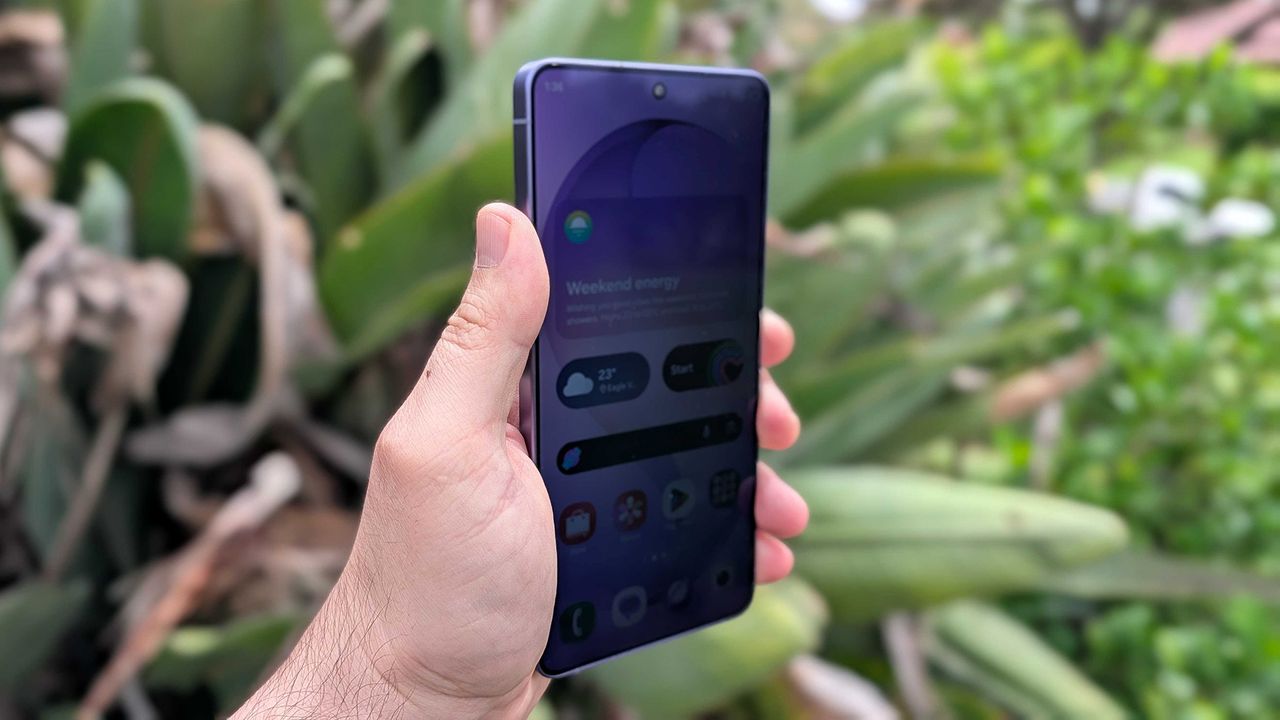
Samsung’s Galaxy S26 range has finally landed, and after spending the past two weeks with the Galaxy S26 Ultra, one feature in particular feels like a genuine throwback to the company’s glory days of bold hardware innovation.
Despite the company’s growing focus on Galaxy AI features at its recent Galaxy Unpacked event, I’ve come to the conclusion that the most meaningful upgrade on the S26 Ultra is one that can't be achieved by AI alone, and that’s its Privacy Display.

How many times have you been in public, maybe on a packed train or in a cafe, only to become painfully aware of how exposed your screen is to prying eyes? Whether you’re texting with a friend, doing some online banking, or watching some potentially embarrassing TikTok videos, what you do on your phone is nobody else’s business.
But what if you could just turn on a setting in your phone, and the person next to you can’t see a thing? No awkward hand‑shielding, no dimming your screen, just automatic privacy at a hardware level. That’s exactly what the Galaxy S26 Ultra’s new privacy display does — and it’s the first smartphone feature in years that feels genuinely transformative.
The glory days of hardware innovation

Over the past 12 years of reviewing smartphones, I’ve had a front‑row seat to the industry’s constant reinvention. I’ve watched manufacturers chase bold ideas, abandon failed experiments, and occasionally land on game-changing concepts that genuinely shifted the way we use our devices.
Smartphone makers used to compete on real, tangible breakthroughs — the kind you could see and feel the moment you picked up a device, making it feel genuinely unique. I was there when Samsung first introduced curved “edge” displays, I witnessed LG’s wild modular G5 experiment, and I groaned along with everyone else at HTC’s pressure‑sensitive squeeze gestures. I was also present for Motorola’s Moto Mods (a personal favorite), Apple’s Face ID, Huawei’s first dual-camera phone with computational photography… and let's not forget Google’s baffling temperature sensor on the Pixel 8 Pro.
All of these were big swings. Some hit, others didn’t, but these hardware-based features gave each phone a personality and made handset announcements far more exciting. However, fast‑forward to 2026, and everyone’s chasing the same AI features that will inevitably trickle down to every other handset within a year, making it difficult to be enthusiastic about the future of smartphones.
That’s why the Galaxy S26 Ultra’s privacy display stands out so sharply: it’s a rare return to genuine hardware differentiation at a time when the industry seems content to let AI be the main drawcard.
How Privacy Display relies on hardware

Although the Galaxy S26 Ultra’s privacy display is activated via software, it relies on very clever hardware engineering, and it all comes down to how individual pixels are projected on the device’s OLED panel.
Essentially, the panel uses a dual-pixel architecture, with two physical OLED emitters shaped and arranged to direct light differently. In other words, the panel can throw light through a wide emitter that’s viewable from broader angles, or switch to a narrow emitter that projects its light more tightly. These physical emitters are layered directly on top of each other to physically prevent light from escaping the panel sideways, which is why this feature could never be achieved by software alone.
When you’re looking at the phone head‑on, you see a clear, bright image. However, when you view it from even a slight angle, the screen darkens to the point where nothing on screen can be made out. And unlike privacy shield-style screen protectors, the screen darkens when the phone is tilted vertically as well as horizontally.
Using Privacy Mode

By simply swiping down on the S26 Ultra’s Quick Panel, you can toggle Privacy Mode on or off. However, tapping on Privacy Mode in the phone’s settings will allow you to apply specific conditions for when the mode is activated.
For example, you can set Privacy Mode to only switch on when you’re entering a PIN, pattern or password, or when you’re inside your Secure Folder. You can also set Privacy Mode to switch on automatically when using specific apps. Privacy Display mode can even be set to black out notification pop-ups and nothing else.
Privacy Display comes with some caveats

That’s not to say that the Privacy Display’s implementation is flawless — these additional layers have made viewing angles on the Galaxy S26 Ultra slightly worse, even when the mode is switched off entirely. So, while the phone’s display is technically capable of the same level of brightness as its predecessor (around 2,600 nits), it can appear noticeably dimmer.
The switch from wide to narrow pixels also comes with a slight downgrade in resolution and brightness, resulting in reduced visual clarity, most notably around text. Of course, this isn’t a huge problem if you’re only using the Privacy Mode in specific situations, such as when you’re entering a PIN or pattern, or using specific apps.
There’s also a Maximum Privacy mode, which all but blacks out the screen from any angle. It’s effective, but I wouldn’t leave it on permanently unless you’re comfortable with a clear hit to overall image quality.
More like this please, Samsung

Samsung’s Galaxy S26 Ultra is undoubtedly one of the most advanced smartphones I’ve ever tested, boasting several forward-thinking features. I’m a huge fan of the new Horizontal Lock feature for shooting video, which keeps the S26 Ultra’s camera perfectly level at all times, even when you’re turning the phone upside down.
I also love how the AI-powered Audio Eraser feature now works in streaming apps, allowing you to manually adjust background noise levels to your liking in Netflix, YouTube and more.
Admittedly, I couldn’t test the S26 Ultra’s new Agentic AI features during my pre‑release time with the phone, but the ability to run multi‑app tasks and autonomous workflows sounds genuinely useful if it works as promised.
Still, these kinds of AI and software features will likely trickle down to other phones over time, which is why a bold hardware-driven innovation like Privacy Mode is far more exciting to me. It’s the kind of unique feature that no other phone has — one that will be very difficult to copy without some serious changes to display architecture. And it’s exactly the kind of innovation I want to see more of from Samsung.