
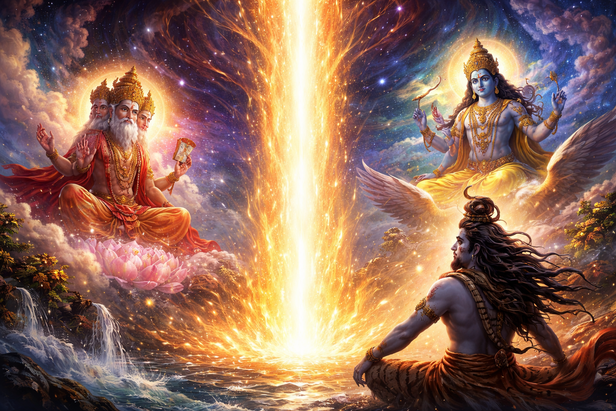
In the vastness of Hindu cosmology, Brahma is the creator, Vishnu the preserver, and Shiva the force of dissolution and transformation. Together they are the Trimurti, three functions of the same ultimate reality. Yet ancient texts describe a moment when even these cosmic forces lost sight of that unity.
The emergence of the Shivling was not planned, installed, or sculpted. It appeared as a response to a crisis of understanding. A moment when power demanded proof, and truth answered without words.

What follows is the forgotten depth behind one of Hinduism’s most sacred symbols.
1. The Cosmic Dispute Between Creation and Preservation
The story begins at a time when the universe was stable and functioning under cosmic law. Brahma, the creator, and Vishnu, the preserver, entered into a debate. The question was simple but dangerous: who among them was supreme.
Brahma argued that creation is the highest act, because without creation nothing can exist. Vishnu countered that preservation sustains all existence, and without it creation collapses instantly. What began as philosophical disagreement slowly transformed into ego-driven assertion.
This moment is crucial because it shows that even divine roles can fall into comparison when awareness of the absolute is lost. The conflict was not about power alone, but about identity.
2. The Appearance of the Infinite Pillar of Fire
As the argument intensified, the cosmos responded. From the space between Brahma and Vishnu arose an immense column of blazing light. It had no visible beginning or end. It was neither form nor formlessness. It was presence itself.
This pillar was Shiva in his most primal manifestation, known as the Jyotirlinga. Not Shiva as a deity with attributes, but Shiva as pure being, consciousness, and infinity.
The pillar did not speak. It did not declare supremacy. It simply existed. That existence alone challenged the very framework of the debate.
3. The Test of Limits and the Failure of Measurement
To resolve their dispute, Brahma and Vishnu agreed to measure the pillar. Vishnu took the form of Varaha and descended downward to find its base. Brahma took the form of a swan and flew upward to locate its summit.
They assumed that infinity could be navigated through effort and speed. This assumption itself was the lesson.
Vishnu traveled for ages through darkness and matter, yet found no end. Exhausted and humbled, he accepted defeat and returned. Brahma flew for equally long, but failed as well. Unlike Vishnu, Brahma chose not humility, but deception.
4. The Lie That Changed Divine Order
Unable to find the top, Brahma encountered a falling ketaki flower. He persuaded it to falsely testify that he had reached the summit. Brahma returned and claimed victory.
This moment marks one of the rare instances in Hindu mythology where a god lies. The lie was not trivial. It was a denial of infinity itself.
Shiva then emerged from the pillar, not in anger, but in absolute clarity. He exposed the falsehood, praised Vishnu’s honesty, and condemned Brahma’s arrogance.
As consequence, Brahma lost widespread worship on Earth. Vishnu, for his truthfulness, was affirmed as worthy of devotion. This was not punishment. It was cosmic correction.
5. Why Shiva Chose Formlessness Over Form
After revealing himself, Shiva did not remain in anthropomorphic form. Instead, he dissolved back into the pillar of light. This pillar later became represented as the Shivling.
The Shivling is not a statue. It is not an idol of Shiva’s body. It represents that infinite axis where creation begins and ends, the unmanifest source behind all forms.
Ancient Shaiva texts describe the Shivling as the symbol of the formless absolute made approachable. It is the reminder that ultimate reality cannot be confined to shape, gender, or narrative.
6. The Philosophical Meaning of the Shivling
The Shivling carries layered meaning rooted in metaphysics.
It represents the union of static consciousness and dynamic energy. The vertical form symbolizes pure awareness. The base, or yoni, represents Shakti, the creative force. Together they express the inseparability of existence and power.
Unlike narrative-based deities, the Shivling invites contemplation rather than storytelling. It asks not who Shiva is, but what existence itself is.
This is why early worship involved silence, water, leaves, and fire rather than ornamentation.
7. Why Abhishek Became Central to Worship
Water poured on the Shivling is not symbolic cooling alone. In Vedic cosmology, water represents life, memory, and continuity. Abhishek reenacts the cosmic flow that sustains existence.
Milk represents nourishment and purity. Bilva leaves are associated with regeneration and the balance of the three gunas. Each ritual emerged from philosophical association, not superstition.
The act of worship becomes participation in cosmic rhythm, not appeasement of a god.
8. The Story’s Message About Ego and Truth
The core lesson of this story is not about which god is greater. It is about the limits of authority when divorced from truth.
Vishnu’s acceptance of not knowing elevated him. Brahma’s refusal to accept limitation diminished him. Shiva did not judge through violence, but through revelation.
The Shivling thus stands as a reminder that truth does not need defense. It only needs presence.







