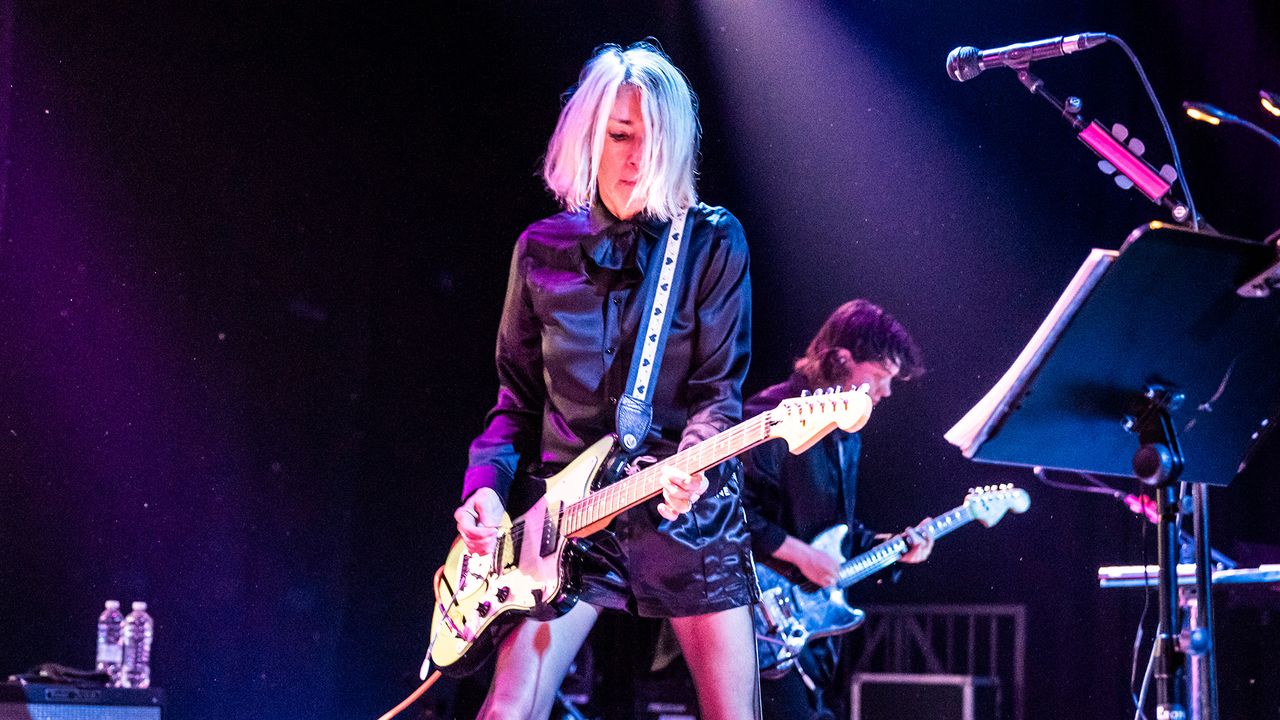
A certain trepidation is natural before an interview with Kim Gordon. Despite all evidence to the contrary – the reams of historic shots of her killing it on a Thunderbird and Jazzmaster with alt-rock pioneers Sonic Youth – the 72-year-old famously doesn’t consider herself a musician.
What’s more, it’s dangerously feasible that she didn’t fret a note on her new solo album, Play Me, which would leave us with 40 minutes to talk about the weather. Add to that Gordon’s slightly icy reputation among journalists back in Sonic Youth’s early ’90s heyday (to be clear, she was never nasty, just too damn cool to do the promotional dance, and desperate to get away).

Luckily, neither doomsday scenario comes to pass. Joining the video call from New York, Gordon is friendly, witty, thoughtful and proud of Play Me’s socio-political battlecries (on which she did play, thank God). And if she’s bemused to learn the name of this publication – “I’m really an artist that plays music, that’s what’s so funny about doing interviews for guitar magazines” – then she’s happy to humour us.
Listening to Play Me, it feels like there are no rules. Was that how it felt to make it?
Yeah, it felt pretty free. I was like, ‘Oh, I love krautrock, let’s have a krautrock beat.’ Sometimes I’d come in with lyrics, like, a page with things scribbled all over it, but I didn’t know exactly how it was gonna fit. I guess I really trust Justin [Raisen, producer].
This is our third record now and he just wants to keep going. It’s not the way I grew up playing music, y’know? In Sonic Youth, eventually, we did have friends who we let in to work on fixing our records, but it was such a different process.
It sounds like you’re looking around at the world on songs like Post Empire or Dirty Tech. What’s keeping you awake at night?
Everything is so fucked up right now. The whole AI thing is just such a nightmare. People are so seduced by technology. It’s being rammed down our throats and even the people making it don’t even know what it is, y’know?
People don’t realise it takes enormous water resources and it’s going to make everyone’s electricity more expensive. It’s just crazy that people are so greedy they don’t care about destroying the world.
The album ends with the vitriolic ByeBye25! and you sound pleased to be rid of it. But what are your hopes and fears for 2026?
I guess I hope the Democrats kill in the midterms and we regain the House and Senate. I just hope there’s some good news. Can music still be a vehicle for social change? I don’t want to say ‘no’. I think it can bring people together.
You never know what can happen. It’s so funny how Trump keeps using music by different artists, then they end up suing him. What is he thinking? Like, does someone else just pick the music?
The instrumentation on this new record doesn’t sound like standard bass and guitar. How did you approach it?
I didn’t play any of the bass, actually – Justin played that. He also played whatever melodic guitar there is and then I played all the kind of dissonant guitar stuff. Basically, I just improvised with a bunch of different pedals and a little Fender tweed amp.
On Dirty Tech, the guitar is super-minimal and I’m unplugging the lead from a distortion box and plugging it back in, that kind of trick. There was one pedal I used a lot on Not Today. I can’t remember the name of the company – I’m so bad at tech stuff – but it’s like a double Memory Man, this weird, swirly circular delay. And it’s way fucked-up.

You’re such an iconic bassist, though. How come you didn’t want to play on this album?
I mean, I haven’t played bass since the last Sonic Youth gig [2011]. I have this improv guitar duo with Bill Nace called Body/Head, and it’s just much more satisfying to improvise on a guitar. You can just get so many more textures and sounds.
I never really saw myself as a bassist. I always played with the pick, punk-rock style. And when I first started playing music, I played guitar. But then I would play basslines on the guitar, so it made sense to just play the bass. But I don’t have any sense of identity as a bass player, strangely enough.
I mean, I’ll give Justin some direction. For one song I put out last year, Bangin’ On The Freeway, I played a bassline and sent it to him, and then he had his sister-in-law – [Eva Gardner of The Mars Volta, who has toured with P!nk, Gwen Stefani and Cher] who’s also a bassist – record it on eight different basses or something.
Then we cut all of that up and it was just the most fucked-up rhythmic thing. So I’m more interested in ideas than actually having to play the bass, y’know?
You’ve long been associated with Jazzmasters. Is that what you used on Play Me?
I’m actually doing a signature guitar for Fender and it’s based on that Jazzmaster... The signature model took a really long time. We finally got Fender to use Seymour Duncan pickups
Yeah, it’s the same one I always use. I forget the year – it might be 2009 or 2010 – but it’s one of the Mexican Jazzmasters. I have other guitars, but that’s really the only one I play.
I’m actually doing a signature guitar for Fender and it’s based on that Jazzmaster. My amazing guitar tech, Salar Rajabnik, he helped me through the process and did a lot of research. The signature model took a really long time. We finally got Fender to use Seymour Duncan pickups.
It’s said you hadn’t actually played an instrument until you were 27?
Yeah, that’s true. I mean, I was in this kind of ‘noise’ garage band in school in Toronto when I was younger. But basically, yeah, not really. I mean, my brother and I would improvise in the living room with an African drum and a gong and this upright piano, and just kinda jump around. But no musical training.
But Patti Smith and Debbie Harry didn’t start playing music til they were, like, 28. So I always felt older than everyone else, but because of that, I actually didn’t feel like it was a big deal. I really moved to New York to do art. I kind of accidentally fell into playing music, like a lot of people in the post-punk era. I really just aspired to be an artist.

When Sonic Youth started out in the early ’80s, did you have a vision for the band?
Without sounding pretentious, we did want to make something that was different. But it’s not like we really talked about it. We just took our influences. The music was forged from each of our personalities. There was such a high bar set by No Wave music, which was also kind of nihilistic.
So we were influenced by Glenn Branca and Rhys Chatham. Rhys had worked with La Monte Young, and so he knew about alternate tunings and putting all the instruments in ‘E’, things like that.
Same with Glenn. And both Thurston [Moore] and Lee [Ranaldo, Sonic Youth guitarists] had played with Glenn. So we definitely knew the power of that, and that was part of our vocabulary.
Sonic Youth were pioneers of alternate tunings…
I think, in the beginning, we just had shitty guitars and so they didn’t sound good in regular tunings doing powerchords anyway. Then Thurston stuck a drum stick under his guitar strings, for the song that became The Burning Spear, and he was using it to almost make a percussive sound.
The funny thing about guitar is the electricity, and how it’s affected by how you move with it. It’s almost like a dance to me. It’s very visceral.
How was your musical headspace different working on Play Me, relative to Sonic Youth?
In Sonic Youth, there was a lot of sitting around jamming until things start getting arranged. Even if Thurston came in with the riff, we’d then all make up parts and work through the structure.
It was almost like songwriting by committee, but as a band, as opposed to [manufactured pop]. Play Me is just me and Justin. No-one else has to agree. It’s much simpler with just one other person, y’know?
How did you approach your bass parts when you were in Sonic Youth?
Because Lee and Thurston played in alternate tunings, I was really making up stuff by listening. Sometimes I would have to play a root note for a song, and that was always the least interesting part to me because I’m a creative person. I used a lot of open strings. I like minimal bass parts, so that’s mostly what I played.
Do you still have your old ’76 Thunderbird IV from back in the day? And why that bass guitar?
I have it somewhere. Why the Thunderbird? Didn’t The Runaways use it? And I think the bass player in Alice Cooper had one. It was incredibly hard to play. The neck is really thin, which makes it easier, but the balancing is a little bit awkward. But it really does feel like it’s kind of a weapon or something because the neck is so long.
Do you still feel the guitar has some juice left in it?
Yeah, sure. I mean, I like working with limitations. I remember in Sonic Youth, as a band first going to England, people hated us. It was that idea of, like [disgusted], ‘Oh, you’re playing guitar?’ Because everything was about synthesisers: ‘That’s so old-fashioned.’ It’s just kind of funny how everything changes.
I do have a vocabulary of technique, I guess, that I built up from playing for so long. But the fun of it for me is that I don’t know [much] about music. J Mascis from Dinosaur Jr and I did a gig together once. It was just the two of us, and it was a party for Marc Jacobs or something.
I was in some kind of open D tuning. And I said, ‘Okay, I’m just gonna drone on this and you do what you do.’ And I guess I also did some vocalising of some sort. But my friends were there and they said, ‘Actually, that really worked.’ So it’s kind of interesting.

What is the guitar to you now? A magic wand? A paintbrush? Just a tool to get the job done?
I guess I see the guitar as an extension of the body, in a certain way
It’s kind of a paintbrush. I mean, I’ve made a few art films with a guitar. I did one in downtown LA, kind of rubbing it on corporate buildings. And then I did one in my house that was based on a Chantal Akerman film, where I have the guitar and it’s plugged into a small amp that you can’t see.
I’m doing domestic chores like cooking and washing the bathtub and eating with my daughter, with the guitar just banging around, but I’m sort of ignoring it. I guess I see the guitar as an extension of the body, in a certain way.
Are you more inspired by visual artists than musicians?
I still hang out more with art people and I’m more aligned with the art world than the bass-playing world. I guess I think about art – or movies – more than I think about music. Music is something that’s fun to do.
Does it ever amuse you that you’ve made such an impact on rock ’n’ roll, without necessarily meaning to?
I have a little bit of imposter syndrome about it, actually. I enjoy it. But I don’t want to think about it or all the stuff around it. What people think of me, I don’t know.
- Play Me is out now via Domino.
- This article first appeared in Guitarist. Subscribe and save.