
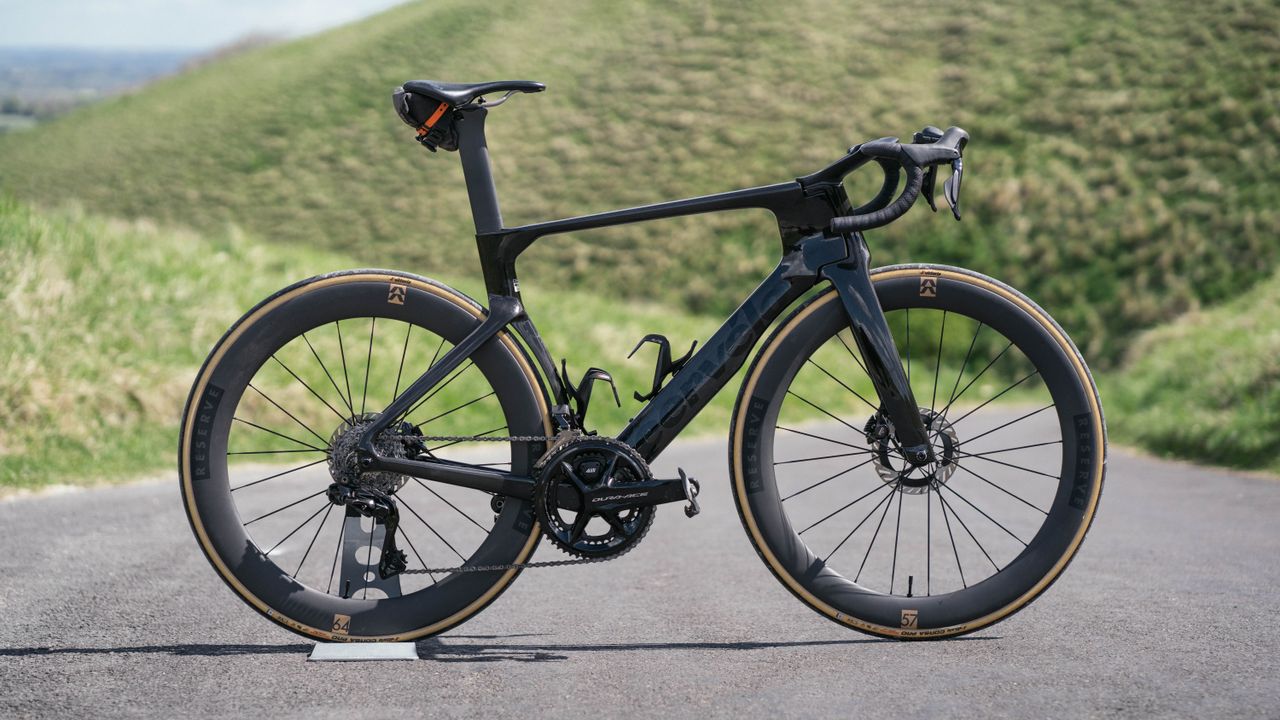
Weight: 7.98kg (measured with pedals, cages and sealant) size 56
Sizes: 48-61
Build options: Shimano Dura Ace, Ultegra, SRAM Red, Red XPLR, Force, Frameset
RRP: £12,000 / $14,350 (Dura-Ace build)
Colours: Red, Black, White, Light blue
Last year, I reviewed the old Cervélo S5, admittedly in a lower tier than this top-spec Dura-Ace monster, but it left me a little taken aback. It was extremely fast, but it never felt like it. Often I’d come home from a ride and assume I was on a bad day, only to be greeted by endless PRs.

The new S5 is, as is so often the case with the best road bikes, labelled as ‘evolution not revolution’ compared to its predecessor. It’s lighter (surprise surprise), more aerodynamic (shocking), and more integrated thanks to a new one-piece cockpit. To find out if it’s better (spoiler alert: it is), I’ve put over 550km in on it so far, taking in some fast, flat loops, group rides, solo endeavours, and one memorably hilly day out with over 2,700m of elevation. The short answer is that it's very likely the best aero road bike, and therefore, for most situations, the best race bike out there right now.

Design and aesthetics
Yes, it looks like the old one. Yes, many such new bikes also resemble their predecessors, and in many cases it does somewhat annoy me that brands seem reluctant to totally overhaul their aero bikes to keep up with the pack.
However, given that the S5 has a history of being very aerodynamic, I can absolutely see why in this case the Cervélo designers just wanted to tweak things around the edges, and our own aero testing shows it to be one of the fastest bikes in the peloton, if not the outright fastest, depending on how you look at things.
The new cockpit, happily backwards compatible with the old S5, is probably where the biggest changes have been made. It’s now a single piece, slightly flared with the hoods a full 4cm narrower than the drops, and the crossbar bridging the Y-shaped gap is slimmed down, though still just about having enough material to hold a computer mount, though not without a proprietary mount or (in my case) drilling your posh K-Edge one to fit the new holes.
The new cockpit, along with little tweaks to the dropouts (the rear being UDH-friendly now) and the seatpost wedge, has resulted in a 6.3 watt saving over the old one, which is quite significant, though I would suggest almost all of these gains are down to the cockpit. Shorter cranks across all sizes, also allowing a lower BB, will have some small aero advantages too.
At the core of the machine though the frame remains basically unchanged in terms of its shape and geometry. The same instantly recognisable seat tube shrouding the rear wheel, the same slight cut out in the downtube. While most aero bikes looked pretty similar until things got all weird in 2025, the S5 remained unique looking, and while it’s not what I’d ever call beautiful, it has a purposeful functionality that softens the visuals. Maybe if it looked like it did but was actually really slow and never won any races I’d call it ugly, but it isn’t, and it has, so I won’t.
While the outer aesthetics are very similar to the old machine, the new S5 has been on a slight diet. More of a short juice cleanse than an Ozempic overhaul, but nevertheless the Cervélo engineers have stripped out a total of 124g from the package, primarily from the seatpost and cockpit, with the slightly deeper tube shapes at the front giving a small weight penalty initially before being offset by savings elsewhere.
The wheels and tyres have been upgraded compared to my previous test machine, ignoring the fact that this is also a Dura-Ace outfitted bike rather than second-tier SRAM. The tyres are the new 29c Vittoria Corsa Pros, designed ostensibly to work with this specific bike for Visma-Lease a Bike on their new Reserve 57/64 wheels. These are deeper than the old 52/63 setup, are claimed to weigh the same, and offer marketing words like ‘turbulent aero’. We haven’t tested them in the wind tunnel standalone, but we have tested the whole bike (in a 1x configuration) and swapped to a set of stock, very fast Enve wheels, and the S5 is faster with the Reserves it was designed with (a relief, I’m sure the designers will agree).
If you want an idea of how fast this bike is by the numbers then you can either read our labs test asking ‘what is the fastest bike in the world?’, where we did back to back testing of the planet’s greatest aero bikes, or our individual lab test write up of the Cervélo S5, but with this bike perhaps more than any other, more so than the Factor ONE simply because it’s less new and novel, it’s easy to distil it down to a single wattage figure. But as I found out when I reviewed the Felt Nexar, bikes that are good on paper don’t always make good bikes in the real world. In this case, however, the S5 is good on paper and very good in the real world too.

Performance
Good Lord, this thing is fast.
It’s not so much the speed of the thing that’s disconcerting, but the placid manner in which it is delivered. On my first ever ride on it, I hit 85kmh coming off the back of a classically steep British country descent, and I could have happily done the crossword. I actually think, rather than questioning whether I was as immortal as I was at 19, as I normally do when travelling above 70kmh, I was thinking about what I was going to have for my tea.
The perception of speed is a curious thing, and I think we tend to judge velocity mostly through vibrational feedback. Harsh bikes feel fast, despite mounting evidence in the world of tyres, at least that wider road tyres are faster because they’re smoother, but the S5 isn’t in any way plush or muted. It’s not like the Colnago V4Rs or the V5Rs my colleague, Josh, reviewed, where the languid feeling was a result of the geometry. It’s got short chainstays, a low bottom bracket, and a classic 73-degree head angle, but you do feel somewhat disconnected from the ride at times. Like with the old S5, I would often come home feeling like I was on a bad day to be presented with a massive slew of PRs on my Strava.
It does, I am happy to report, feel a little more alive than the old one. Cornering is a little more conscious than with true, flickable, handling-forward machines like the Scott Addict RC and the Pinarello Dogma F, but it holds a line with absolute confidence once you’ve pointed it in the right direction. I think part of this is down to the entire package being similarly stiff. Bits of the Colnago Y1Rs felt stiff, but bits of it very much didn’t, and it added up to an incoherent ride that felt unstable, but with the S5, the frame, wheels, bars, and the bayonet/steerer arrangement all feel identically stiff to the point it almost feels like the whole machine is a single piece. It’s quite pleasant, if a little unusual. The only similar feeling I’ve had is when testing an all-titanium (frame, forks, cranks, and cockpit) Sturdy a few years ago.
It’s not uncomfortable either. It’s no endurance bike, but I happily ticked off 100-mile rides without feeling like I’d been smashed to bits. So fast was it that I also logged my fastest ever 100km, ridden solo, which included an ascent of Cheddar Gorge, so anecdotally as well as by the numbers it’s an absolute rocket.
What I will say is that, while it didn’t feel quite as exciting as some bikes to ride, I was very much glad of the ride characteristics when throwing myself into fast group rides. It felt like there was more of a steady hand on the wheel, and I felt more comfortable sat millimetres from the tyre ahead of me on it than I would on other road bikes.
Climbing isn’t its forte, however. In my guise, the pro-level 54/40 chainset was offset helpfully by an 11-34 cassette, but when tackling the really steep roads around Bristol I did miss the easy acceleration of the Specialized Aethos 2 I’d just finished reviewing before this. On an ascent of Draycott, 2km at 11.3% with a monstrous middle section with 100m over 25%, I found myself weaving like a knackered domestique halfway up the Zoncolan. Realistically, though, you’re probably not considering buying an S5 as a hill climb machine, and on more sustained, seated climbs of 6% and under, it’s actually a lovely, purposeful climber. It's not all that light either. As ridden, with cages, Ultegra pedals and a K-edge computer mount bodged to fit, plus a good glug of goo in each tyre it tipped the scales at 7.98kg, but this only really troubled me on really steep ascents.
Normally I hate non-standard cockpits, and I didn’t much care for the old one, but I really liked this one. I’d have liked less flare – I think 2cm is excessive and to be honest I’d rather have none at all. I’d have liked a narrower option, but the long horizontal section to the drops parallel to the direction of travel remains for happy, whole-hand cruising, and the odd forward-trapezium of the crossbar makes a really good pace to hold your thumbs on long climbs if you aren’t going hell for leather in the hoods… just try not to think about them snapping off in a crash.
Where I really found it to shine was hard, but steady-state riding. You can chill out on it much more than you’d think, far more than on the hyper-aggressive Ridley Noah, but it still feels like a bit of a waste. With your head tucked down and chipping away it feels very efficient, and on shorter punchy rises it handles sprints well, but I think because everything is so stiff I actually missed a little bit of spring somewhere in these situations, purely from a sensations point of view, but this is being really, really picky. It didn’t make me want to ride until my eyeballs popped out every time like the Ridley, but I sort of did anyway without even noticing.
Like many chunky, deep-wheeled aero bikes it doesn’t accelerate from slow speeds with the darting immediacy of a lightweight, tipping the scales at 7.98kg as mentioned, but when you’re already going very fast the accelerations are a lot easier to come by, which is exactly what it was designed for.
All in all, it’s a tangible improvement over the old model, but it retains the same quirks under the hood. One final point in its favour is the cockpit adjustment, which so often bedevils almost every modern bike. I wanted an extra 10mm on the front end from the slammed setup that arrived for some recent lab testing, and with 3 bolts and about ten minutes, I adjusted the height without swearing more than about three times, without even launching a T-handle through the garage window. It’s not as easy as a classic bar and stem, but it’s so much better than most, and needs no cutting of anything.

Value
By the numbers, this is one of the best if not the best race bike in the world. My test bike had what I still consider the best groupset on, though I will admit that SRAM Red runs it bloody close nowadays. The wheels are very top-tier, the tyres are some of the best on the market. The saddle is decent, too, even though I swapped it out for something I really prefer.
None of this is let down by the on-road sensations either; don’t be put off by the serene ride characteristics. It’s not a negative, it’s not boring, it’s just a little surprising. There isn’t really anywhere I can see on this bike that isn’t absolutely top of the tree, and so I expect it to also garner top of the tree pricing: £12,000, or $14,350. Yeah, that’ll about do it.
This is megabucks. It’s $1,350 more than a Dura-Ace S-Works Tarmac, which is still for better or worse the benchmark all-rounder. Does this make it bad value? Honestly, I don’t think so. I’m not going to pretend it’s cheap, but it does a far better job of justifying its price tag than the Colnago Y1Rs, which rode worse and cost substantially more. It’s not a bargain, but at the end of the day, it’s by many metrics the best bike you can buy, so it was never going to be cheap.
Verdict
Aside from the surprisingly calm ride characteristics that are common with this and the previous model, this top-flight Cervélo S5 has almost nothing I can fault. It’s extremely aerodynamic, it handles well, better than the old one and while it doesn’t feel quite as lively as bikes I have truly loved riding, it’s extremely stable, corners with absolute confidence as long as you’re conscious of what you’re doing, and is blisteringly fast.
It’s no mountain goat, but with some lightweight wheels (and maybe some lower gears if you’re going really steep), it’d hold its own. It thrived on steady-state, hard efforts, and while it was perfectly happy soaking up sprints, it felt best seated. It’s stiff all over, which I think is why it feels different to many similarly pitched bikes.
If you want the best race bike possible, it’s very, very hard to look past the S5. There’s not really much more to say than that.
Design and aesthetics |
No drastic changes, but clear improvements over the old bike. A cockpit that's easy to live with helps too. It's not pretty, but I like the way it looks due to the functionality. |
10/10 |
Weight |
Not the lightest by hyperbike standards, but considering how aero it is it's not too shabby. |
8/10 |
Performance |
Basically it's impossible to fault as a race bike. Class leading aero and great, handling, even if the ride feel lacks the excitement of some. |
10/10 |
Build |
No weak points, and everything has been designed to work in harmony. |
10/10 |
Value |
It's very, very expensive at the top end, but it's also very very good. Not a bargain, but also not a rip-off either. |
8/10 |
92% |