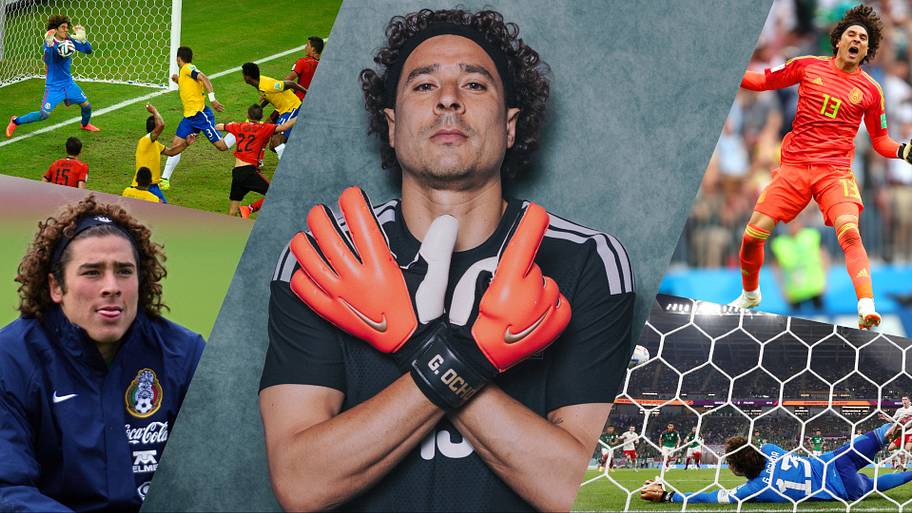
MEXICO CITY — Kissing the posts of his goal after an emphatic 3–0 World Cup win. Embracing fellow goalkeepers Raúl Rangel and Carlos Acevedo, who encouraged the crowd at the Estadio Azteca to keep chanting his name. Taking a knee to soak it all in, as tears flowed down his face. Then, being hoisted by the entire Mexico national team squad who promptly threw him in the air. What a way to ride off into the sunset for legendary Mexico goalkeeper, Guillermo Ochoa.
On the eve of Mexico’s second group stage game of the 2026 World Cup, reports surfaced confirming the curly-haired goalkeeper is headed for retirement. The news came as little surprise considering he’d already announced the 2026 World Cup would be his last dance with El Tri, the squad that kept him going.

“The Mexico national team has always been my compass in my career and my life,” a teary-eyed Ochoa revealed during his chapter in FIFA’s Letters That Unite. “It’s given me direction.”
For over two decades, since his national team debut in 2005, Ochoa has been a mainstay with El Tri. His retirement isn’t only the goodbye of the greatest, most capped Mexico goalkeeper ever, it’s also the farewell of by far the most iconic World Cup figure in Mexico’s history.
Is it even a World Cup without this man?
— Sports Illustrated FC (@SI_FootballClub) June 25, 2026
Guillermo Ochoa has official made it number six. pic.twitter.com/aRZLUQGdE2
With El Tri already qualified to the round of 32 as the winner of group A and up 2–0 in its final group stage match against Czechia, the Azteca burst into mayhem when Ochoa took off his warm-up shirt and prepared to enter the match with a little over 10 minutes left on the clock.
“Today he’s going to play,” Mexico fan Rogelio, 41, wearing a tricolor curly-haired wig, told Sports Illustrated before the match. “Maybe just 10 minutes, but he’s going to play. We want one final memory of his final game.”
He was almost dead on. It was 12 minutes plus stoppage time. That’s how long the last professional appearance of the greatest Mexican goalkeeper of all time lasted. It’s only fitting that it came at the same stadium he made his debut in over two decades ago.
An Undeniable World Cup Icon
Guillermo Ochoa (2006) pic.twitter.com/wWH7BYwXWH
— Sports Illustrated FC (@SI_FootballClub) June 3, 2026
Ochoa sits at an exclusive table alongside Lionel Messi and Cristiano Ronaldo as the only three players in history to take part in six different World Cups. His career is not only bound to El Tri, it’s forever intertwined with the biggest tournament in the sport.
Yet unlike the two all-time greats, Ochoa had only featured in three of his six tournament appearances—until he made it a fourth in his final appearance as a professional against Czechia. He was never expected to play in Germany 2006, when as a 21-year-old Ricardo La Volpe included him in Mexico’s roster as the third goalkeeper behind Jesús Corona and undisputed starter Oswaldo Sánchez.
The story was much different four years later. Ochoa became Mexico’s starter for the entire process towards South Africa 2010. But a major blunder in a pre-tournament friendly against North Korea led to manager Javier Aguirre—the same man in charge of El Tri in 2026—to pivot and start veteran Oscar Pérez in South Africa. At 25 years old and three years after earning a Ballon d’Or nomination, Ochoa was benched in a hugely controversial decision.
A surge in form from Corona and Alfredo Talavera threatened to once again deny Ochoa from making his World Cup debut in 2014, but Miguel Herrera finally gave him the chance he had been dreaming of for almost a decade. In Brazil 2014, Ochoa’s legend was born.
In his second career World Cup appearance, Ochoa delivered the greatest performance of his career and one of the best a goalkeeper has produced in tournament folklore, leading Mexico to a scoreless draw against hosts Brazil. Six saves, including a simply astonishing double, spoiled the Brazilian party. One afternoon in Fortaleza changed Ochoa’s life.
He was stellar the rest of the tournament as well, but Mexico was eliminated in a heartbreaking defeat against the Netherlands in the last 16. Four years later, he was imperial once again and kept a clean sheet as Mexico secured its greatest ever tournament result, defeating then reigning champion Germany 1–0 in its curtain-raiser at Russia 2018.
Mexico was humbled in Qatar 2022, enduring its first group stage elimination in over a quarter-century. Ochoa, though, still had his moment of magic, stopping a Robert Lewandowski penalty to keep his fourth and final World Cup clean sheet to date in a scoreless draw against Poland.
Regardless of Mexico’s results, Ochoa enhanced his status as a World Cup folk hero with every passing save. He became the definition of a World Cup player, a goalkeeper the globe was delighted to be re-introduced to every four years.
He disappeared from the world’s spotlight in the years between tournaments, but his career longevity is an ode to tenacity, resilience and an unyielding need to keep going despite glaring struggles.
A Tribute To Endurance
After bursting onto the scene for Club América and emerging as one of the best, most exciting goalkeepers in Liga MX during the mid 2000s, Ochoa’s club career is at best described as unremarkable.
He won a Liga MX title and the now Concacaf Champions Cup during his early years at América, but the 2017–18 Belgian Cup during his time at Standard Liege is Ochoa’s only trophy at club level in the last 20 years.
On the other hand, he’s endured three relegations during his European career. First in France with Ajaccio in 2013–14, then in Spain with Granada in 2016–17 and finally, with Salernitana in Serie A during his lone season in 2023–24. Overall, he’s conceded more than 1,000 goals across the entirety of his club career.
To his credit, he’s one of the few Mexican players that not only pushed for a move to European soccer but also fought tooth and nail to stay there. He did return to Club América for three and a half years between 2019–23, but cruelly, he never lifted a trophy in his second stint at the club. América won the championship the season prior to his arrival and immediately after his departure.
But it always felt like Ochoa’s club career was a means to an end, an excuse to be ready for whenever El Tri needed him. Whether it was World Cup qualifiers, the Gold Cup, Nations League, friendlies, you name it, he was always there.
Spending so long under El Tri’s spotlight made him a constant target of criticism, especially later in his career when him aging coincided with Mexico’s overall decline, prompting many to question why he was still part of the team.
Still, he’s won seven titles with the national team in his career and is the third most capped player in El Tri’s history. At 40, a passing of the torch in Mexico’s goal was needed, but Aguirre including him in the 2026 World Cup roster feels like the proper send-off for a player that spent the entirety of his career eager to represent El Tri despite the noise surrounding it and the criticism aimed his way.
The End Of An Era
Ochoa’s retirement marks the end of an entire generation in Mexican soccer. He’s the bridge between players like Rafael Márquez, Claudio Suárez and Cuauhtémoc Blanco, one that others such as Javier “Chicahrito” Hernández, Giovanni Dos Santos, Carlos Vela and Hector Herrera also crossed to make way for the likes of current regulars like Raúl Jiménez, Edson Álvarez, Johan Vásquez and Gilberto Mora.
Ochoa’s career spans a generation that saw him grow up from a teenager to a now 40-year-old in his final World Cup. An entire life fits inside the curly-haired icon’s career. Some that were in elementary school when he made his maiden El Tri appearance are now married with children. Growing up, growing old, and everything in between ... throughout it all, Ochoa was there protecting El Tri’s goal.
“I can’t understand my career without the national team,” a sobbing Ochoa told FIFA. “I don’t know what my career would be like without the national team. And now that my time with the national team is ending, I don’t see any more meaning in football. I don’t see any more meaning in continuing to play.”
Him getting to write his final chapter at the World Cup is tremendously appropriate, defending the colors he loved most, in the tournament that made him a household name worldwide. The greatest Mexican goalkeeper of all time will start a new chapter knowing he left it all out there.
“I’ve enjoyed each moment there. I gave it my all. I leave in peace, with my head held high and proud to have experienced this.”
Ochoa’s Perfect Goodbye
Ochoa simply had to play against Czechia. The script was too much of a fairytale not to make it a reality.
One fan, Enrique, 41, was almost insulted by the question pre-match. "Ochoa has to play, he has to. It’s probably the last game we will ever see Memo [Ochoa] and he’s a legend, a legend of Mexico.
“He’s the best goalkeeper in Mexico’s history, the best in national team history. Jorge Campos has his place there, Oswaldo Sánchez has his place there, but Memo is one of a kind. He has to have a good farewell, at the Azteca, at his home.”
But when the lineups where announced, Aguirre didn’t seem prepared to oblige, sticking with Rángel, who produced a tremendous double-save many described as "Ochoian” to secure Mexico’s win against South Korea in the second match of the group stage, as his starter.
Once Mexico took a commanding lead against Czechia in the second half, though, the chants started: “Ochoa, Ochoa, Ochoa!” The over 80,000 in attendance at the Azteca sang as one, desperately pleading for one last opportunity to witness the Mexican legend. Finally, in the 78th minute, Aguirre granted their wish.
The sound of the Azteca as Ochoa, already on the verge of tears, replaced Rangel was nothing short of earsplitting. The roars following the goals from Mateo Chávez, Julián Quiñones and Álvaro Fidalgo were silent when compared to the sheer volcanic eruption produced by Ochoa’s final entrance.
Ochoa could barely keep it together during his first minutes on the pitch, acknowledging a comletely maniac crowd that exploded every time the ball came to him and sang "Ole, Ole, Ole, Memo, Memo!” over, and over, and over again during the final minutes.
Even Alan, a beer vendor walking the stands of the Azteca, outright stopped his job to take in the moment. "He’s a legendary goalkeeper. There’s a reason this is his sixth World Cup.”
On Feb. 15, 2004, an 18-year-old Guillermo Ochoa made his professional debut for Club América, helping Las Águilas defeat Monterrey 3–2 at the Azteca. Exactly 22 years, four months and 10 days later, Ochoa stepped on the pitch of the soccer temple for one final time.
Embracing his son and two daughters on the pitch before taking a lap around the stadium that will forever be his home, Ochoa dropped the curtain on his career. Playing for El Tri, in the World Cup and at the stadium where it all started.
The perfect goodbye for the greatest Mexican goalkeeper of all time.