
Get all your news in one place.
100’s of premium titles.
One app.
Start reading
Motorsport
Motorsport
Sport

The F1 champions with the worst points conversion rates

Is Lando Norris a worthy Formula 1 world champion or not? That question has divided opinion since his title victory in Abu Dhabi. Quite a few believe that Max Verstappen was the better driver in 2025 and that Norris did not extract the maximum from his McLaren.

But in dividing opinion over his worth as a champion, the Briton is far from alone in Formula 1 history.

Let’s take a look at the raw numbers. Norris finished the season with 423 points, while a maximum of 648 were available. That equates to a points conversion rate of 65.28%.

Among all 76 world championship seasons in F1 history, Norris’ campaign ranks 48th in terms of his points conversion – incidentally one place ahead of Verstappen the year before, when the Dutchman achieved “only” 65.03% of the available points in his Red Bull.

Of course, statistics like these are always something of a gimmick – and even more so in Formula 1. Cars differ massively in competitiveness and, as always, the various points systems used over the decades distort any such number-crunching exercise.

Even so, the figures suggest that Norris is a long way from being an undeserving or unworthy world champion.

Still, let’s have a bit of fun and take a closer look at who actually recorded the worst – and the best – points conversion rates of every world champion in Formula 1 history.

Ayrton Senna, McLaren MP4-5B Honda. (Photo by: Rainer W. Schlegelmilch / Motorsport Images)

The limitations

As mentioned, this is complicated by the different points systems over the years. Before 1991, dropped results were part of the sport: only a certain number of races counted towards the championship, with the rest discarded.

Sometimes this had little impact, because only one result per half of the season was dropped. At other times, however, drivers could afford a number of mistakes, as only 11 of 16 races, for example, were counted towards the title.

For this article we decided to use only the points that were genuinely available – in other words, the maximum number of points a driver could have on the scoreboard by the end of the season, and how many he actually did score.

Naturally, this approach favours drivers from earlier eras. On the other hand, reliability was far worse back then, which would otherwise have made it virtually impossible for them to achieve strong statistics.

Unsurprisingly, Juan Manuel Fangio, the dominant force of the 1950s, appears several times near the top of the rankings. In his case, usually only the best five results of a season counted (although seasons were, of course, much shorter back then). Four of his titles therefore rank fifth, 11th, 12th and 13th in terms of points conversion.

Even better than Fangio, however, were two other drivers: Alberto Ascari and Jim Clark. Both essentially managed perfect seasons, scoring 100% of the points available to them.

In Ascari’s case, only the best four results from eight races counted at the time. After skipping the Swiss Grand Prix to compete in the Indianapolis 500, which was part of the world championship back then, the Italian won the other six races and also set the fastest lap every single time. It simply can't get any better than that – and two of those victories did not even count towards the championship.

Alberto Ascari, Ferrari 500 (Photo by: Motorsport Images)

The following year, not all of his wins were counted either. And because he did not set the fastest lap in one of the races that did count, and had to share the fastest lap point at another victory with a second driver, he ended up 1.5 points short of perfection.

What Ascari failed to achieve, however, was managed by another driver. Clark won “only” two Formula 1 world championships – but both with a perfect 100% points score.

The 1965 season is particularly interesting. Clark won the first six races he entered. As only six results counted towards the championship, it effectively did not matter what he did in the final three races – his points total and the world title were already secured.

Clark was killed in a Formula 2 race at Hockenheim in 1968, and many are convinced that he would have won further titles had he not lost his life so tragically.

If we were to consider only those seasons in which every race counted towards the championship – that is, from 1991 onwards – Verstappen would be the clear number one. In 2023, Red Bull won every race of the season except Singapore, something that is clearly reflected in the statistics.

Verstappen scored 575 of a possible 620 points, a conversion rate of 92.74%. Remarkably, the Dutchman dropped just 45 points – in a season with 22 races, six sprints and, crucially, the bonus point for fastest lap, which Verstappen often had little influence over because other drivers could simply pit late in the race.

That alone cost him 13 points.

Max Verstappen, Red Bull Racing, 1st position, lifts the winners trophy (Photo by: Glenn Dunbar / Motorsport Images)

As a result, the season was even more dominant than Michael Schumacher’s 2002 campaign, when he finished on the podium in every race but still “only” achieved 84.71% of the available points – 144 out of 170.

Incidentally, if you were to compile a top-10 of the modern Formula 1 era from 1991 onwards and rank each season individually, it would not be particularly varied: Verstappen, Schumacher, Sebastian Vettel, Vettel, Schumacher, Lewis Hamilton, Senna, Hamilton, Hamilton, Hamilton.

But it is also worth looking at the other end of the list. And this is where the impact of modern reliability becomes apparent. Only one driver from 2000 onwards appears in the bottom 10: Vettel.

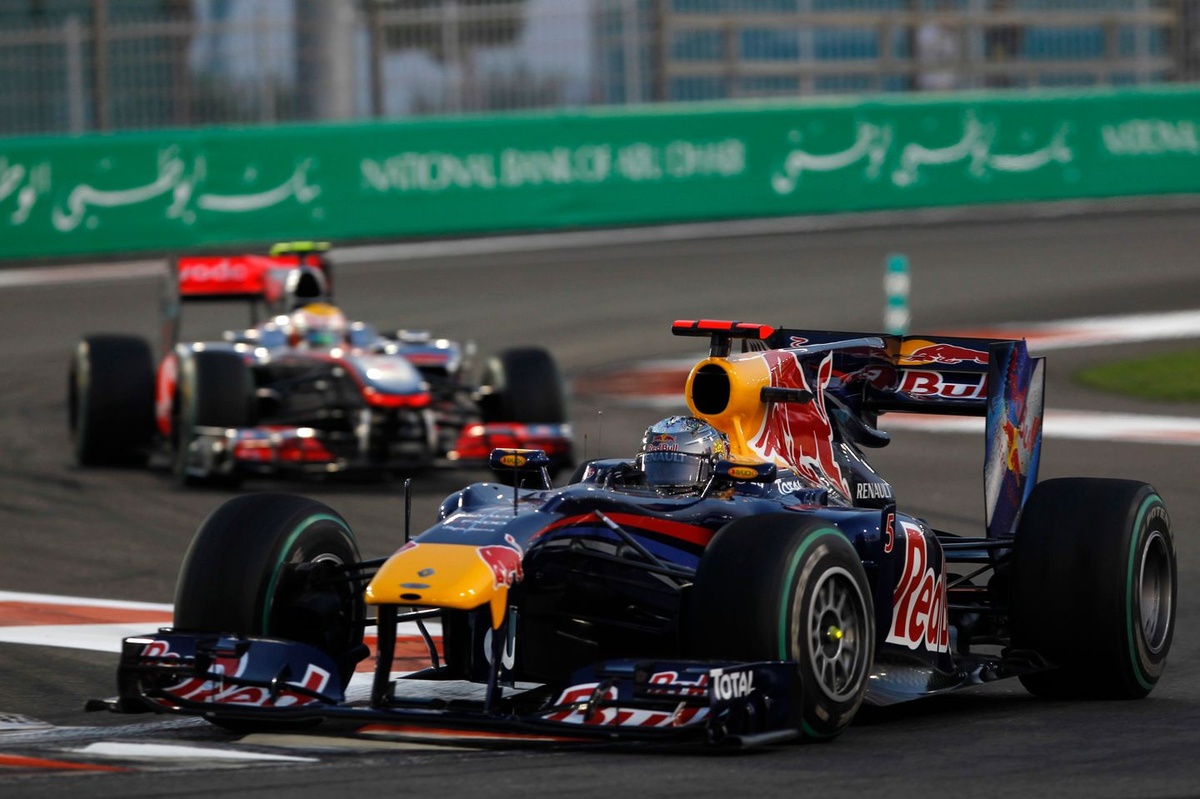
Being in this region does not automatically mean that a world champion was weak or undeserving. In Vettel’s case, the 2010 season was simply so closely contested that many drivers took points off each other. Fernando Alonso, Mark Webber, Hamilton and Jenson Button all harboured title hopes deep into the season, before Vettel snatched the crown.

The German led the championship for the first time all year only after Abu Dhabi – and that was enough to secure the title with a points conversion rate of 53.89%.

Hardly anyone would argue that Jochen Rindt was a weak or undeserving world champion either, despite scoring only 45 of a possible 99 points. On the contrary: with five consecutive wins, Rindt could have ranked much higher on the list.

But fate intervened. Rindt was killed in a crash at Monza and was unable to compete in the final four races of the season. As five of the last six races counted towards the championship, Rindt was left with just his victory at Hockenheim – and four zero scores. Even so, no other driver could catch him, making him the only posthumous Formula 1 world champion to date.

Jochen Rindt, Lotus 72C Ford (Photo by: Motorsport Images)

Rindt ranks second on the flop list, surpassed only by Keke Rosberg in 1982 – which is hardly surprising given that he won just one race that season. The Finn scored only 44 of a possible 99 points (44.44%), making him the world champion with the lowest points conversion rate of all time.

In fact, his statistics are flattered by the dropped-results system, as only 11 of 16 races counted. Had the entire season been counted, as it is today, 144 points would have been available – and Rosberg would have scored just 30.56% of them.

The whole list

Year Driver Conversion rate (%) Points won
1952 Ascari 100.00 36 out of 36
1963 Clark 100.00 54 out of 54
1965 Clark 100.00 54 out of 54
1953 Ascari 95.83 34.5 out of 36
1954 Fangio 93.33 42 out of 45
1962 Hill 93.33 42 out of 45
1966 Brabham 93.33 42 out of 45
2023 Verstappen 92.74 575 out of 620
1988 Senna 90.91 90 out of 99
1960 Brabham 89.58 43 out of 48
1955 Fangio 88.89 40 out of 45
1957 Fangio 88.89 40 out of 45
1951 Fangio 86.11 31 out of 36
2002 Schumacher 84.71 144 out of 170
2013 Vettel 83.58 397 out of 475
1950 Farina 83.33 30 out of 36
2011 Vettel 82.53 392 out of 475
2004 Schumacher 82.22 148 out of 180
2015 Hamilton 80.21 381 out of 475
1991 Senna 78.79 78 out of 99
2020 Hamilton 78.51 347 out of 442
1969 Stewart 77.78 63 out of 81
1958 Hawthorn 77.78 42 out of 54
2018 Hamilton 77.71 408 out of 525
2014 Hamilton 76.80 384 out of 500
1989 Prost 76.77 76 out of 99
1971 Stewart 76.54 62 out of 81
2022 Verstappen 76.17 454 out of 596
2019 Hamilton 75.64 413 out of 546
1961 Hill 75.56 34 out of 45
2006 Alonso 74.44 134 out of 180
1980 Jones 74.44 67 out of 90
1964 Surtees 74.07 40 out of 54
1987 Piquet 73.74 73 out of 99
1985 Prost 73.74 73 out of 99
2016 Rosberg 73.33 385 out of 525
1986 Prost 72.73 72 out of 99
1984 Lauda 72.73 72 out of 99
2017 Hamilton 72.60 363 out of 500
2001 Schumacher 72.35 123 out of 170
1979 Scheckter 70.83 51 out of 72
2005 Alonso 70.00 133 out of 190
2021 Verstappen 69.57 395.5 out of 568.5
1959 Brabham 68.89 31 out of 45
1972 Fittipaldi 67.78 61 out of 90
1992 Mansell 67.50 108 out of 160
1956 Fangio 66.67 30 out of 45
2025 Norris 65.28 423 out of 648
2024 Verstappen 65.03 437 out of 672
2007 Raikkonen 64.71 110 out of 170
2000 Schumacher 63.53 108 out of 170
1967 Hulme 62.96 51 out of 81
1998 Hakkinen 62.50 100 out of 160
1993 Prost 61.87 99 out of 160
1973 Stewart 60.68 71 out of 117
1996 Hill 60.62 97 out of 160
1995 Schumacher 60.00 102 out of 170
1991 Senna 60.00 96 out of 160
1975 Lauda 59.72 64.5 out of 108
1983 Piquet 59.60 59 out of 99
2003 Schumacher 58.12 93 out of 160
2009 Button 57.58 95 out of 165
1994 Schumacher 57.50 92 out of 160
2012 Vettel 56.20 281 out of 500
1976 Hunt 54.76 69 out of 126
2008 Hamilton 54.44 98 out of 180
2010 Vettel 53.89 256 out of 475
1977 Lauda 53.33 72 out of 135
1968 Hill 53.33 48 out of 90
1978 Andretti 50.79 64 out of 126
1981 Piquet 50.51 50 out of 99
1997 Villeneuve 47.65 81 out of 170
1999 Hakkinen 47.50 76 out of 160
1974 Fittipaldi 47.01 55 out of 117
1970 Rindt 45.45 45 out of 99
1982 Rosberg 44.44 44 out of 99
Sign up to read this article
Read news from 100’s of titles, curated specifically for you.
Already a member? Sign in here
Related Stories
Top stories on inkl right now
One subscription that gives you access to news from hundreds of sites
Already a member? Sign in here
Our Picks
Fourteen days free
Download the app
One app. One membership.
100+ trusted global sources.