Get all your news in one place.
100's of premium titles.
One app.
Start reading
Digital Camera World
David S Young

The f/0.95 mystery: Why 'world record' super-fast camera lens speeds are often just about the bragging rights

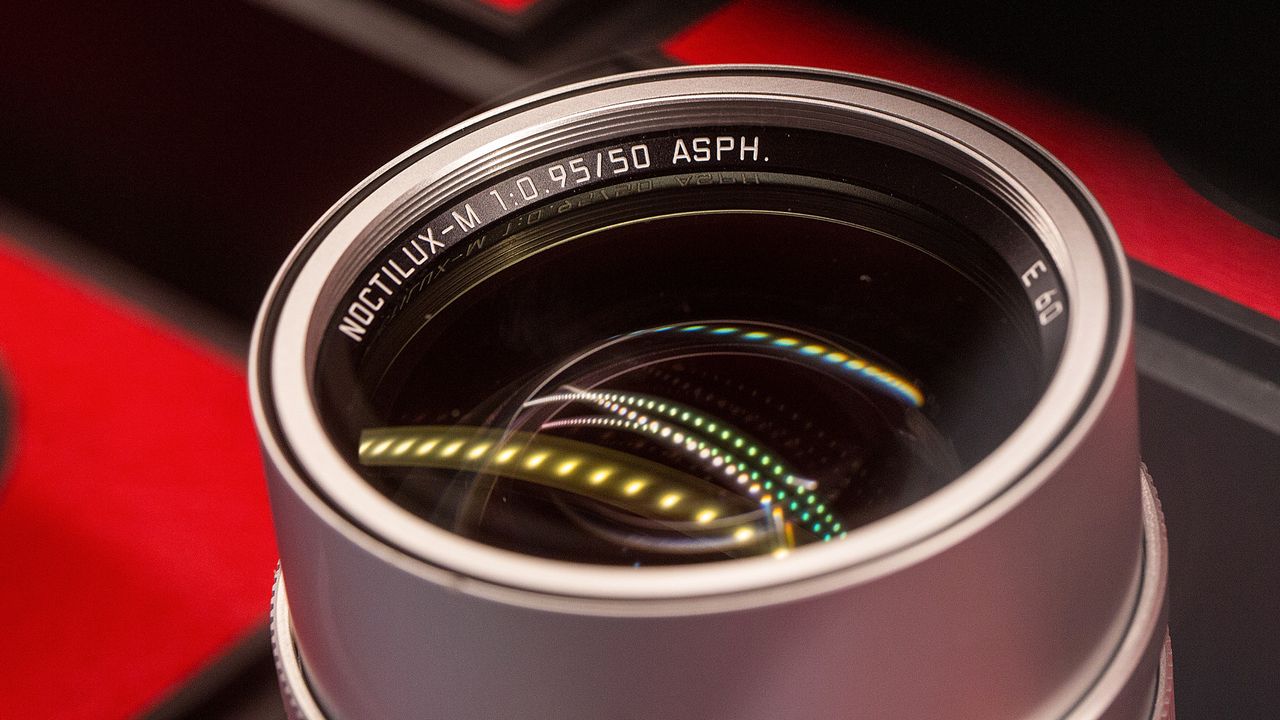
Leica Noctlux 50mm f/0.95.

These days, it seems everybody and his uncle makes super speed (generally considered to be f/1.2 and faster) lenses. But there was a time back in the 1950s, when such things simply did not exist. The story of how we got to where we are is a fascinating one.

It all started in 1953, when a small Japanese company, Teikoku Kogaku, introduced its very good, if rather expensive, 5cm f 1.1 lens under the Zunow brand. It was available in in M39 (Leica), Nikon "S" and Contax mounts, and was designed by Michisaburo Hamano (who previously worked at Nippon Kogaku – now Nikon). It remained the fastest lens available for a 35mm camera, until Nikon matched the speed with their 50mm f/1.1 Nikkor in 1956.

In 1961, Canon rocked the world with its stunningly fast, 50mm, f/0.95 for the Canon 7 rangefinder camera. The lens was so heavy and its rear element sufficiently large that Canon added a special three-lug bayonet mount around the normal lens mount of their 7 and 7S rangefinder cameras, to accommodate the f 0.95. No other lens ever used that bayonet and the lens fit no other cameras. Despite its problems of significant spherical aberration and minimal control of flare, it was made until the end of Canon’s rangefinder era, in 1971.

This “need for speed” picked up it’s pace when, 1966 Leica introduced its 50mm f/1.2 Noctilux. Designed by Helmut Marx and Paul Sindel (the successors to Max Berek at Leitz), it was an excellent lens, and used two aspherical elements which at the time, could only be made by hand. In fact they were all made by hand on a single, special machine, and then hand-polished by one expert craftsman, Gerd Bergmann.

Leica had no way to test them until assembly was completed and quickly discovered that nearly 50% of the lenses failed their quality tests. Those that passed were groundbreaking lenses that significantly reduced spherical aberration at full aperture, resulting in exquisite bokeh. While the lens was made until 1975, just 1757 lenses were completed.

Canon 50mm f/0.95 (Image credit: Canon)

Also in 1966, the Zeiss Gigantar was born at a time when camera companies are aiming for lenses with ever-larger apertures, much as they are going for cameras with more and more megapixels and ever-higher ISO ratings today. Canon has just released its 50mm f/0.95 and photographers are becoming fixated on the speed of lenses, rather than their performance.

The Gigantar was claimed to be the fastest lens in the world. But was it true? Well, no.

Wolf Wehran, then head of the Zeiss public relations department, realized that Zeiss was unable to compete in this area due to the smaller "throat" of its lens mount necessitated by their use of Compur shutters. So, he decided to poke some fun at this” fast glass” fad. In the Zeiss lens design lab, he found an old condenser lens for an enlarger, and with an engineer’s help, some left-over parts and a few new ones, he created a “Frankenlens” for the Zeiss Contarex. He arbitrarily decided that the lens would have a focal length of 40mm and a maximum aperture of f/0.33 and then had it proudly displayed at Photokina, in a locked glass case, as the “Super-Q-Gigantar’. The “Q”, by the way, stood for “quatsch”, which translates from the German as “nonsense”!

The Zeiss Gigantar 40mm f/0.33 that sold at auction at Leitz Photographica for €60,000 (Image credit: Leitz Photographica Auction)

The Gigantar was, of course, a hoax and not capable of actually taking a photograph. This fact did not stop the one-off lens from selling at auction in 2011 for €60,000 (or $83,000 at the time)!

The final part of our story is with E. Leitz’s famed lens designer, Walter Mandler, who was “loaned” to Leica’s new Canadian branch, for six months, in 1952. He stayed for 30 years; Mandler became a Canadian citizen and was buried there.

It is said that Mandler had worked on an f/1.0 lens design for some time, without permission from the head office. A design without aspheric elements to avoid the problems of the f/1.2 Noctilux of 1966. On a trip to Wetzlar, he slipped the prototype into his pocket and flew to Germany.

Leica NOCTILUX-M 50 f/0.95 ASPH. (Image credit: Leica)

When he showed it to the German staff, they were amazed, and the lens was quickly approved for production in Canada. And thus, in 1976, the legendary f/1.0 Noctilux was born. It was said to capture more information on film than the photographer could see with the naked eye. This ultimate hi-speed lens was made until 2008 when the last man who knew how to make them retired. It was then superseded by an f/0.95 version in 2008. As Leica’s current lens designer, Peter Karbe, told your scribe, “It needed a redesign, anyway”!

By the way, the difference in light gathering between f/1.0 and f/0.95 is infinitesimally small (0.14 of a stop) and irrelevant in photography. The two terms are used to either distinguish between two versions, such as with the Noctilux, or simply for bragging rights, as with Canon’s f/0.95.

In 1982, Kodak was the first to master the art of precision moulding. rather than grinding, Aspheric glass lens elements, and soon Hoya, Schott, Rochester Precision Optics and others would provide lens makers with reasonably priced, moulded aspheric lens elements , which explains the recent proliferation of lenses marked ASP or ASPH and the distinct improvement of modern optics.

Sign up to read this article
Read news from 100's of titles, curated specifically for you.
Already a member? Sign in here
Related Stories
Top stories on inkl right now
One subscription that gives you access to news from hundreds of sites
Already a member? Sign in here
Our Picks
Fourteen days free
Download the app
One app. One membership.
100+ trusted global sources.