Get all your news in one place.
100's of premium titles.
One app.
Start reading
Guitar World
Guitar World
Entertainment
Damon Orion

“The engineer claimed to me that he would overdub his own guitar tracks in place of Mars’. Not even the band knew about it”: The wild times and recording tricks behind Mötley Crüe’s game-changing sophomore album

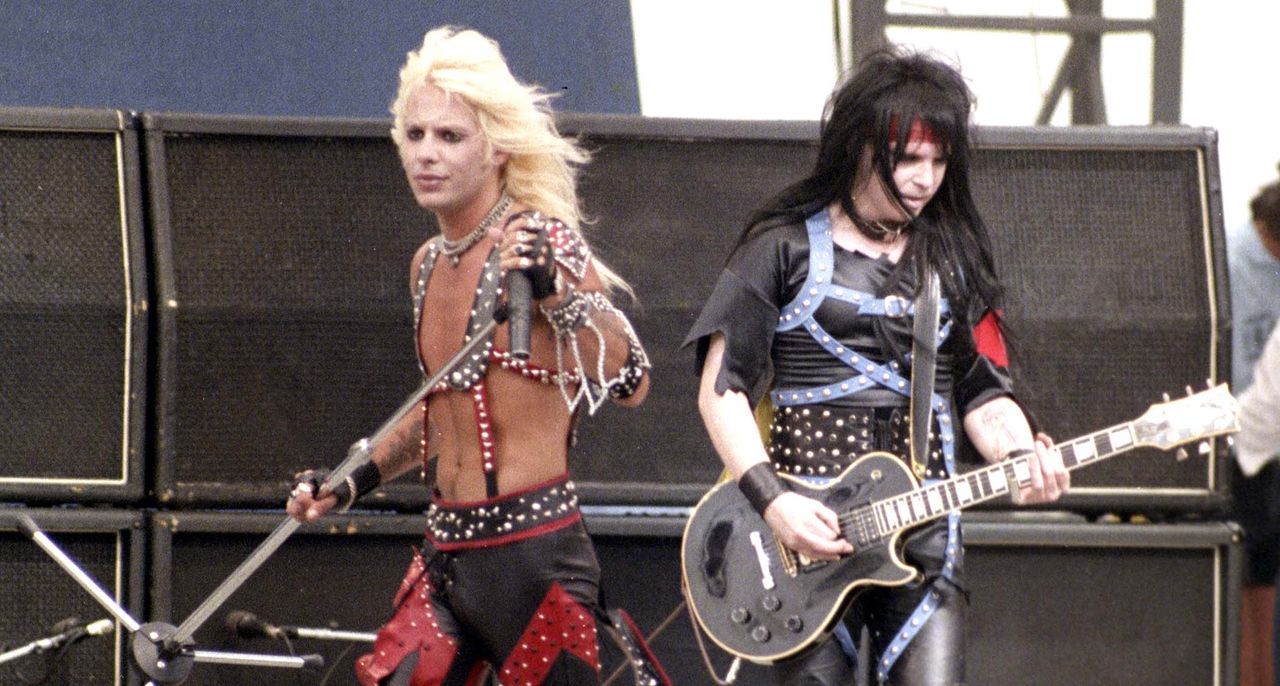
Vince Neil and Mick Mars perform at the US Festival 1983.

In light of Mötley Crüe’s infamous penchant for bad behavior, you’d think trying to get a coherent performance out of them in the studio would be like trying to train a pack of hyenas as valet attendants.

It’s easy to picture the band members anointing the walls of Hollywood’s Cherokee Studios with liquor, spray paint, lighter fluid and various unsavory emissions as their hapless producer begs them to pick up their instruments and give Looks That Kill a run-through.

The Shout at the Devil liner notes do little to dispel that notion: “This album was recorded on Foster’s Lager, Budweiser, Bombay Gin, lots of Jack Daniels, Kahlua and brandy, quackers and krell [the band members’ nickname for their favorite illegal nasal decongestant] and wild women!”

Jonathan Little, owner of the L.A.-based audio gear company Little Labs, had a front-row seat to the bedlam while working as a tech during the Shout sessions.

“I saw all the well-known Mötley Crüe debauchery,” he says. “There would be chicks getting champagne bottles inserted in their private parts, [and] for most of one night, I sat in a little back room with Nikki Sixx and [Doors keyboardist] Ray Manzarek doing blow.”

He adds that even engineer Geoff Workman “always had a big Coca-Cola glass full of ice and Jack Daniels. He’d go through a bottle of Jack each night.”

However, Shout at the Devil producer Tom Werman says the Crüe’s antics didn’t impede recording progress.

“There was a lot of partying in the studio, but it was really softcore,” he says. “They didn’t get near the heroin thing, which they did later, but not in the studio, really. Alcohol and party-favor drugs – that was normal in probably the majority of recording sessions in L.A. in the ’80s, but we got it done. They wanted good music, and they wanted to be successful, so they took the partying only so far.”

Werman adds that working with Crüe guitarist Mick Mars was the best part of the recording experience, largely because Mars came into the studio with his guitar parts worked out in advance.

“The only thing I really contributed to Mick’s playing was fills. He would have the basic guitar lines down, but he wouldn’t have any fills between verses or between a verse and a chorus, so I would suggest stuff to him, and he would be very cooperative.”

The late Geoff Workman’s experience with Mars was less pleasant, according to Little. “Geoff was getting frustrated with Mick[’s performances]. He claimed to me that he would take the tapes to [Toto keyboardist] David Paich’s place, which was called Hog Manor, and overdub his own guitar tracks [in place of Mars’]. Not even the band knew about it.”

Leaving aside the question of whose playing made it onto the record, the rhythm guitar track on Looks That Kill consists of a single performance split to two separate tracks. One track was close-mic’d with a Neumann U 87 and panned left. The other, recorded with a microphone in the back of the room, was panned hard right.

“I was a rhythm guitar player, so that was really the basis of my whole approach to making records; put a good rhythm guitar [track] down, double it and spread it left and right,” Werman says. “That was the cushion on which the whole song sat.”

As the first thing mainstream audiences heard from the Crüe, the Looks That Kill riff was the battering ram the band used to smash their way into popular music’s hall of victors. It played a crucial part in transforming Mötley from underground sensation to the unchallenged trash sultans of the heavy metal world. In the process, it helped set the template for the commercial metal sound that ruled the 1980s.

Werman acknowledges the powerful impact Looks That Kill and Shout at the Devil had on music. “[Mötley Crüe] were as new and influential as Guns N’ Roses was when they came along. It established a new bar for metal achievement and attitude.”

Looks That Kill – Axology

GUITAR: 1972 Gibson Les Paul Standard or Gibson Les Paul Custom with T-Top pickups

AMP: Marshall JCM800 or late-’60s/early-’70s Super Lead plexis with master volume mod and extra gain stage (Volume 1: 7, Volume 2: 8, Presence: 3, Bass: 8, Middle: 4.5, Treble: 4.5, Master Volume: 9 o’clock), Marshall cabinets loaded with Celestion V30 or G12M Greenback speakers

STRINGS: Ernie Ball Light Gauge

TUNING: D standard

Sign up to read this article
Read news from 100's of titles, curated specifically for you.
Already a member? Sign in here
Related Stories
Top stories on inkl right now
One subscription that gives you access to news from hundreds of sites
Already a member? Sign in here
Our Picks
Fourteen days free
Download the app
One app. One membership.
100+ trusted global sources.