Get all your news in one place.
100’s of premium titles.
One app.
Start reading
MusicRadar
MusicRadar
Entertainment
Ben Rogerson

“The drums were triggering random sounds on the Juno and DX7, making what you now hear as the intro: a squelching, pulsing bass sound”: How a happy accident helped George Michael have a huge hit with the banned song he thought sounded too much like Prince

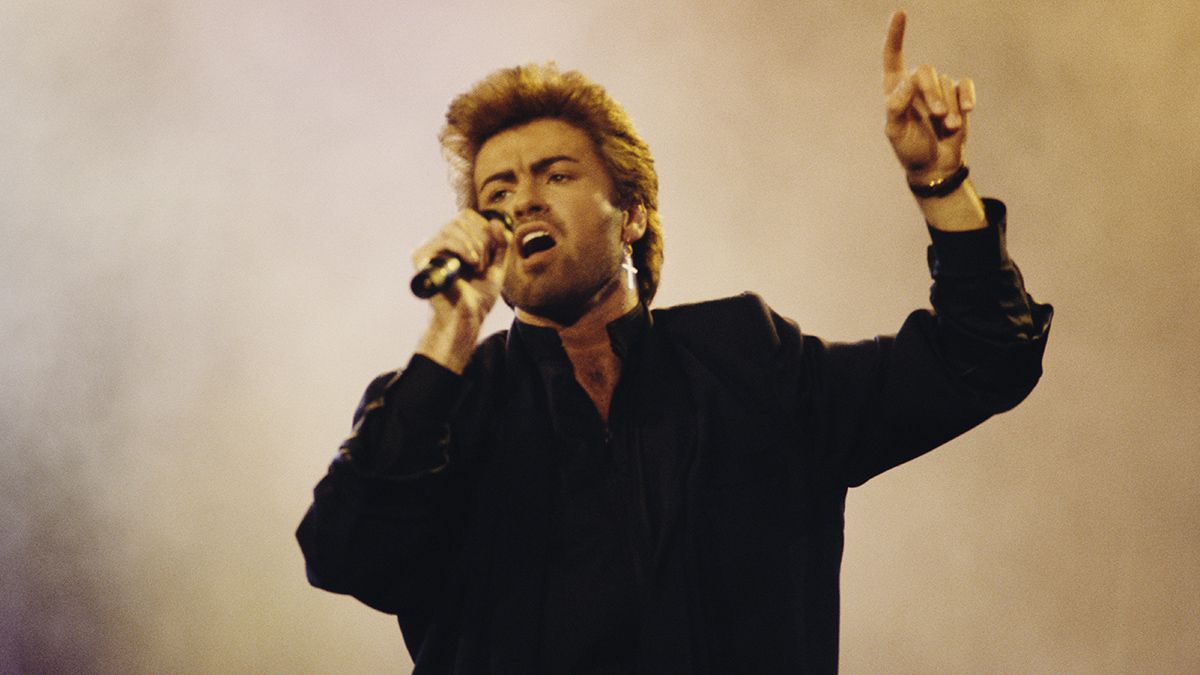
English singer, songwriter and musician, George Michael (1963-2016) performs live on stage at an Aids awareness charity concert at Wembley Arena in London in April 1987. (Photo by Michael Putland/Getty Images).

It might have gone on to sell 25 million copies, but George Michael’s 1987 debut album, Faith, didn’t exactly start on the firmest footing.

Released in May of that same year as part of the soundtrack to Beverly Hills Cop II, first single I Want Your Sex might sound relatively tame by today’s standards, but 40 years ago, it caused quite the commotion, facing radio airplay bans and censorship.
Despite this, I Want You Sex was a big hit, reaching number 2 in the US and number 3 in the UK. Not bad for a song that Michael said was “really easy to do”.

The story of the making of I Want Your Sex, though, is rather more complicated than he was letting on. By the time it appeared on Faith, it had been extended with a second part, and those who bought the album on CD even got a third part - A Last Request - as a bonus track.

All of which would suggest that Michael was heavily invested in the song, but he never performed it again after the Faith tour, and in 2011 said that he no longer liked the original version.

There are reasons for that, which we’ll get to, but let’s start by going back to 1986, when the song that would eventually be known as I Want Your Sex - Pt 1 was recorded.

Armed with a LinnDrum, a Roland Juno-106, a Yamaha DX7, and a Greengate DS3 sampler, Michael got to work, but he didn’t come in with any specific idea of what he was going to record.

“I didn't want to write a song as such,” he would tell International Musician and Recording World magazine in 1987. “I wanted to make a record. When it comes to making dance records I'm much more able to do them as I go along in the studio, because it's much more about sound and rhythm. I deliberately wanted to make a record where if you stripped it down to what was left of the song, there wasn't much of a song there.”

As such, it was more about creating a groove, with variations every 16 bars or so to stop it getting too repetitive.

That said, one of I Want Your Sex’s most notable pieces of ear candy occurs right at the start – the rhythmic synth riff you hear in the intro. This wasn’t planned, though – it came about completely by accident while Michael was working with engineer Chris Porter on something else.

"We were working on a song, again we just had the Juno, LinnDrum and DX7, and we'd connected them all up so that we could run them off MIDI,” Porter told Sound on Sound in 2013. “After doing some programming, we returned to the studio the next afternoon, I pressed 'play' on the tape machine, the MIDI obviously wasn't right and everything started making these weird noises. The drums were triggering random sounds on the Juno and DX7, starting to make what you now hear as the intro on I Want Your Sex: a strange squelching, pulsing bass sound.”

Porter was about to try and fix the problem, but with his keen ear for a hook, Michael told him not to.

"I went, 'Oh damn, I'll reset it,' and George said, 'Hang on a second, hang on a second! That sounds really good, doesn't it?' I said, 'It's a bit weird,' and he said, 'Yeah, but if we just take a bit out of here and a bit out of there we might be able to use it... '”

Turns out he was right.

“We recorded a few bars of that odd squelching noise, and it then morphs into the song, at which point the bass becomes the bass part and just the Juno, LinnDrum and DX7 provide the overall soundscape,” Porter explained.

I Want Your Sex Pt 1 was recorded in painstaking fashion, four bars at a time, and when Michael decided to add a second part at Denmark’s Puk studios in early 1987, he wanted to work in a similar way.

This time, though, he had company; while George played guitar and keyboards, Deon Estus was brought in on bass, and there was also a seven-piece brass section to keep happy. According to Porter, though, they weren’t particularly keen on the bit-by-bit recording method.

“Paul Spong and Steve Sidwell were playing trumpet, and working for really long periods of time could get to their lips,” he recalled. “Still, we were all young, we were in a fantastic place, it was a creative process and it was really exciting.”

Explaining the recording workflow, Porter said: “George would tell them 'Play something like this,' they'd rehearse the part and we'd drop it in. If it didn't work, we'd drop it in again, and then George would say, 'OK, now what if it went something like this for the next few bars?' After another rehearsal, we'd drop in those few bars, and that's how the whole thing got built up from beginning to end, over the course of eight or nine hours in a single night.”

A marathon I Want Your Sex session, you might say.

What of Michael’s later reluctance to perform the song, though? Discussing I Want Your Sex with DJ Mark Goodier in an interview that was included in the booklet that came with the 2011 deluxe reissue of Faith, he said: “I’ve never liked it very much. I love Part 2, but Part 1. You know why I don’t like it? Because I was so enamoured with Prince at the time, and it shows on that record so much. I thought it was really naff to be so enamoured with one of your peers.”

He was being hard on himself: I Want Your Sex Pt 1 might have echoes of Prince, but it’s far from an explicit homage. In fact, a more obvious nod to Prince comes towards the end of Hard Day, Faith’s third single, when Michael uses the pitched-up vocal trick that Prince favoured when exploring his Camille alter-ego to make his voice sound more feminine.

Whatever Michael ultimately thought of I Want Your Sex Pt 1, it didn't do him any harm. In fact, it was a crucial staging post on his journey from boyband member to global solo superstar; his next single would be Faith, a song that spent four weeks at the top of the US charts and would end up being the biggest of the year.

Sign up to read this article
Read news from 100’s of titles, curated specifically for you.
Already a member? Sign in here
Related Stories
Top stories on inkl right now
One subscription that gives you access to news from hundreds of sites
Already a member? Sign in here
Our Picks
Fourteen days free
Download the app
One app. One membership.
100+ trusted global sources.