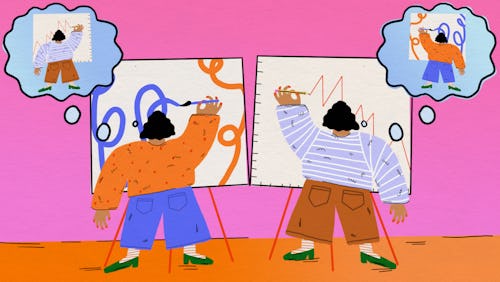
As children, we’re often asked what we want to “be” when we grow up. Our answer is supposed to lie within a very specific list of responses: A doctor. A teacher. An actor. The president. In short: We are forced to respond with a job. From an early age in America, we are taught that our identity — who we are today or might one day become — is entirely defined by work. And therefore, when we dream of our future lives, we are automatically also conceptualizing the next several decades of our future labor.
During the aughts and 2010s, “hustle culture” taught many millennials that if they put in enough hours, they might be rewarded with their dream job — a fun, stimulating, and fulfilling career — and therefore, their dream life. However, this mindset is quickly shifting among working-age Americans, largely due to the pandemic, which exposed not only abysmally low wages and often non-existent benefits, but also the apathy companies often hold for their hard working employees.