Get all your news in one place.
100's of premium titles.
One app.
Start reading
The Conversation
The Conversation
Gerard Toal, Professor of Government and International Affairs, Virginia Tech

The Dayton Peace Accords at 30: An ugly peace that has prevented a return to war over Bosnia

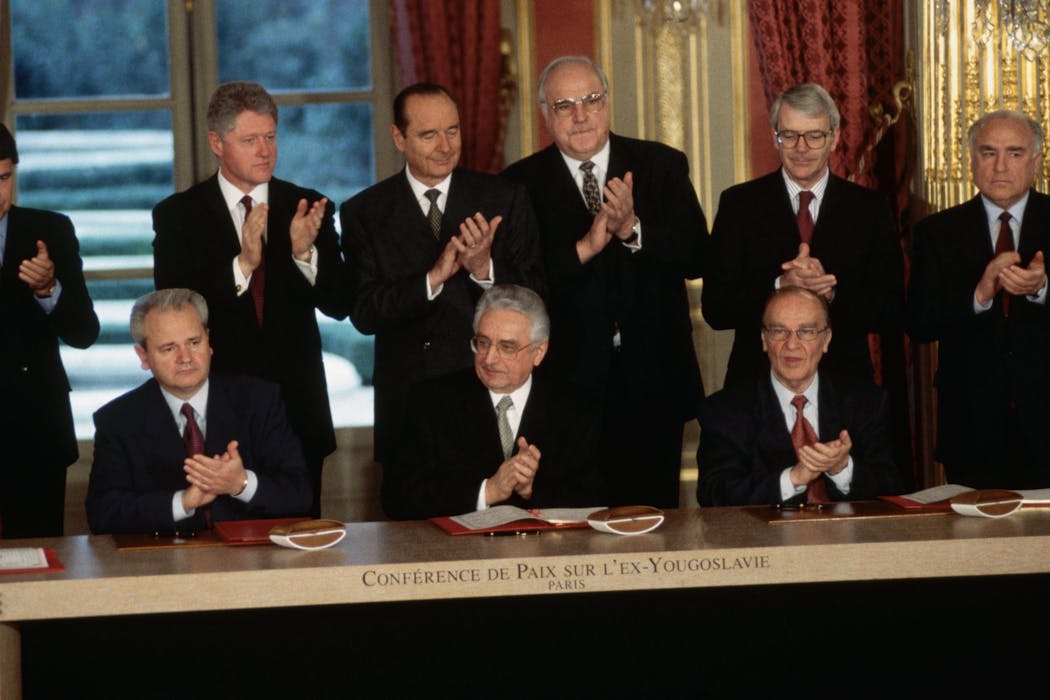
World leaders clap as, from left, Serbian President Slobodan Milosevic, Croat President Franjo Tudjman and Bosnian President Alija Izetbegovic sign the Dayton Peace Agreement. Peter Turnley/Corbis/VCG via Getty Images

On Nov. 21, 1995, in the conference room of the Hope Hotel on the Wright-Patterson Air Force Base in Dayton, Ohio, the leaders of Bosnia-Herzegovina, Serbia and Croatia initialed an agreement that brought the three-and-a-half-year war in Bosnia to an end. Three weeks later, the General Framework Agreement, known as the Dayton Peace Accords, was signed.

The war over Bosnia was the most brutal and devastating of the wars spawned by the dissolution of Yugoslavia. Attacked from the moment it moved toward independence in early 1992 by militias supported by the neighboring nations of Croatia and Serbia, Bosnia was born under fire and nearly perished. Half of its population of 4.4 million were forcefully displaced, and over 100,000 people died during the conflict.

Sign up to read this article
Read news from 100's of titles, curated specifically for you.
Already a member? Sign in here
Related Stories
Top stories on inkl right now
One subscription that gives you access to news from hundreds of sites
Already a member? Sign in here
Our Picks
Fourteen days free
Download the app
One app. One membership.
100+ trusted global sources.