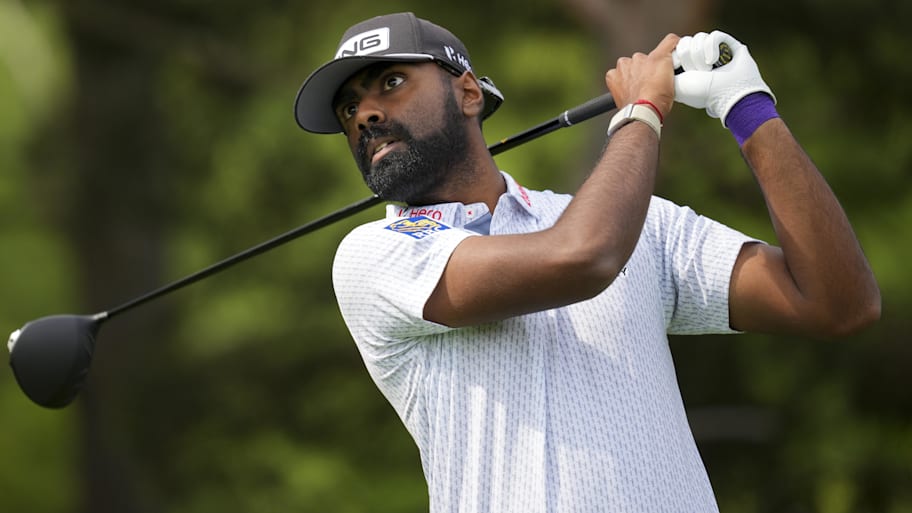
I am a fan of the golfer Sahith Theegala, and because I like him, and the things he has come to represent for me, the Genesis Invitational’s decision to award him a spot in the tournament through the Charlie Sifford Memorial Exemption left me scratching my head. But the more I thought about it, the more I wondered if the exemption allows us to think through who gets to be a part of the broader American story, particularly during these fraught political times.
According to the tournament website, the exemption “has been given to a deserving golfer from a minority background” since 2009, recognizing “players whose journeys reflect the power of opportunity, perseverance and progress in the game of golf.” In 2017, the exemption was named after Sifford, the great Black golfer whose journey in the game during the 1950s and ’60s was not nearly as smooth nor as meteoric as the tournament host—Tiger Woods.

From a nuts-and-bolts perspective, I was surprised that the exemption was awarded to Theegala, given his past successes on the PGA Tour. Perhaps the tournament feels like he is the rightful representative of the Sifford legacy. Perhaps it was a golf decision. Or maybe a box-office one. Theegala is a popular player who grew up in Los Angeles. But he has not played well enough lately to get himself into the Genesis, one of the tour’s signature events with a $20 million purse. The tournament can make its own decisions and, in turn, Theegala can make his. And I can’t begrudge a guy for wanting to play Riviera Country Club.
In some ways, Theegala is the next-generation, millennial Vijay Singh. Both walk tall and upright around a golf course. But where the Fiji-born Singh has always seemed to me to be on the outside looking in, never saying much, there is something distinctly American about Theegala’s affect. He has a kind of lo-fi masculine swagger borne at the crossroads of a post-Woods era in golf and growing up, I suspect, in an Indian American immigrant household where sports swagger may have been a bit out of place. A couple of years ago when I drove down to Riviera to see him play, I noticed that he has a cool hitch to his walk that makes you wonder if he even knows he has the hitch. In a novel I published last year, I had Theegala’s stride in mind as I was trying to describe the swagger of a 16-year-old Indian American kid after he’s run for a couple of touchdowns for his high school team.
Theegala is the child of Indian immigrants. His parents and a crew of extended family and friends often cheer him on during his tournament rounds. I saw them at Riviera; it was all exceptionally sweet. He grew up playing public courses in and around L.A. and played his collegiate golf at Pepperdine. Since turning pro in 2020, he has one title and has earned over $20 million on the Tour. He has had plenty of commercial opportunities off it. By any measure, he’s been a great success already.
The Sifford Exemption is laudable for trying fix, in one small way, a long-standing golf problem of not having enough minority players—particularly Black players—in the professional game. Sifford began playing golf in the late 1940s and could not join the PGA Tour until the “Caucasians only” clause was removed in 1961. Woods’s arrival in the mid-1990s was supposed to have revolutionized inclusion in the game, and to some extent, it has. Collin Morikawa, who just won at Pebble Beach, and Akshay Bhatia, the 54-hole leader, are part of this generation that grew up watching Woods on TV. But the professional game is still not very diverse, in terms of race or class. For the most part, the pathways into the professional game require a certain amount of privilege, time, money and luck.
The Sifford provides one such pathway. It doesn’t really fix the bigger problem. But sometimes a symbol is important. A then little-known golfer named J.J. Spaun got the exemption in 2016. It was his only PGA Tour start that year. Maybe some small bit of confidence he earned there allowed him to drain a career-defining putt nearly a decade later at the U.S. Open at Oakmont. A newly arrived Vijay Singh, growing up humbly and having toiled on a lot of mini-tours around the world, could have used the exemption had it existed in the early 1990s. The last five recipients—all Black men—have used the exception to make their first or second start on the Tour. Clearly, the exemption is a golf lifeline or a Hail Mary. Theegala has made nearly 100 starts.
In giving Theegala the exception, the tournament is signaling that his journey into professional golf is roughly in the same vicinity as Sifford’s or any of the other past recipients. Is it? I don’t know what Theegala experienced on his way up. But I suspect they could have found someone else, stuck on a mini-tour or in the post-college ranks, for the exception. But they made their decision. And it’s an interesting one for what it says about how Indian Americans like Theegala belong in our broader American conversation on diversity and struggle.
I have been thinking through what it means to be Indian in America for some years. There are roughly four million Indian Americans in this country. On average, they have the highest family income among all Asian Americans. And yet there are plenty who struggle financially. They have tended to vote as Democrats, but there are now many Republican Indian Americans in our current political moment. They populate the Silicon Valley at every rung of the ladder, from programmer to CEO. They work in motels and liquor stores around the country. They drive the trucks that deliver the tomatoes and peaches to your grocery store. They are victims of racial discrimination and perpetrators of it. They are not Black. And they are not white. They are whatever brown is. Turn on a TV show in the past few decades and if the casting calls for a smart, nerdy kid or maybe a doctor, it’s likely that they are Indian American. They are typecast as smart and successful and seldom athletic.
All this to say that they are a hugely diverse group of people, some of whom have been successful, others who have not. And yet, and this is from too much personal experience, America will still let you know—on a private golf course, at a public post office, at an ice cream shop where you’re buying your kids a scoop or two—that you don’t fully belong.
Ultimately, I don’t know the genesis of the decision making. It probably has nothing to do with any of this. And yet, making Theegala the Sifford exception places him and his story in the larger American story of struggle.
So what does Theegala himself think of getting the exemption? When asked at his press conference ahead of the tournament, he talked about how “enormous” it was for him to play a part in growing and diversifying the game. But there was something else he said that really struck me. “My buddy—actually a couple of my buddies have gotten this, but I remember vividly my buddy Aaron Beverly getting it [in 2022] and how cool that was for him and even how cool it was for me.” In that moment, Beverly’s opportunity and joy had become Theegala’s. The sentiment of connection between these two men, these two golfers, is another important layer of Sifford’s legacy.
More Golf from Sports Illustrated
- Genesis Invitational Picks, Props Predictions: Betting Tommy Fleetwood, Matt Fitzpatrick and Rory McIlroy
- Genesis Invitational Preview: Field, Course, History, Tee Times, How to Watch
- 2026 Genesis Invitational Betting Models, Picks: A Challenge at Rain-Soaked Riviera
- Tiger Woods Masters Status Unclear as he Hosts the Genesis Invitational
This article was originally published on www.si.com as The Curious Case of Sahith Theegala’s Exemption Into the Genesis Invitational.