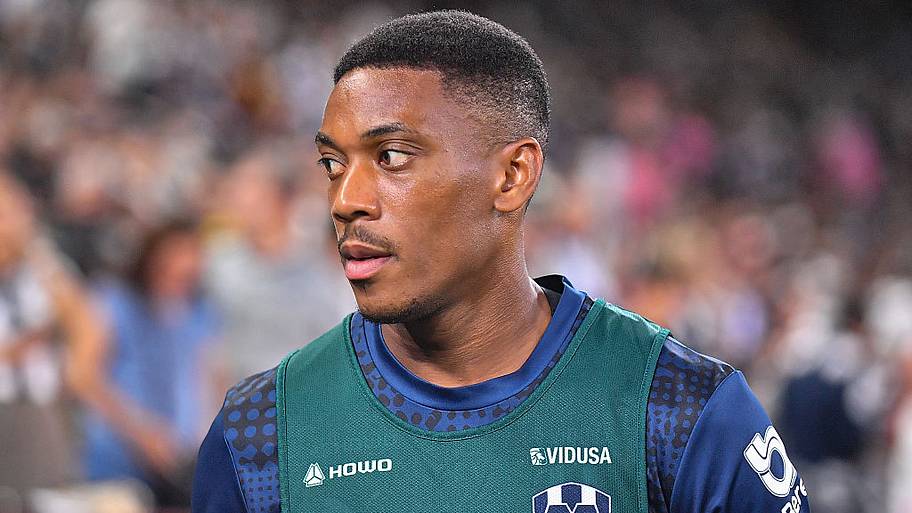
When Anthony Martial became the surprise marquee signing by Manchester United of 2015’s summer transfer window, not many outside France knew very much about him.
But, as the newly crowned soccer’s most expensive teenager—a record he took from teammate Luke Shaw that had until 2014 belonged to United captain Wayne Rooney—the young Frenchman had the world at his feet. Now, more than a decade later, a 30-year-old Martial is about to start the new season without a club and with his career hanging in the balance.

“He made me think of Thierry Henry, in his style, his ability to beat players and to accelerate. His talent jumped out at you,” ex-France defender Willy Sagnol told France Football in 2015.
The Red Devils spent big money on Memphis Depay and Morgan Schneiderlin that summer, as well as offering Bastian Schweinsteiger an extension on his career in Europe. But Martial’s arrival late in the window dwarfed what the others had been bought for.
Monaco hadn’t intended to sell but senior club official Vadim Vasilyev said United almost trebled the size of their initial offer and that the Ligue 1 side rejected four proposals before settling on a package starting at £36 million, rising to £58 million with add-ons—$78.3 million at today’s rate. Infamously, one of those add-ons was conditional on Martial winning the Ballon d’Or. “It’s the price of Luis Suárez or Neymar [joining Barcelona]—the best players in the world,” Vasilyev added.
It demonstrated just how highly United valued Martial and his potential.
Audiences outside France had enjoyed a small taste of Martial during the 2014–15 Champions League campaign, when Monaco notably dismantled Arsenal in the round of 16.
By the time he arrived in England in September of 2015, Martial had played four first-team games for Lyon and 70 for Monaco. Born and raised in the suburbs of Paris, his soccer journey began in the junior ranks of famed local club Les Ulis. Henry had taken the same early steps there in the 1980s, while Patrice Evra started his own journey at Les Ulis in the 1990s.
Martial left home to join Lyon aged 14, debuting for the first team the day after his 17th birthday in December 2012, and was recruited by Monaco just seven months later. His time in the principality was initially split between the B team and the senior squad until a permanent promotion to the latter in his second season, during which he made 48 appearances and scored 12 goals.
‘Tony Martial Scores Again’
To say there was immediate pressure on Martial to deliver at Manchester United because of his price tag was an understatement. The English press was skeptical and even Martial’s new manager, Louis van Gaal, bluntly said the fee was “ridiculous,” reflecting a trend of increasingly wealthy Premier League clubs routinely being charged more for players. The Dutchman tried to offset expectations by insisting Martial had really been signed “for the next Manchester United manager.”
But if there was a perfect way to prove himself, it was a debut goal against Liverpool. The 19-year-old appeared off the bench and scored a late solo strike, coming off the left flank, to powerfully reinforce those early comparisons with Henry. Eight days later, he netted twice in a win over Southampton.
Another highlight from that debut year included a stoppage-time winner in the FA Cup semifinal against Everton that helped set up the club’s first major trophy since Sir Alex Ferguson retired. It ended up being 11 goals in the Premier League and a total of 17 in all competitions. The numbers were promising, rather than outstanding, but painted a bright picture for the future.
Big Change ‘Hurt’ Martial
Yet, for Martial, that was as good as it got for a while. United had a new manager in José Mourinho by the summer of 2016 and arming the boss with more experience was crucial after the squad’s striker options had been cut to just Martial, by then aged 20, and an 18-year-old Marcus Rashford. The response was recruiting coveted free agent Zlatan Ibrahimović, which did more to Martial than simply take away his status as the team’s chief source of goals and attacking focal point.
Martial had been assigned the No. 9 shirt upon arriving from Monaco but lost it to Ibrahimović without his blessing. A few weeks into the new season, representative Philippe Lamboley said to RMC that it both “surprised” and “hurt” his client. “Personally, I did not accept the decision, which I thought was disrespectful and misplaced. I let the United hierarchy know how I felt. You do not do things like that. We have turned the page, but not forgotten about it.”
After Ibrahimović, the competition came from big-money signing Romelu Lukaku instead. And while Martial improved his numbers after a seriously disappointing tally of just four Premier League goals in 2016–17, not far short of half his 45 appearances in 2017–18 were still as a substitute. The following season was a little more up and down; he won the club’s Player of the Month award in October 2018, but was still in Lukaku’s shadow, even if they weren’t directly fighting over the same position on the field.
Still, the Belgian’s own problems eventually paved the way for a frustrated departure ahead of 2019–20, when the team was under the control of Ole Gunnar Solskjær. Martial, now reunited with his old No. 9 shirt, grabbed the opportunity with both hands.
Martial’s Goalscorer Era Proved Fleeting
Having predominantly played from the left flank up to that point in his United career, Martial was deployed centrally throughout the Covid-19-affected campaign. He had seen off his competition, and Solskjær’s faith, combined with a new maturity and composure, allowed him to score 23 times overall in a new-look team that seemed like it was going places.
That was also Rashford’s first time surpassing 20 goals in a single season. But where the Englishman backed it up with the same feat a year later, Martial followed up the best season of his career with what was—at that stage—his worst. Two of his four Premier League goals came in just one match against Southampton, a 9–0 pile on. A red card and a three-match ban in the early stages of the campaign had set the wrong tone, as did the advent of increasing injury and fitness problems.
The physical issues took hold towards the end of 2020–21 and Martial never really recovered, bleeding into 2021–22, which he finished on loan with Sevilla by failing to rediscover his golden touch—no goals in nine La Liga appearances. He couldn’t stay healthy in 2022–23 or 2023–24 when, on paper, the Erik ten Hag era looked made for him. Martial played his last United match on Dec. 9, 2023 and was released when his contract ended six months later.
Martial’s two best seasons in Manchester United colors—2015–16 and 2019–20—produced 40 goals in 97 appearances. His last four years yielded 19 goals in 95. It was an alarmingly sharp decline from a player who once seemed destined to be a star. At this point, it feels important to note that when Sagnol had spoken so effusively about the potential to be next Henry, he also labeled the transfer a “superb gamble,” one with the potential to equally go wrong.
In a 2022 interview with France Football, Martial himself alluded to being a player who needs continuity to perform, someone who plays better with a defined, regular role, rather than adapting to changing circumstances, demands and injury constraints. It served to explain some of his struggles when Ibrahimović and then Lukaku came into the team, as well as his diminishing impact later on when fitness problems limited his ability for consistent minutes.
“When I have my place, it often goes well, but when I’ve been used less, my performance has not been the same,” he reflected. “It’s a vicious circle: I’m less efficient because I play less, and therefore I play even less. When it’s like that, I can sometimes drop out a bit.”
Destined to be Unfulfilled
In the same France Football interview given just after the start of the 2022–23 campaign, Martial revealed he had “regularly played injured” during the previous two seasons—to the point where he “couldn’t accelerate” in the wake of his career year in 2019–20.
There appeared to be some bitterness towards Solskjær for that. “Solskjær tells me that he needs me, so I play.” But without his acceleration, Martial’s game became very blunted and it left him open to criticism without context that he felt was unfair. “The coach never bothered to tell the media,” he added.
It may have been the beginning of the end for Martial there and then, left abandoned by the key attribute that had once made him stand out as a superstar in the making. From a technical point of view, he remained of extremely high quality, but it almost didn’t matter when he couldn’t physically perform to make those abilities actively count.
Martial’s career has sadly only gone downhill since his release from Old Trafford two summers ago. Having signed as a free agent with AEK Athens, he managed a respectable tally of seven goals in 16 Super League Greece appearances; the problem was not necessarily with his output, just that it was only 16 appearances.
Still, it was enough for Monterrey to actively recruit him last summer—beyond simply taking a punt on a free agent. But it was tougher in Mexico, not helped by a dislocated shoulder. More Liga MX games (17) yielded far fewer goals (1) and, after local reports of a rift, Martial was cut loose by mutual consent halfway through a two-year contract.
That was in early June and, two months later, that is how the situation has remained. His name is no longer being talked about and his prospects look worryingly bleak.