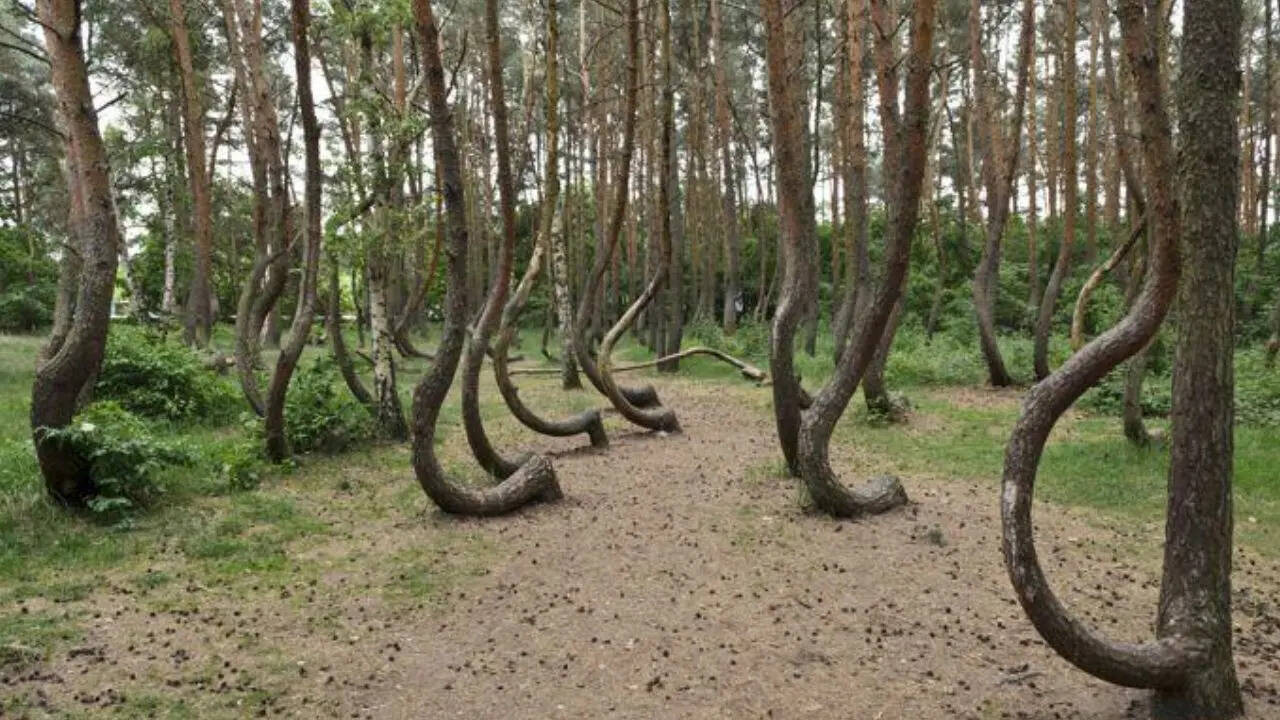
In northwestern Poland lies the Crooked Forest (Krzywy Las), a protected grove of approximately 400 Scots pines (Pinus sylvestris) that grow up in a way that doesn’t conform to nature. The trees were planted around 1930, and each tree has a sharp 90-degree bend at the base, all of which face straight north, with most of them then curving back up towards the sky. Local folklore attributes the shape of the trees to snowstorms or to when World War II tanks drove through, but the Gryfino Forest District and researchers at the University of Pennsylvania point to human intervention as the cause of the trees' curvature and/or design. A leading theory among scientists is that local foresters systematically manipulated the saplings so that they would produce timber with a ‘natural curve’ for shipbuilding or furniture. This industrial use for the trees was likely abandoned when the Nazis invaded Poland in 1939; however, leaving behind this ‘J-shaped’ mystery. The persistence of these uniform curves serves as a living reality to interrupted craftsmanship, blending human intent with resilient botanical growth.