Get all your news in one place.
100's of premium titles.
One app.
Start reading
MyLifeXP
MyLifeXP
Technology
Palak Khanna

The Car Features That Were Invented Because of One Real-Life Accident

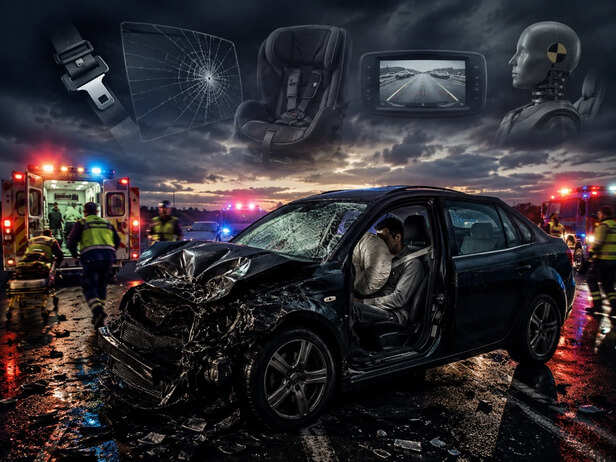
Every time you buckle your seatbelt or glance at a backup camera, you're using technology that might not exist if history had unfolded differently. Many of today's life-saving car features were inspired by one shocking accident that forced engineers, lawmakers, and automakers to rethink vehicle safety. While these stories often began with heartbreak, they ended by saving millions of lives around the world. Here are five car features that owe their existence, or widespread adoption, to one unforgettable real-life incident.

Laminated Windshields Were Inspired by a Lab Accident

The Accident That Reinvented Glass
One dropped flask transformed road safety.​

Sometimes, accidents happen before a car even hits the road. In 1903, French chemist Édouard Bénédictus accidentally dropped a glass flask. Surprisingly, it cracked but did not shatter into dangerous pieces. The flask had previously contained a liquid plastic called cellulose nitrate, which left behind a thin coating. Years later, after hearing about people suffering horrific facial injuries from shattered car windshields, he realized the same idea could make vehicles much safer. That discovery eventually led to laminated safety glass, where a plastic layer is sandwiched between two sheets of glass. Instead of exploding into sharp fragments during a crash, the glass stays largely intact, reducing severe injuries. Today, laminated windshields are a standard feature in nearly every passenger vehicle.

Three-Point Seatbelts Became Essential After Countless Fatal Crashes

The Belt That Saved Millions
A simple design with a life-saving legacy.

Early cars either had no seatbelts or simple lap belts that often caused serious injuries during high-speed collisions. As road deaths increased in the 1950s, Swedish engineer Nils Bohlin designed the three-point seatbelt for Volvo. His design distributed crash forces across the chest and pelvis instead of concentrating them on the abdomen. One of the strongest motivations came from studying real crash victims and understanding how people were being thrown around inside cars. Volvo made the remarkable decision to leave the patent open so other manufacturers could use the design freely. That choice is estimated to have saved more than a million lives worldwide. It remains one of the greatest safety innovations in automotive history.

Child Car Seats Changed After One Heartbreaking Crash

For decades, children simply sat beside adults or on their laps while traveling. That changed after several devastating crashes highlighted how vulnerable young passengers were, including a widely discussed 1960s collision in which children were thrown from a vehicle despite adults surviving. Researchers realized children required restraints designed specifically for their size and body structure. Those tragic incidents pushed governments, pediatric experts, and automakers to create modern child safety seats with proper harness systems. Today, child restraint laws exist in many countries and have dramatically reduced fatalities among young passengers.

Rearview Cameras Became Common After a Tragic Driveway Accident

The Blind Spot That Changed Everything
One tragic mistake led to safer reversing.​

Not every deadly crash happens on a highway. In many heartbreaking cases, drivers accidentally reversed over young children who were hidden in the vehicle's blind spot. One particularly influential case involved a family tragedy in the United States that drew national attention and highlighted the danger of rear blind zones. Public awareness grew rapidly as similar accidents were reported across the country. The demand for safer vehicles eventually led to rearview cameras becoming mandatory in new passenger vehicles in several markets, including the United States. Today, a quick glance at a screen before reversing has helped prevent countless driveway accidents.

Crash Testing Became More Realistic Because Earlier Tests Missed the Truth

In the early days of automobile safety, many vehicles were declared safe based on limited testing methods that did not accurately reflect real crashes. A series of severe highway accidents during the mid-20th century revealed that cars behaved very differently in real collisions than engineers had predicted. These findings encouraged governments and independent organizations to develop standardized crash testing using crash test dummies, high-speed cameras, and controlled impact scenarios. Modern crash ratings now influence how cars are designed long before they reach showrooms. Every star on a crash test report represents lessons learned from real-world tragedies.

Every Safety Feature Has a Story

It's easy to think of seatbelts, windshields, and backup cameras as ordinary parts of a car. But behind many of these features lies a story of loss that changed the automotive industry forever. Each accident revealed a weakness that engineers worked hard to fix. While no technology can eliminate every risk, these innovations have transformed driving into something far safer than it was just a few decades ago. The next time you get into a car, remember that many of the features protecting you today exist because someone else's tragedy sparked a life-saving idea.

Unlock insightful tips and inspiration on personal growth, productivity, and well-being. Stay motivated and updated with the latest atMy Life XP.

Sign up to read this article
Read news from 100's of titles, curated specifically for you.
Already a member? Sign in here
Related Stories
Top stories on inkl right now
One subscription that gives you access to news from hundreds of sites
Already a member? Sign in here
Our Picks
Fourteen days free
Download the app
One app. One membership.
100+ trusted global sources.