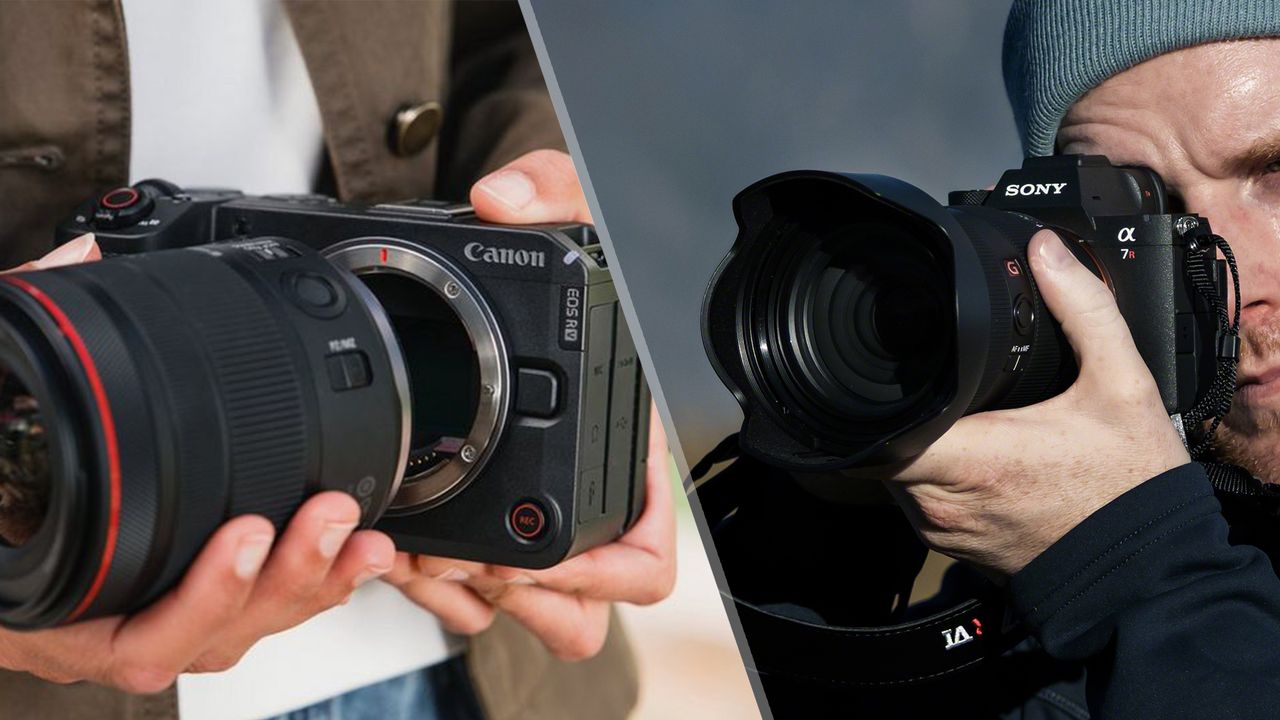
It's been quite an eventful few week for cameras. Insta360 launched a Go 3S Retro Bundle, we saw the GoPro Mission 1 lineup, and on Wednesday May 13th, Sony and Canon dropped a camera each — what a time to be alive! Sony and Canon's announcements came out of the blue, with teasers posted on their respective social channels either a week or just a few days prior to the launches.
Canon has expanded its V-series lineup of video-first cameras with the new EOS R6 V, while the Sony A7R VI succeeds the four-years-old A7R V. Sony's offering sounds like the ultimate hybrid that builds on its predecessor's success, while Canon's latest camera looks like it could be the best mirrorless camera for video.

Needless to say, I'm excited and thrilled. As someone who reviews cameras for a living and loves photographing her surroundings, I'm intrigued by both cameras. But is there one I'm excited about more than the other? Well, that's what we're here to find out.
A quick rundown of specs
Specs |
Sony A7R VI |
Canon EOS R6 V |
|---|---|---|
Price |
||
Sensor |
66.8MP Stacked Exmor RS BSI full frame |
32.5MP CMOS full frame |
Processor |
BIONZ XR2 |
DIGIC X |
Stabilization |
Up to 8.5-stops IBIS |
AF system |
Real-time Recognition AF+ |
Dual Pixel CMOS II |
Viewfinder |
0.64-type Quad-XGA OLED, 9.44M dots, 120fps refresh rate |
No |
Display |
3.2-inch 4-axis multi-angle LCD, 2.1M dots |
3-inch vari-angle, 1.62M dots |
Max video resolution |
8K/30fps and 4K/120fps |
7K/60fps RAW and 7K/30fps Open Gate |
Max shooting speed |
30fps |
40fps |
Battery life (Stills, CIPA) |
600 shots (viewfinder) |
640 shots |
Who are the Canon EOS R6 V and Sony A7R VI for?

Both the Canon EOS R6 V and the Sony A7R VI have different target audiences — but with some overlap. The A7R VI sets a new gold standard for high-resolution full frame cameras with its 66.8MP sensor and 30fps RAW burst capabilities, which make it great for all genres of photography, including wildlife, sports, and portrait. It also features 8K/30fps video so it sounds like a fantastic all-rounder.
Bolstering the A7R VI's position as a powerful hybrid camera is its OLED viewfinder with a 120fps refresh rate and 9.44M-dot resolution. You also get a 3.2-inch 4-axis LCD monitor with a 2.1M-dot resolution. Oh, and 8.5-stops of in-body image stabilization (IBIS) which means you can shoot at very slow shutter speeds and still walk away with a usable photo.
And what about the EOS R6 V? It's the second R-V body Canon has introduced, and it joins the excellent Canon EOS R50 V. The 'V' version of the EOS R6 is also the fourth EOS R6 body in existence — and as the 'V' suggests, it's a video-first take on Canon's hybrid camera. There's no viewfinder so you must rely on the camera's 3-inch vari-angle screen and its 1.62M-dot resolution. The EOS R6 V offers 7K/60fps RAW and 7K/30fps Open Gate video capabilities, both of which make it ideal for content creation.
In addition to that, you get 40fps continuous shooting which is... surprising, and something I wasn't really expecting in a video-first camera. While this camera sounds like it would be peerless for video, I'm sure it will be ideal for capturing photos of birds in flight too with its 32.5MP CMOS sensor and best-in-class Dual Pixel CMOS II autofocus system. And did I mention it packs up to 8.5-stops of IBIS, just like the A7R VI? Yep, it's almost got it all.
The one I'm most excited for (and why)

I'd be lying if I said I wasn't intrigued by the Canon EOS R6 V. It features the same 32.5MP sensor as the Canon EOS R6 Mark III. As a video-first iteration of the series, it packs an active cooling fan — which you'll most certainly need if you're shooting 7K/30fps Open Gate... or even 4K/60fps, really, especially outdoors.
With the EOS R6 Mark III and its predecessors, battery life while recording video was always a sticking point, but this time around, Canon's going for the "best battery life" crown. The company claims the EOS R6 V can record for two hours or more as long as the built-in fan is toggled on, the overheat limit is set to high, and the camera's on a tripod.

While all of this sounds great (and I'm looking forward to test the camera for my full review), the EOS R6 V isn't the one I'm most excited about — it's the Sony A7R VI. The A7R VI packs a newly developed 66.8MP sensor and enables you to shoot RAW photos at 30fps. This will certainly be a boon for wildlife photographers such as myself.
I loved the Sony A1 II when I tested it and it's the one camera I've thought about buying myself time and again. I captured some of my best photos on it, and being able to make extreme crops was a walk in the park thanks to the 50MP resolution. But 66.8MP sounds even better, and the sensor's stacked nature delivers faster readout speeds and minimizes rolling shutter distortion. Then you've got the new BIONZ XR2 processor for 30fps blackout-free bursts, so you don't lose track of your subject because of, well, black screens between shots.
The A7R VI also borrows Auto subject detection mode from the A1 II, so you don't need to manually change the subject you're photographing — handy for anyone who captures a variety of subject. I loved this on the A1 II as I photograph birds, animals and (occasionally) humans and I can't wait to see how it holds up on the A7R VI.
A new trick up its sleeve

In addition to all the goodies the Sony A7R VI offers, it also features a new battery pack: the 2,670mAh NP-SA100. Sony says that with this battery pack, the A7R VI is CIPA-rated for 600 shots with the viewfinder or 710 shots with the monitor. Its predecessor, the A7R V, is CIPA-rated for 440 shots, so Sony's made some strides.
CIPA testing is done under strict conditions and the number is often conservative, so it'll be interesting to see how the battery holds up in real-world use.
I think it's going to be interesting to see how both the A7R VI and the Canon EOS R6 V perform in practice as, in theory, they both sound great in their own right. I'm obviously not pitting both cameras against one another. That would be unfair as they have different target audiences (and there's quite a bit of a price difference). Needless to say, though, it's an exciting time for photographers and camera enthusiasts. I can't wait to get my hands on both cameras and put them through their paces!
More from Tom's Guide
- I tested the Sony A1 II for 2 weeks — and its autofocus results blew my mind
- I just tested the Canon EOS R5 Mark II to photograph wildlife — and this one feature has changed how I take photos forever
- ‘Few wildlife cameras come close to this’: why the OM System OM-1 Mark II is perfect for photographing birds in flight and other animals