
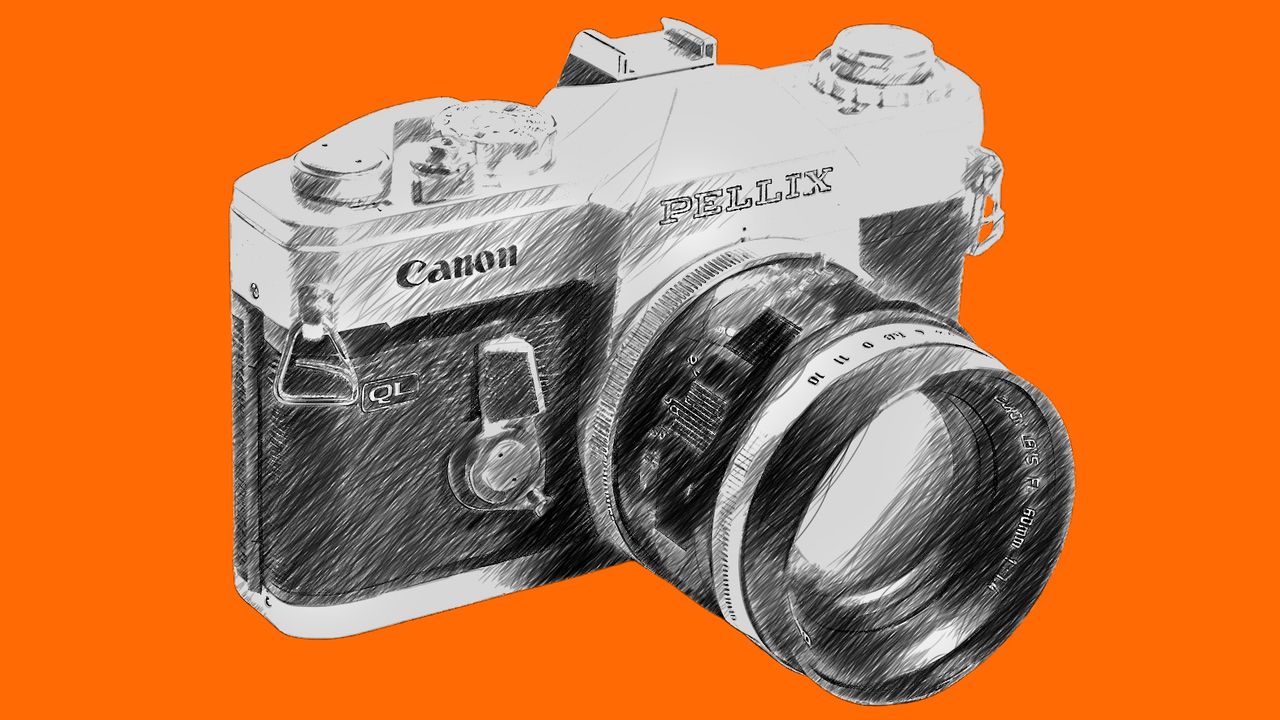
For professional sports photographers (and a very few others) one of the big bugaboos with Single Lens Reflex cameras is the loss of the image during the precise moment that the photo is captured.
The Instant Return mirror (first used in the 1954 Asahiflex) really helped, but in 1965 Canon’s rather innovative solution was to use a fixed “pellicle” mirror, with a semi-transparent coating just 0.02mm thick, which transmitted 65% of the light to the film, and reflected 35% to the finder. It was replaced within a year by the Pellix QL, which used Canon’s Quick Load system for easier film loading, but was otherwise identical; so I’ll treat them here as the same camera..
While the fixed mirror meant that the photographer never lost sight of his subject, (s)he also had a camera that was harder to focus in dim light (remember, this was long before autofocus), having lost two-thirds of the light normally sent to the viewfinder. This was not helped by the fact that the Pellix used stop-down metering, which required the photographer to press a nicely-shaped self-timer lever towards the lens, to stop down the lens, enabling metering but also reducing the light in the viewfinder as the less aperture closed. In bright light, it worked well, but in dim light it made things even more difficult.
Similarly, exposures were longer, as a half stop was lost at the film plane thanks to the rest of the light being diverted to the viewfinder. This was offset somewhat, by not having any “Mirror Slap” – the vibration from the instant return mirror – making longer exposures easier to handhold and the camera somewhat quieter.