Get all your news in one place.
100's of premium titles.
One app.
Start reading
Newslaundry
Newslaundry
Prateek Goyal

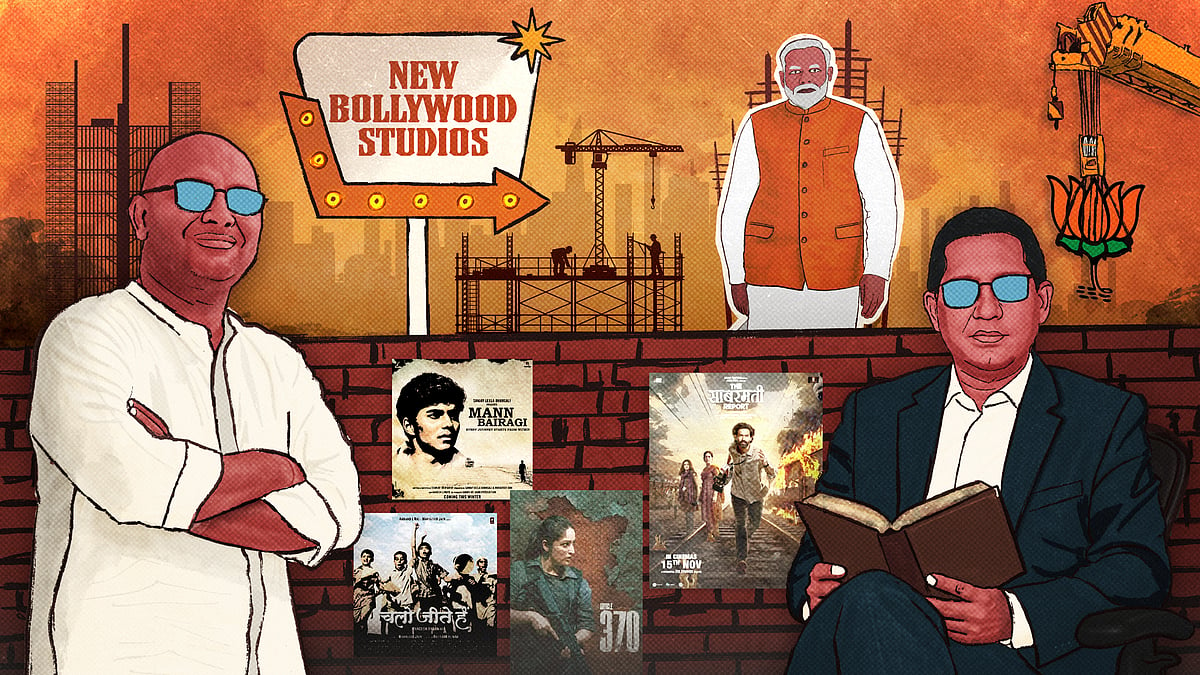
The Bollywood pracharaks who found their place in Modi’s orbit

Read the first part of this series here.

On the evening of September 21, 2025, as Bollywood celebrities arrived at Mumbai’s Nita Mukesh Ambani Cultural Centre for a grand musical tribute to Narendra Modi, a man in a plain white kurta-pyjama moved swiftly through the arriving crowd – greeting actors, holding their hands, positioning them before the paparazzi, guiding them through the media line. Ranbir Kapoor, Vicky Kaushal, Akshay Kumar, Tiger Shroff, Raveena Tandon, Janhvi Kapoor, Rajkumar Hirani, Ashutosh Gowariker – one after another, they followed his cues.
Inside, as the formal inauguration began, another man stood on stage in a blue kurta, sharing the dais with Maharashtra Chief Minister Devendra Fadnavis and BJP national general secretary Vinod Tawde during the ceremonial lamp lighting. He was not some renowned politician, not a star. Yet he appeared entirely at ease at the centre of power.

These two men were Mahaveer Jain and Hitesh Jain.

No, they were not related by blood. What connected them instead was something perhaps more durable: a shared ecosystem built over the last decade at the intersection of Bollywood and the BJP, one that has seemingly reshaped how Hindi cinema engages with political power and, increasingly, how it tells its stories.

Mahaveer Jain, Rajkumar Hirani, Ranbir Kapoor, Saijd Nadiadwala, Ashutosh Gowariker and Vicky Kaushal at the event in September 2025. Instagram/Mahaveer Jain Films
Hitesh Jain on stage with Maharashtra CM Devendra Fadnavis during the event in Mumbai.

Neither holds elected office. Neither is a household name. But over the last several years, both have appeared at nearly every major intersection of Bollywood and the governing establishment – from closed-door meetings between film stars and Narendra Modi, to RSS programmes, Mann Ki Baat celebrations, the WAVES Summit, and high-profile campaigns built around the Prime Minister’s image. Industry insiders describe them as the men who facilitated access, built the networks, and helped align sections of Bollywood with government messaging and ideological narratives.

Think of them as pracharaks – not of the RSS variety, but of a newer kind: men who found their vocation in preaching the BJP’s vision inside the most glamorous industry in the country, and whose own rise seemed to mirror the party’s.

How exactly did that happen? And what does it reveal about how political power now moves through Bollywood?

This report documents patterns of access and influence that possibly led to a new wave of films aligned with the Modi-led government’s messaging. Newslaundry reached out to all named individuals for comment prior to publication; responses received from named individuals and entities are noted in the text.

Mahaveer Jain: The pracharak who found his pulpit

Mahaveer Jain – full name Mahaveer Jain Gogad – grew up in Pali, Rajasthan, where his father had relocated for work from Balotra. He studied at Saraswati Shishu Mandir, an RSS-run school, before moving to Mumbai. His family came from textiles. The family’s textile business is largely handled by his elder brother Surendra Jain, who is also part of some companies linked to Mahaveer Jain.

A close relative described Mahaveer Jain’s belief: “He has always believed cinema is an extremely powerful medium, something that can shape the thinking of entire India within just a few hours. That belief is what drew him towards the film industry. Nationalistic films and films carrying social messages are the kind of cinema he believes can bring change.”

He is, in the relative’s telling, “completely self-made”. He started in casting agencies supplying actors for South Indian films – a venture that eventually collapsed after he was cheated – before gradually moving toward production. A writer who knew him early said Jain “campaigned in support of Modi” during the 2014 Lok Sabha elections and “spoke about wanting him to become Prime Minister. Even back then, he saw Modi not just as a politician, but as a leader who could bring major change to the country.”

His first film bore none of this. Dekh Indian Circus (2011), starring Nawazuddin Siddiqui and Tannishtha Chatterjee, was a critically acclaimed independent drama that premiered at Busan, screened at New York’s Indian Film Festival, and won four National Awards including Best Children’s Film.

Then, for nearly seven years, Jain disappeared from film production entirely.

When he returned in 2018, it was not with another independent social drama. It was with Chalo Jeete Hain – a 32-minute film about the childhood of Prime Minister Narendra Modi, released barely nine months before the 2019 Lok Sabha elections.

Poster of Chalo Jeete Hain

Chalo Jeete Hain: The film that changed everything

Produced with T-Series head Bhushan Kumar and presented alongside Aanand L Rai, Chalo Jeete Hain followed a boy named Naru growing up in Vadnagar, Gujarat – a thinly-veiled portrait of Modi’s own formative mythology.

What followed its release on July 11, 2018, was not a normal film rollout.

Within a fortnight, a special screening was organised at Rashtrapati Bhavan, attended by then President Ram Nath Kovind and senior BJP ministers including Piyush Goyal, Dharmendra Pradhan, J P Nadda, Rajyavardhan Singh Rathore, Anant Kumar, and Kirron Kher. Jain and his team were formally honoured at the event. The very next day, another screening took place at Parliament’s Library Building, attended by L K Advani, Rajnath Singh, Sushma Swaraj, and Sumitra Mahajan; the official Lok Sabha account promoted the film, and then Vice President Venkaiah Naidu issued a formal message praising the movie and its makers. A third screening on July 29 in Mumbai drew Amit Shah, Devendra Fadnavis, Mukesh Ambani, Kangana Ranaut, Sachin Tendulkar, Akshay Kumar, and then-CBFC chairman Prasoon Joshi.

Special screening of Chalo Jeete Hain at Rashtrapati Bhavan. (Credit: Digital photo library Rashtrapati Bhavan)
Senior BJP leaders and ministers at a special screening for Chalo Jeete Hain at Parliament’s library building. (Credit: Loksabha Secretariat)
Mahaveer Jain felicitated by then Lok Sabha speaker Sumitra Mahajan. X/Chalo Jeete Hain
Amit Shah, Devendra Fadnavis and Piyush Goyal at the screening of Chalo Jeete Hain in Mumbai. X/@Fadnavis_Amruta
Akshay Kumar at the screening in Mumbai.
The then CBFC chairman Prasoon Joshi and Kangana Ranaut at the Mumbai screening. (Credit: Bollywood Hungama)
Mukesh Ambani at the screening in Mumbai. Hitesh Jain can also be seen in the picture. (Facebook/Mangesh Hadawale)

BJP leaders amplified the film across platforms. Piyush Goyal’s office, while tweeting about it, tagged PM Modi and wrote: “The hardships faced by Prime Minister Narendra Modi’s mother perhaps gave rise to the Ujjwala Yojana, and as of today, LPG connections have reached 5 crore women.”

Piyush Goyal’s tweet about Chalo Jeete Hain on August 9, 2018.
BJP leader Dharmendra Pradhan’s tweet on August 13, 2018.

Several BJP leaders gave interviews praising the film to a YouTube channel called New India Junction – run by BlueKraft Digital Foundation, the organisation headed by Hitesh Jain, the man in the blue kurta. Mahaveer Jain himself appeared on the same platform, praising both the film and the Prime Minister.

The institutional reach kept growing. Chief ministers and cabinet ministers from BJP-ruled states in Madhya Pradesh, Jharkhand, Haryana, Maharashtra, and Manipur screened and promoted it through official channels. The film was broadcast across Star Network channels, streamed on Hotstar, and aired on DD National and multiple regional Doordarshan channels. In Maharashtra alone, it was shown to around 15 lakh students in more than 16,000 schools – an extraordinary reach for a 32-minute short. Even the Indo-Tibetan Border Police was shown the film as part of its outreach.

Then MP CM Shivraj Singh Chouhan watched the film with his cabinet and state BJP leaders. (X/@ChouhanShivraj)
Chalo Jeete Hain screened at thousands of schools in Maharashtra in 2018. (X/@Dev_Fadnavis)

The film won a National Award the following year – best non-feature film on family values at the 66th National Film Awards – which Mahaveer Jain received personally.

Mahaveer Jain receiving the National Award for Chalo Jeete Hain. (Facebook/NeetuMahaveerJain)

And then, six years later, on PM Modi’s 75th birthday in September 2024, Chalo Jeete Hain was re-released. The Ministry of Education directed CBSE-affiliated and centrally-run schools across the country to screen it between September 16 and October 2. It was simultaneously released in 500 cinema halls.

Ministry letter directing schools to screen the film. (Credit: CBSE)

The relative summarised what lay behind all of this: “After making Chalo Jeete Hain, Mahaveer’s access to the top leadership including Prime Minister Modi definitely increased. But he already had connections within the BJP and RSS ecosystem even before the film. A project based on the Prime Minister’s childhood could not have been made without discussions at the highest levels.”

Chalo Jeete Hain was the inflection point. Before it, Jain was a minor figure; after it, he became something else – a well-connected intermediary who moved between Bollywood’s elite and Delhi’s corridors of power with growing ease.

The access network

In July 2018, two days before the film’s release, he met Prime Minister Modi alongside Rajkumar Hirani and Aanand L Rai. In October 2018, he accompanied Aamir Khan, Rajkumar Hirani, Ritesh Sidhwani, Siddharth Roy Kapur, and Aanand L Rai to a meeting with Modi in Delhi on the film industry’s role in nation-building. In December 2018, he was present at a high-profile interaction at Mumbai’s Raj Bhavan involving Modi, Governor C Vidyasagar Rao, Chief Minister Fadnavis, and leading Bollywood figures. In January 2019, a delegation of younger Bollywood celebrities was flown to Delhi on a private aircraft to meet the Prime Minister – a gathering widely understood within the industry to have been coordinated by Jain.

Mahaveer Jain met Prime Minister two days before the release of Chalo Jeete Hain in July 2018. (X/@Koimoi)
Meeting with PM Modi in October 2018. ( Instagram/neetumahaveerjain)
Meeting at Raj Bhavan in Mumbai in December 2018.
Bollywood actors and filmmakers on their way to meet the PM in January 2019. (Instagram/Mahaveer Jain Films)

In September 2019, on Modi’s 69th birthday, Akshay Kumar unveiled the first look of Mann Bairagi – Jab Main Mujhse Mila, another Mahaveer Jain production about Modi’s life, co-produced with Sanjay Leela Bhansali. The Prime Minister thanked Kumar on Twitter after the unveiling.

Poster of Mann Bairagi

A senior executive of a top production house said: “Over the last 8–9 years, Mahaveer Jain began appearing everywhere and had close ties with the top leadership in Delhi. After all, who would refuse an opportunity to meet the Prime Minister? If someone offers to arrange such a meeting, most people would say yes, and that is exactly what Mahaveer facilitated.”

An A-list producer described the mechanics: “The strategy of such people is simple. They begin with a simple call. They will offer to collaborate on a film. Even if you say you don’t have dates, they will politely insist, ‘No problem, take your time, we’ll make it whenever you’re free.’ They are so persistent, yet polite, that it becomes difficult to refuse. At the same time, examples are subtly set in front of you, creating a sense of fear for saying no. They see us as ‘bhands’; there is no real respect, only a desire to use our names.”

From casting calls to Ayodhya

The scope of Jain’s role sharpened most visibly around the Ram Temple consecration at Ayodhya in January 2024. He accompanied senior RSS leader Sunil Ambekar – the Akhil Bharatiya Prachar Pramukh – to personally visit the homes of Ranbir Kapoor, Jackie Shroff, and others, inviting them for the Pran Pratishtha ceremony. He was part of outreach to Virat Kohli and Anushka Sharma. He then accompanied Madhuri Dixit and Dr Shriram Nene, Vicky Kaushal and Katrina Kaif, Ranbir Kapoor and Alia Bhatt, Ayushmann Khurrana, Rohit Shetty, and Rajkumar Hirani to Ayodhya on a private flight. He also arranged interactions between Bollywood figures and Uttar Pradesh Chief Minister Yogi Adityanath.

Mahaveer Jain with Bollywood figures on their way to attend the Ram Temple consecration event. (Reddit)
RSS leader Sunil Ambekar, Mahaveer Jain giving invites to Ranbir Kapoor, Alia Bhatt. (X/@indiaforums)
Jackie Shroff receiving the Ayodhya invitation from Sunil Ambekar, accompanied by Mahaveer Jain. (Instagram/ayeshashroff)

At the two-day RSS centenary event in Mumbai in February 2026 – attended by Akshay Kumar, Salman Khan, Ranbir Kapoor, Karan Johar, Shilpa Shetty, Jackie Shroff, Vicky Kaushal, Madhur Bhandarkar, Subhash Ghai, Prasoon Joshi, Vipul Shah, Raveena Tandon, Nitesh Tiwari, Manoj Muntashir Shukla, and Ananya Panday – Jain was again understood to have been instrumental in facilitating the participation of several film personalities.

Mahaveer Jain with RSS chief Mohan Bhagwat. Sunil Ambekar can also be seen in the picture. (Instagram/Mahaveer Jain Films)

A former OTT executive, now at a major production house, recalled: “During the RSS centenary event in Mumbai, several actors, directors, and producers privately met Mohan Bhagwat even though they did not attend the public programme. I was at a dinner where one such actor was present. When someone tried to take a selfie, the actor immediately said, ‘Please don’t take my photo, I told them I am not even in Mumbai.’ He was worried that if the picture surfaced online, they would realise he had been lying and didn’t come to the event purposely.”

His access seemed to translate into leverage. At the screening of The Sabarmati Report at the 55th International Film Festival of India in Goa, Jain reportedly called producer Ektaa Kapoor from inside the theatre immediately after the screening and handed the phone to Goa Chief Minister Pramod Sawant, who personally praised Kapoor and thanked her for “bringing forward the facts”. The film was later declared tax-free in Goa.

Mahaveer Jain with Pramod Sawant at 55th International Film Festival of India in Goa. (Instagram/Mahaveer Jain Films)

Vikrant Massey and Rajkumar Hirani – among the earliest Bollywood figures introduced by Jain to Modi – attended the Prime Minister’s oath-taking ceremony in June 2024. In September 2025, Jain accompanied Massey to the Adani Green Talks event in Ahmedabad, where Gautam Adani publicly praised the actor for winning the National Award for 12th Fail.

Mahaveer Jain, Vikrant Massey with Gautam Adani. (Instagram/Mahaveer Jain Films)

The Massey connection runs deeper than red carpets and oath ceremonies. Jain is currently producing White, a thriller about Sri Sri Ravi Shankar’s reported role in helping end Colombia’s five-decade civil war, with Massey playing the spiritual leader. The film is being co-produced with Siddharth Anand, director of Fighter, the film inspired by the 2019 Balakot airstrikes.

Jain and his wife Neetu are close followers of Ravi Shankar, but the overlap with the ecosystem goes beyond personal faith. On May 3, 2024, in the thick of the Lok Sabha elections, both Ravi Shankar and Vikrant Massey appeared together at the Viksit Bharat Ambassador Yuva Samvad at Banaras Hindu University, addressing nearly 4,000 first-time voters. The event was organised under the Viksit Bharat Ambassador initiative run by BlueKraft – Hitesh Jain’s organisation.

During the interaction, Ravi Shankar referenced the Ram Mandir in Ayodhya and praised the work of the Modi government. The actor playing him in Mahaveer Jain’s film, on stage at a BlueKraft-run government campaign, with the spiritual leader he is portraying.

Apart from Mahaveer Jain’s rapid rise within Bollywood since Chalo Jeete Hain, he has also incorporated a slew of companies.

The companies and the link with BlueKraft

Jain has incorporated multiple film companies, several of which attracted politically connected businessmen and financiers, suggest publicly available MCA records.

Sundial Ventures Pvt Ltd, a production company incorporated in 2012 with Jain, his wife Neetu, and brother Surendra as directors, reported zero revenue between 2014 and 2017. After Chalo Jeete Hain, revenues rose sharply, touching Rs 14.98 crore in 2019–20 before declining again.

Mahaveer Jain Films Pvt Ltd, incorporated in April 2022, reported just Rs 201 in revenue in 2023–24, then jumped to over Rs 4.49 crore in 2024–25.

What is particularly notable is who became associated with Mahaveer Jain Films: Sujit Jain, the brother of Hitesh Jain and a key figure in the BlueKraft structure.

Other investors and directors in affiliated companies include Jaina Kavin Shah (wife of Mumbai BJP co-treasurer Kavin Shah); Saral Bhansali (son of Enam Holdings chairman Vallabh Bhansali); members of the Motilal Oswal family trust; Gruhas Proptech LLP co-founded by Zerodha’s Nikhil Kamath and investor Abhijeet Pai; Gautam Munot of the Munot business group; and Dev Govind Binani of AB Construction and Spicy Entertainment & Media Ltd.

Change Within Foundation, incorporated in 2021 with Neetu Jain and Surendra Jain as trustees, closely echoed the ‘Change Within’ initiative launched by PM Modi – later framed as a Bollywood commitment to change its storytelling and cultural direction. (Read the first part for more details.)

On the occasion of Guru Purnima in 2023, Jain shared a post listing those he considered his gurus: Prime Minister Modi, Sri Sri Ravi Shankar, Aamir Khan, Sooraj Barjatya, Rajkumar Hirani, Zerodha’s Nikhil Kamath, Motilal Oswal, Vallabh Bhansali, and Jio Studios CEO Jyoti Deshpande. To some, it read more like a map of his network.

Reached for comment, Mahaveer Jain said, “I prefer myself to stay away from the media. I only talk about my pictures at the time of their release. I will pass this.”

Hitesh Jain: The man behind the curtain

While Mahaveer is widely described as a soft-spoken, smooth operator, insiders say Hitesh Jain is the more powerful of the two – someone who operates behind the scenes and whose influence runs through legal systems, political structures, and cultural institutions simultaneously.

Hitesh Jain is a lawyer, BJP functionary, and co-founder of BlueKraft Digital Foundation – one of the most influential, and least publicly visible, communication platforms associated with the Modi government.

He comes from Pune, from a family closely associated with the RSS. His father S K Jain was a noted lawyer there. Hitesh studied at Symbiosis Law College and completed his LLM from the London School of Economics in 1996. He moved to Mumbai in 1998, built a litigation practice at the Bombay High Court, and rose through a succession of firms before founding Parinam Law Associates in December 2018.

His real ascent came through politics.

Hitesh Jain with Prime Minister Modi. (X/@Hiteshj1973)

Around 2009, he joined the Friends of BJP initiative founded by Rajesh Jain – the strategist widely credited as the key architect of the BJP’s ‘Mission 272+’ campaign and Modi’s 2014 electoral victory. Hitesh Jain became part of a core group that included Amit Malviya and worked closely with Hiren Joshi – once considered one of the most powerful figures in the Prime Minister’s Office, often described as Modi’s eyes and ears – and Akhilesh Mishra, now CEO of BlueKraft.

Hitesh Jain with Home Minister Amit Shah. (X/@Hiteshj1973)

In 2016, Hitesh Jain co-founded BlueKraft Digital Foundation with Rajesh Jain. He was appointed vice-president and spokesperson of the BJP’s Mumbai unit in 2020. But long before he held an official party position, he had already become a significant bridge between Bollywood and the BJP establishment.

Since 2018, his fingerprints appear at every major gathering of the film world and political power: the December 2018 Raj Bhavan meeting with Modi, the large gatherings at the Prime Minister’s Delhi residence, the WAVES Summit where he sat on a sub-committee while Mahaveer Jain coordinated with Bollywood actors. In 2020, he helped organise a closed-door interaction between Union Minister Piyush Goyal and Bollywood personalities at Mumbai’s Grand Hyatt – attended by Ritesh Sidhwani, Bhushan Kumar, Prasoon Joshi, Kailash Kher, and others – held during the BJP’s outreach campaign to build support for the Citizenship Amendment Act. Mahaveer Jain was also present.

Hitesh Jain at the December 2018 meeting between PM and Bollywood figures at Raj Bhavan, Mumbai.
Hitesh Jain at PM’s residence in Delhi. ( X/ @HiteshJ1973)
Hitesh Jain (second row, second from extreme right) and Bollywood celebrities at PM’s residence during the October 2019 meeting. (X/@narendramodi)

Through Parinam Law Associates, Hitesh Jain built a formidable presence inside the entertainment industry. His firm has worked as production counsel for Netflix and Amazon Prime Video projects including Guns and Gulaabs, Farzi, The Family Man, Rana Naidu, and The Great Indian Kapil Show. It has advised Abundantia Entertainment, D2R Films, Akshay Kumar’s Cape of Good Films, and others. It has handled endorsement and licensing work for Kareena Kapoor Khan, Saif Ali Khan, KL Rahul, Kapil Sharma, and Guru Randhawa.

Bollywood actors and filmmakers at Hitesh Jain’s party. (Picture credit: Knots by AMP)

Law, credits, and ‘conflict of interest’

His name also appears in the opening credits of films. In Article 370 – which centred on the abrogation of Article 370 and featured dramatised portrayals of Modi and Amit Shah – he received a special thanks. His name appeared again in the opening credits of Dhurandhar, directed by Aditya Dhar. It was also credited in Brahmastra and Ram Setu, and his law firm in The Sabarmati Report.

Hitesh Jain’s name in the opening credits of Article 370.

Around the release of Article 370, BlueKraft published a book titled Article 370: Undoing the Unjust, A New Future for J&K, stating: “By ensuring that Article 370 was repealed, Prime Minister Modi altered the course of history and also fulfilled BJP’s decades-old commitment.” Separately, Neetu Jain – Mahaveer’s wife – publicly praised the film on social media, specifically thanking Hitesh Jain. The film, the book, and the people around them were, by this point, indistinguishable parts of the same apparatus.

A CBFC member, speaking on the condition of anonymity, spoke about the contradictions: “Hitesh Jain handles CBFC cases from the government’s side. He was once a relatively minor lawyer but has suddenly become quite influential. He is an office bearer in the Mumbai BJP and has, in a way, become a lobbyist. CBFC cases are poorly paid – they hardly bring in Rs 5,000–6,000 – but he fights these cases…You will also find his name in the opening credits of many films. His name constantly crops up. There appears to be a conflict of interest in his case. It’s like, if I were a producer and my film was going for certification, would I certify my own film?

“Some people have raised objections, questioning how someone who is a functionary of the BJP, handles CBFC cases, runs a law firm, and is also a member of the Law Commission of India – an independent and non-aligned body – can hold all these roles at the same time.”

In 2019, Hitesh Jain represented the producers of Vivek Oberoi’s PM Narendra Modi before the Election Commission, which had held the film back for allegedly violating the Model Code of Conduct. He argued the film was “entirely a commercial venture” with no connection to the BJP. He was, at the same time, an active BJP functionary helping arrange Bollywood meetings with the Prime Minister and running BlueKraft's government messaging campaigns.

Consider what Hitesh Jain was doing simultaneously at any given point in the last several years. He was a BJP office bearer – vice-president and spokesperson of the party’s Mumbai unit. He was co-founder and effective head of BlueKraft, a platform openly devoted to promoting Prime Minister Modi and government messaging. He was the CBFC’s lawyer, representing the certification board in court when filmmakers challenged its decisions. His name appeared in the opening credits of films whose content aligned with BJP-RSS narratives. His law firm advised production houses and OTT platforms whose projects he might, as CBFC counsel, have an indirect bearing on. And in April 2025, he was appointed a full-time member of the Law Commission of India – a body meant to be independent of political affiliation – before abruptly resigning within six months under circumstances that were never made public. Each of these roles, taken alone, is legitimate. Taken together, they describe a single individual positioned at regulatory, political, and creative pressure points through which a film in India must pass.

Punjab 95 and the ministry meeting

Jain’s most striking episode of regulatory involvement concerns Satluj, earlier known as Punjab 95, the Diljit Dosanjh starrer about human rights activist Jaswant Singh Khalra. The film faced extensive cuts from the CBFC – then chaired by Prasoon Joshi – and was reportedly forced to withdraw from the Toronto International Film Festival and recently taken down by OTT platform Zee5 globally.

Parinam Law had represented the CBFC when the film’s makers, Ronnie Screwvala and Honey Trehan, approached the Mumbai High Court.

A source privy to developments at the Ministry of Information and Broadcasting said Jain then went further – when Screwvala and Trehan were called to a meeting at the I&B Ministry in Delhi with a senior bureaucrat. “Ronnie Screwvala and Honey Trehan were called for a meeting at the I&B ministry in Delhi by the official concerned. The meeting was supposed to take place only between the three of them. However, when Screwvala and Trehan reached the ministry, they were surprised to see Hitesh Jain already present in the meeting room.

“During the meeting, the I&B ministry official asked whether they had any issue with Prasoon Joshi, as he was the only one objecting to the film. They were also told that since they had agreed to withdraw the international release, efforts would be made to facilitate the film’s release. Both Screwvala and Trehan were highly upset by Jain’s presence in the meeting and expressed their discomfort to the official afterward. They also felt helpless as they couldn’t do anything about it.”

Newslaundry could not independently verify this account; no response was received from the parties concerned by the time of publication.

A leading filmmaker said: “CBFC has become an entry point for the party in power to enter the film industry and control creative content and narratives. Hitesh Jain is the lawyer for CBFC, and his company, Parinam Law, handles most of its cases. Any filmmaker who attempts to make independent or unconventional cinema is often questioned by CBFC and such power centres about what the film offers to the government.”

A filmmaker whose project was stalled by the CBFC offered a rueful joke: “Sometimes I feel that if I want my film to release smoothly, I need to change my lawyer and go to Parinam Law – otherwise the parinaam (outcome) may not be favourable. These days, only those associated with Parinam seem to get a positive parinaam.”

A CBFC member said creative freedom suffered. “As per the Cinematograph Act, CBFC is required to hold quarterly meetings every three months, but for the last seven years, not a single CBFC board meeting has been held. The board exists only on paper. Prasoon Joshi was appointed chairperson in 2017, and the rest of us were appointed at the same time for a three-year term. Our tenure ended by 2020, yet he continued as chairperson even after that. The entire CBFC became centred around him, with decisions functioning according to his will alone. He was on a different power trip. He stopped listening to other members, and the functioning of the CBFC became completely non-transparent. In the process, creative freedom in Indian cinema suffered, while both the ministry and the Prime Minister’s Office were misled about the actual situation inside the board.”

Joshi was replaced and appointed chairman of Prasar Bharati on May 2, 2026.

Scripts rewritten at someone else’s direction?

A celebrated Bollywood director and producer, speaking on the condition of anonymity, described what this power actually looks like on a film set. “CBFC cannot direct producers and directors to add quotes or scenes featuring the Prime Minister in their films. However, this is happening, and producers and directors are being compelled to comply. CBFC reportedly asked Aamir Khan Films to include a quote from Prime Minister Narendra Modi in their film Sitare Zameen Par. Aamir Khan initially opposed this, but eventually had to include the quote,” the director claimed.

The filmmaker claimed that Modi’s speech was included in Dhurandhar 2 to make the narrative look more credible.

“Similarly, in The Sabarmati Report, director Ranjan Chandel was asked to add certain scenes after the film had already been completed. When he refused, he was told to leave the project, and another director was brought in to add those scenes. Such practices are increasingly happening in Bollywood.”

The BlueKraft thread

Sujit Jain – Hitesh Jain’s brother – sits at the convergence point of the two men’s networks: he is both a partner in Mahaveer Jain Films Pvt Ltd and a key figure in the BlueKraft structure. BlueKraft’s Mumbai office operates from a property in the Lodha Supremus complex that Sujit Jain owns. After Rajesh Jain stepped back from BlueKraft’s directorship, his replacement was eventually Pankaj Jain – a cousin of Hitesh Jain.

In April 2025, Hitesh Jain was appointed a full-time member of the Law Commission of India. Within six months, he abruptly resigned under circumstances that were not made public. Around the same time, Hiren Joshi was also rumoured to have stepped down, triggering political controversy; the Congress party publicly alleged links between both men and the Mahadev betting app scandal. These are opposition allegations; neither Jain nor Joshi has been found guilty of any wrongdoing.

During his brief Law Commission tenure, Jain attracted attention for publicly criticising retired judges such as Justice Abhay Oka and Justice Madan Lokur over their criticism of the Modi government – an irony not lost on observers, given that Jain himself was openly associated with political advocacy and pro-Modi campaigns.

A senior filmmaker summed up the system these two men have built: “Hitesh Jain and Mahaveer Jain are seen as power centres in Bollywood. For the last 7–8 years, they have been the people connecting filmmakers and actors with projects that push a certain narrative. If someone needs issues resolved through Delhi or the ministry, they know these are the people to approach. People avoid refusing them because it could harm their interests. Big production houses and filmmakers are valued for their reach and craft. Production houses like Dharma, Maddock, Yash Raj already have established audiences, but once they become part of such networks, there is pressure to stay aligned. The industry itself lacks unity.”

What the industry says

A film producer said: “Propaganda and censorship have gone too far in the last few years. Filmmakers with independent voices are increasingly sidelined, while those aligned with power benefit from it. You can see it in incidents like Naseeruddin Shah’s invitation to Kalina University being cancelled, or Javed Akhtar and Shabana Azmi having their invitations withdrawn from the Delhi International Film Festival. Even filmmaker Honey Trehan was disinvited from an event at Hindu College.”

A renowned casting director said: “Today, many actors and directors feel they must stay in favour with the ruling establishment to survive in the industry. There is so much self-censorship that some lead actors may even avoid playing a character named Usman or Salim out of fear of backlash. Portraying Muslims negatively has unfortunately become the safer option for many filmmakers because they believe it helps projects move smoothly and keeps them away from trolling or boycott campaigns.”

An OTT executive said: “Everyone has to earn a living. No one wants to be trolled or face boycott calls. People in the industry are affected by this, so they avoid taking a stand because they have a lot to lose. Morally, it may not be right, but in practical terms, it’s difficult to judge. If no one speaks up, these trends will only grow stronger.”

An award-winning director concluded: “Actors are the most vulnerable because their careers depend on visibility and public acceptance. Many talented people have quietly stopped getting work because of their political or social views. Directors like Hansal Mehta and Vishal Bhardwaj, who once spoke openly, are now largely silent, while Anurag Kashyap himself has spoken about how difficult it has become to make films in Bollywood. A lot of young filmmakers with strong independent voices now feel helpless.”

Newslaundry sent a questionnaire to every individual and company named in this report. This copy will be updated if a response is received.

In the final part of this series, we examine BlueKraft Digital Foundation: where it came from, who controls it, and how it operates.

Newslaundry is a reader-supported, ad-free, independent news outlet based out of New Delhi. Support their journalism, here.

Sign up to read this article
Read news from 100's of titles, curated specifically for you.
Already a member? Sign in here
Related Stories
Top stories on inkl right now
One subscription that gives you access to news from hundreds of sites
Already a member? Sign in here
Our Picks
Fourteen days free
Download the app
One app. One membership.
100+ trusted global sources.