Get all your news in one place.
100's of premium titles.
One app.
Start reading
Kiplinger
Kiplinger
Business
Tom Taulli

The Best Semiconductor Stocks to Buy

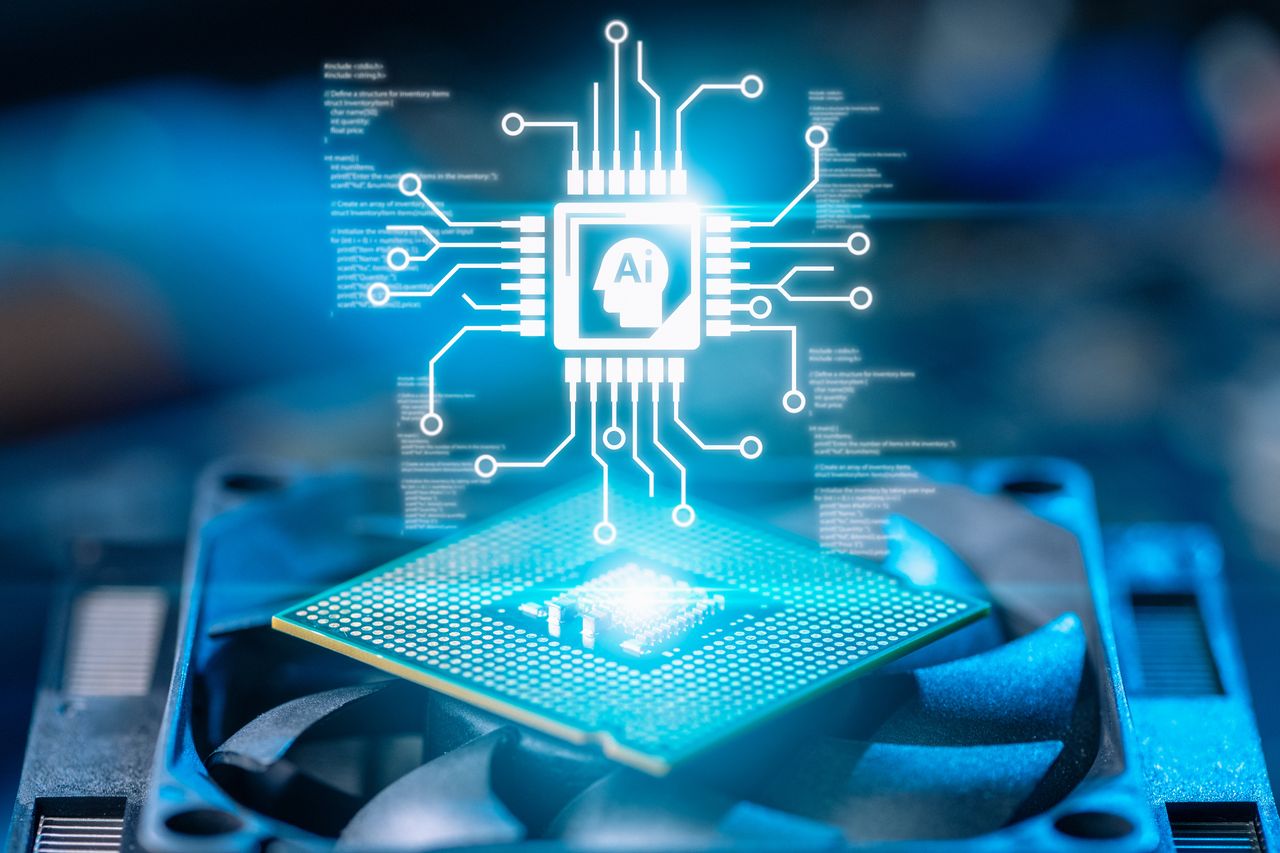
Advanced artificial intelligence silicon microchip mounted on a computer cooling fan, featuring glowing neural network circuit graphics for generative AI, machine learning, and cloud computing.

Semiconductors are at the heart of the artificial intelligence (AI) infrastructure build-out. Chips made from silicon power everything from advanced chatbots and sprawling data centers to smart devices and edge computing.

The rapid growth of AI has spurred massive capital expenditures, or capex, for hyperscalers such as Alphabet (GOOGL), Amazon (AMZN), Meta Platforms (META) and Microsoft (MSFT).

About two years ago, IDC forecast global spending on AI would rise at an annual rate of nearly 30%, from about $235 billion in 2024 to roughly $630 billion through 2028. Consider that those four Magnificent 7 stocks alone are expected to invest $690 billion to $720 billion on AI infrastructure in 2026.

Indeed, the opportunity seems to be only getting bigger. A significant portion of this capex will be for graphics processing units (GPUs) and central processing units, as well as custom chips.

But investing in semiconductors is not a sure thing. And there will be big swings, to the upside and to the downside while the story plays out in the real world.

"Investors should expect more volatility as semiconductor stocks have surged sharply and expectations are sky high," SmartTech Research CEO Mark Vena says. "But in the longer term, fundamentals remain compelling and valuation discipline and execution are much more important as AI spending broadens out beyond the first wave of infrastructure investment."

Based on prevailing trends and the broader context, here are five semiconductor stocks well positioned to benefit from the AI boom.

Data is as of July 27.

  • Market value: $4.8 trillion
  • Dividend yield: 0.5%

Nvidia (NVDA) has generated a total return of more than 1,000% over the trailing 10 years. Lately, however, NVDA has struggled, with a year-to-date gain of 5.5% through July 27 vs 9% for the S&P 500.

But Nvidia's underlying business is robust, and it's still the leader of the AI revolution. Nvidia's GPUs provide the huge parallel-computing capabilities critical to the development and operation of advanced AI models.

Nvidia also benefits from CUDA, its widely adopted software platform for programming GPUs, and extensive integrations with leading AI frameworks and development tools.

Competitive pressures are rising. Hyperscalers are developing custom AI chips, and other chipmakers are building competing accelerators and integrated AI systems.

These alternatives may gradually capture portions of the market. But challengers must contend with Nvidia’s powerful chips, as well as its mature ecosystem that's the de facto standard for AI developers.

Nvidia earnings are still defying the "law of big numbers.," supported by huge growth rates at the top line. Fiscal 2027 first-quarter revenue surged 85%, and net income was up 211%.

Wall Street has high expectations for management's second-quarter report in August. But recent price action means NVDA looks attractive based on valuation, with a forward price-to-earnings ratio of 21.9.

  • Market value: $638.0 billion
  • Dividend yield: 0.5%

Founded in 1984, ASML (ASML) got its start in a leaky shed beside a Philips (PHG) facility in Eindhoven, Netherlands. Its founders saw huge potential in semiconductor lithography, a process that uses light to project extremely small circuit patterns onto silicon wafers.

ASML has grown into a global semiconductor giant, mainly due to management relentlessly pushing the limits of innovation. And its systems can cost $350 million to $400 million.

Its technologies include deep-ultraviolet lithography, immersion systems that use water to improve resolution, and TWINSCAN machines that increase production efficiency by processing two wafers simultaneously.

ASML has also pioneered the commercial use of extreme-ultraviolet lithography, or EUV, which uses extremely short wavelengths of light to manufacture the world's most advanced chips.

ASML recently raised annual guidance for a second time in 2026. Gross margins are robust and improving, now forecast at 54% to 56% vs 51% to 53%.

"ASML's lithography tools touch virtually every leading-edge logic and memory chip," Thornburg Investment Management portfolio manager Sean Sun writes, "making it a critical enabler of the AI buildout."

  • Market value: $165.6 billion
  • Dividend yield: 0.1%

Marvell Technology (MRVL) develops high-performance chips for data centers and networking systems. Its portfolio includes custom application-specific integrated circuits (ASICs), optical and electrical interconnect products and Ethernet switches and controllers.

Marvell is increasingly positioned as an infrastructure supplier for the growth of AI. Its chips help with GPUs, accelerators and processors, as well as memory and storage systems inside large AI clusters.

Marvell reported fiscal first quarter revenue of $2.418 billion, up 28% year over year. And CEO Matt Murphy expects growth to accelerate.

"We are seeing exceptional AI-related bookings," Murphy said in a press release announcing Marvell's results, "and as a result, we are significantly raising Marvell's revenue outlook for both fiscal 2027 and fiscal 2028 compared with the guidance we provided last quarter."

It doesn't hurt that Nvidia CEO Jensen Huang is one of Marvell's biggest fans and identified MRVL as the next trillion-dollar company based on mission-critical networking and connectivity chips.

Huang has backed up his forecast with a $2 billion investment in Marvell.

  • Market value: $180.1 billion
  • Dividend yield: 2.2%

Qualcomm (QCOM) is a dominant player in the mobile world, with its Snapdragon processors, modems and radio-frequency components. Its deep intellectual property in cellular connectivity, low-power computing and chip integration provides a significant competitive advantage.

Those assets also generate substantial revenue through both semiconductor sales and technology licensing. Qualcomm is now leveraging these capabilities to become a major provider of on-device and edge AI technology.

Its processors combine CPUs, GPUs and neural processing units, including the Hexagon NPU, to run generative AI models directly on smartphones, PCs, vehicles, wearables, robots and industrial devices.

Qualcomm's most recent quarterly results were tepid, reflecting the maturity and cyclicality of the smartphone market. But management's Investor Day presentation in June offered a bright long-term picture.

Management raised its fiscal 2029 target for non-handset revenue to $40 billion and projected more than $15 billion in data-center revenue, $10 billion in automotive revenue and more than $14 billion from IoT.

Qualcomm expects handsets to represent only about a third of its semiconductor revenue.

Indeed, according to Mark Vena, "Qualcomm's broadening presence in automotive, industrial IoT, AI PCs and now AI data center infrastructure provides investors many growth engines rather than just one market."

  • Market value: $806.8 billion
  • Dividend yield: 0.0%

Advanced Micro Devices (AMD) has built its strategy on high-performance CPUs and GPUs. So it serves the full range of computing needs across PCs, traditional servers and rapidly expanding AI infrastructure.

AMD's latest results show this strategy is gaining momentum. First-quarter revenue increased 38%, while net income soared 95%.

Data-center revenue surged 57% on strong demand for EPYC processors and continued growth in Instinct GPU shipments. The client business also grew 26%, as the Ryzen system gained market share.

Management expects momentum to continue, guiding to second-quarter revenue growth of about 46%.

AMD's next major opportunity will be the launch of its MI400-series accelerators and Helios rack-scale AI platform. Helios combines AMD accelerators, EPYC processors, networking and software into a complete AI infrastructure system. This will help the company compete against Nvidia’s integrated platforms.

CEO Lisa Su said customer interest in the MI450 series and Helios is exceeding AMD's initial expectations. And Gabelli Funds portfolio manager Hendi Susanto sees the potential.

"AMD remains Nvidia's strongest challenger in AI accelerators while continuing to gain share in the traditional server and PC processor markets," Susanto writes. "We expect a strong ramp of the MI400 accelerator and the Helios rack-scale platform in the second half of 2026."

Related content

Sign up to read this article
Read news from 100's of titles, curated specifically for you.
Already a member? Sign in here
Related Stories
Top stories on inkl right now
One subscription that gives you access to news from hundreds of sites
Already a member? Sign in here
Our Picks
Fourteen days free
Download the app
One app. One membership.
100+ trusted global sources.