Get all your news in one place.
100's of premium titles.
One app.
Start reading
The Independent UK
The Independent UK
Eloise Barker

The best holidays for budding birdwatchers

There has been a a tenfold increase in 16 to 29-year-olds regularly birdwatching - (Getty Images / iStockphoto)

It was a tiger safari that got me interested in birds. Alongside our search for big cats, we spent our time watching bee-eaters and rufous-bellied eagles. The birds of India are so colourful: lilac-breasted rollers, kingfishers – even the pigeons can be green.

But then came a surprise: I asked the naturalist on safari which bird they’d most like to see. The answer: “A ruff in its breeding plumage.” I looked it up. It’s rare, but you can spot this wading bird in all its finery right here in the UK, in Norfolk.
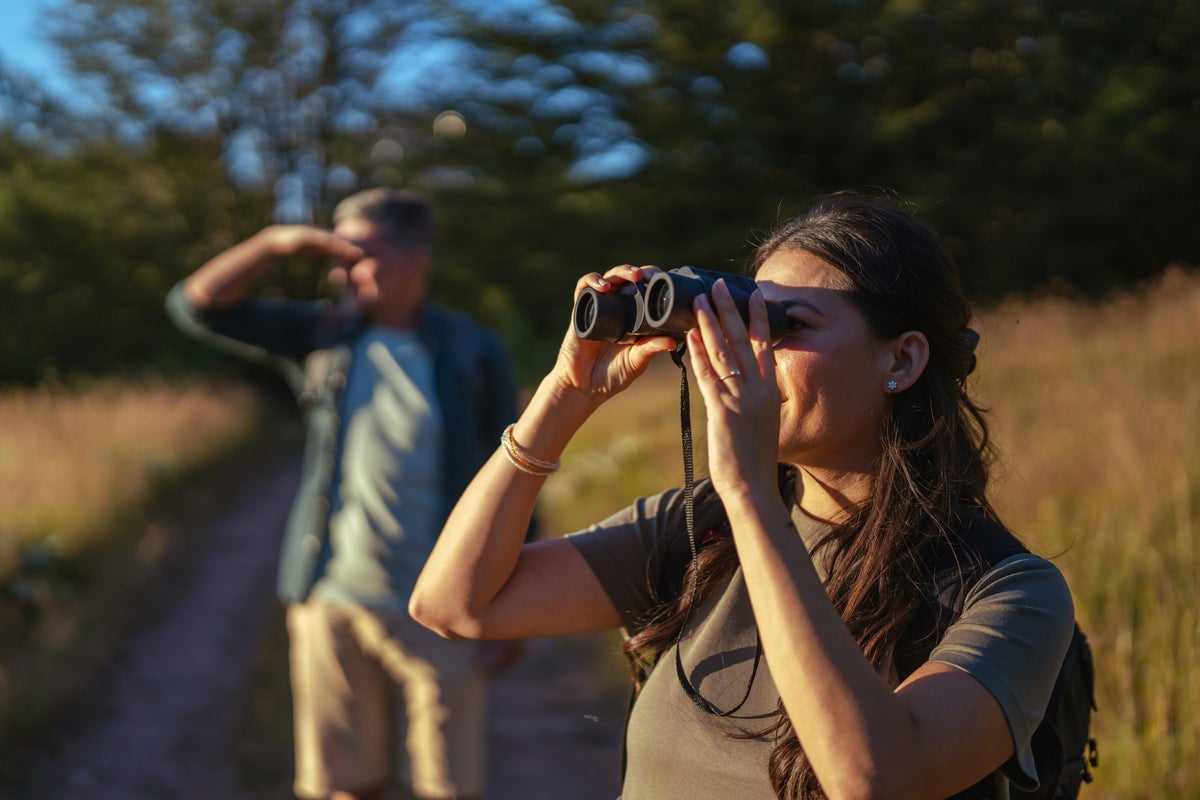
A curiosity was born. Back home in south west England I could see myself getting into birdwatching. But without a holiday itinerary or a helpful guide, I didn’t understand how.

Birdwatchers can seem like a tough crowd to join. In my limited experience of encountering them on trips, they took things very seriously: out before the crack of dawn, back after dark, wielding very expensive cameras and scopes. I had imposter syndrome.

Ruffs in their breeding plumage (Getty Images/iStockphoto)

What happened next was a series of false starts. I snuck around, constantly in fear that “serious” birders would find out and tell me to stop. I’d surprise people precariously balanced on cliffs with timidly whispered questions. Eventually, I realised that random people in the forest aren’t always going to be your friend. What I really needed was a community.

Nothing gets people together like a spectacle. The turning point came last winter, with a word-of-mouth tip about the half a million starlings that perform murmurations on the Somerset Levels near me. I went for my birthday.

Finding my flock

Seeing the starlings, I managed to find my flock. People of all ages and experience levels are drawn to this event. I found female friends, also in their thirties, who wanted to join. Soon, every few weeks I was visiting the Somerset marshes and Severn Estuary: for migration staging, breeding season, nesting season.

India might have had colour, but the UK had its charms – we’re right on the East Atlantic Flyway, and our coastlines see many avian visitors. I love seeing something new in a landscape I thought I was familiar with, and having an outdoor hobby for winter, when shorter days make getting out for dawn and dusk easier prospects. I saw my first dipper in the Lake District and my first Manx shearwater on Lundy Island.

Despite my furtive early attempts, it’s not the solitary hobby I thought it would be. Birding bleeds into other interests – I take binoculars on hikes with friends; I’ve dragged people to osprey nest viewpoints. And it’s not isolating; you can’t help but spout enthusiasm for it to others.

A starling murmuration first inspired Eloise (Getty Images / iStockPhotos)

A national pastime

I’m not alone – the RSPB, which manages more than 200 nature reserves in the UK, has reported a 47 per cent increase in regular birdwatchers across Britain in eight years, including a tenfold increase in 16 to 29-year-olds taking part.

For Jamie Wyver, editor of the RSPB Magazine, taking up the hobby is simple.

“One of the many wonderful things about birding as a hobby is just how easy it is to get started. A pair of binoculars really helps to open up the world of birds and nature but they’re not a must-have for beginners. Simply going out for a walk, taking time to really see and listen to the wildlife around is enough,” he says.

Birding apps are a huge help: “Being able to see or hear a bird, then use a phone to identify its calls, makes it so much more accessible and you’re building your own knowledge at the same time.” The UK is the second-largest user in the world of Merlin, an app trained to identify more than 1,000 bird species by song.

Starlings aside, there are plenty of other UK birding spectacles that bring people together. “Species like puffins, ospreys or golden eagles never fail to get the heart racing,” says Jamie. Meanwhile, the RSPB celebrates Dawn Chorus Day in early May, and organises a garden birdwatch in spring.

Puffins 'never fail to get the heart racing' (Getty Images / iStockPhoto)

Read more: This beautiful UK national park is perfect for an autumn hiking trip

Birders on tour

My next step is to take birding on holiday. Rachael and Dan Brown are professional ecologists who run Wild Discovery, a wildlife watching tour company based in Scotland with trips in the UK and further afield. While serious birding trips can involve box-ticking lists of hundreds of species, beginners might spend more time learning about identification, and about seeing the bigger picture.

“There’s always a story behind the bird,” says Rachael, “whether it’s the huge migrations, or really weird nesting habits, or what they feed on, or how they interact with the animals. We take the pressure off that listing element.”

Have they seen a rise in interest in birding? “I think it’s becoming more socially acceptable to like birds and wildlife,” says Rachael. “Now you’ll see people walking around with binoculars. I never used to see that.”

Beginner wildlife trips focus on identification rather than box-ticking (Getty Images / iStockPhoto)

Rachael’s partner, Dan, loves helping newer birders, reassuring me that my local hide is more welcoming than I initially thought. “If someone asks a question, we’re always there to help,” he says.

Rachael suggests that beginner birders look at volunteering opportunities – that’s how she met people when first moving to Scotland. There are ornithology clubs across the country, including local groups where birders readily share sightings and alerts for rare birds.

Organisations like the RSPB and the British Trust for Ornithology also have youth clubs.

“It doesn’t matter who you are, what your background is or level of interest,” says Rachael. “There are people out there who will be on exactly the same wavelength as you. You’re definitely not alone going into birding.”

The Scottish islands are home to some spectacular wildlife, including white-tailed sea eagles (Getty Images / iStockPhoto)

Top places to visit for a beginners’ birdwatching holiday

“Visiting places like Mull in Scotland always provide unforgettable experiences,” says Jamie. In fact, there are plenty of sites around the Scottish islands, from Islay to the Western Isles. “Shetland is always, always a great one because you can see birds so well and so closely,” adds Dan.

In England, Jamie recommends Bempton Cliffs in Yorkshire, home to half a million seabirds. For me, the Somerset Levels, restored to provide habitat for bitterns in the 1990s, has become my patch, whilst Dan points out that the Isles of Scilly are famous for turning up rare birds.

Further afield, the Danube Delta Biosphere Reserve is Europe’s biggest reed bed and one of the world’s best-preserved river deltas, hosting migrating birds from as far away as Siberia and China and explorable by boat. In Southern Europe, Spain’s Donana National Park is one of the most vital protected areas for migrating birds on the continent.

Sign up to read this article
Read news from 100's of titles, curated specifically for you.
Already a member? Sign in here
Related Stories
Top stories on inkl right now
One subscription that gives you access to news from hundreds of sites
Already a member? Sign in here
Our Picks
Fourteen days free
Download the app
One app. One membership.
100+ trusted global sources.