
What is it?
In 2025, Gretsch reignited its solidbody Corvette design – spurred-on by the success of the Jack Antonoff Princess CVT – with the production model Electromatic CVT Double-Cut. This dual-humbucker rock machine turned heads worldwide, proving once again that there’s more to Gretsch than grease.

However, while the retro looks and middleweight tones ticked a lot of boxes for standard-tuned players, the overall identity of the CVT (especially when decked-out in Havana Burst and Wychwood finishes) positively screamed for a trip downtown.
An excursion made difficult (as I noted in my review) by the one-size-fits-all 24.6-inch scale length. Well, contrary to philosopher Jagger’s claims, it turns out that sometimes you can get what you want, because Gretsch has gone back to the bench and given the CVT a little more road with the 27-inch scale Electromatic CVT Baritone.
Specs
- Launch price: $599/£599/€649
- Made: China
- Type: Six-string solidbody baritone electric
- Body: Mahogany
- Neck: Maple, bolt-on, Performance C shape
- Fingerboard: Rosewood
- Scale length: 27"/686mm
- Nut/width: Graph Tech Nu-Bone, 42.86mm
- Frets: 22, medium
- Hardware: Gretsch die-cast tuners, Adjust-O-Matic bridge and stoptail, nickel finish
- String spacing at bridge: 52mm
- Electrics: 2x Gretsch Twin Six humbuckers, master volume, master tone, push/pull coil splits, treble-bleed circuit
- Weight: 8lb/3.62kg
- Options: N/A
- Left-handed options: No
- Finishes: Bristol Fog
- Cases: No
- Contact: Gretsch
Build quality
Build quality rating: ★★★★★
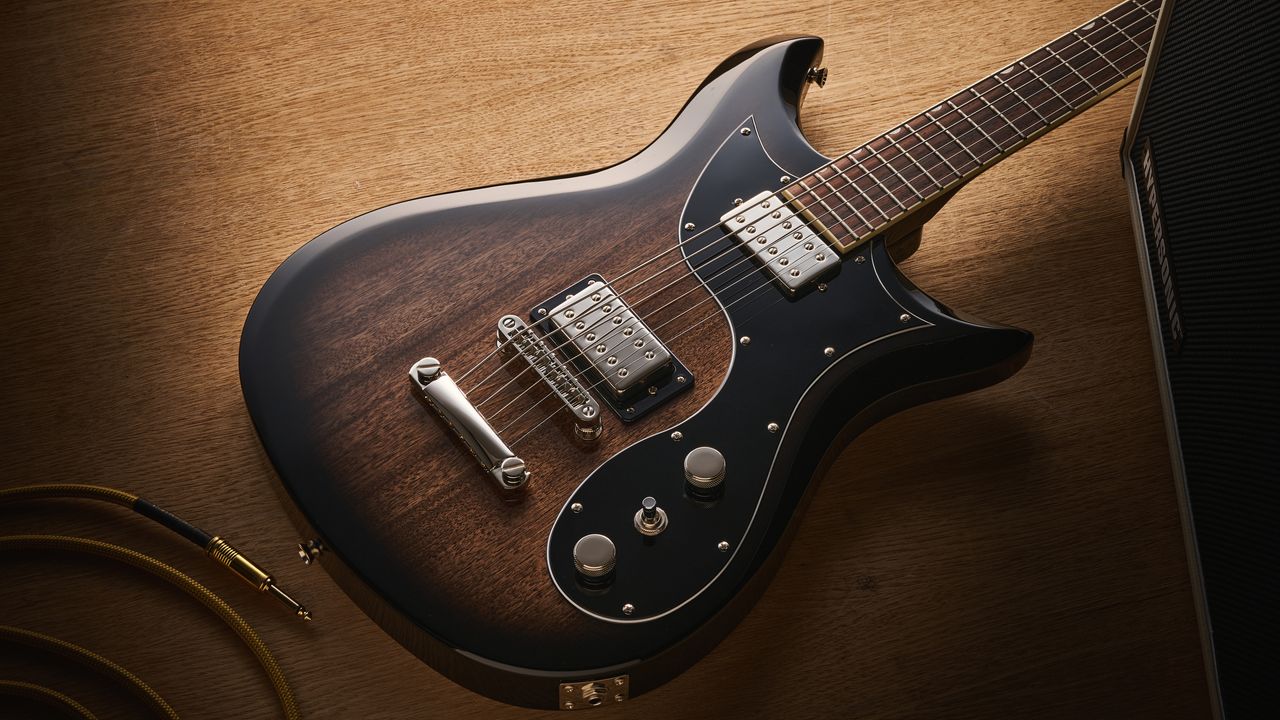
On the face of it, this is the Electromatic CVT Double-Cut with a longer neck - it obviously features the same CVT outline, here cut from mahogany and bevelled at the edges producing a weight of 8lb, edging towards the hefty end of manageable for some. It uses the same Twin Six humbuckers as the regular-size version too. But look a little closer and you’ll discover a few spec changes. First up is the fingerboard which is rosewood for the baritone version, marked neatly with Neo-Classical ‘Thumbnail’ inlays and bound tidily at the edges.
Next up, the humbuckers are wired to enable coil splitting via the single volume and tone pots. These, along with the selector switch feel purposeful with their chunky metal design, making quick engaging/disengaging easier than some plastic control knobs. They’re fastened with grub screws too, so you’re not going to end up yanking it off the guitar by mistake when you go looking for single coil tones. The bridge has been swapped as well, changing from the wraparound bridge of the regular CVT to an Adjusto-O-Matic bridge and tailpiece.
There really isn’t a lot to complain about here, that is, until you realise that the Bristol Fog finish (a sort of trans-brown ’burst we’ve seen throughout Gretsch’s line-up) is the only available colour option. That’s right, no Wychwood, and no Havana Burst that caught the eyes of so many with the Electromatic CVT.
To counter that, Gretsch has done a superb job. It’s a bit of a chameleon, stylistically, being simultaneously dark, moody and totally beardcore-friendly, while also unlikely to look out of place in more classic settings. So, a limited palette, but a potentially diverse application.
Playability
Playability rating: ★★★★½
The great thing about a baritone guitar is that everything you learned in standard tuning is immediately transferable. Standard baritone tuning shifts your tuning down by 5 semitones, so the open strings now become B E A D F# B. To accommodate this, Gretsch has fitted the CVT Baritone with 14-68-gauge strings.
If you’re used to playing 9s or 10s, this is obviously going to require a bit of getting used to, but it’s not entirely alien, and as a result the tension is maintained for the lower register - refreshing if you’re used to down-tuning a regular scale-length guitar and discovering that your lower-pitched strings lose their tuning and intonation due to being too flappy.
Of course, the trade-off is that it’s still six strings across 22 frets, so the same interval range applies, but it starts lower and finishes at a lower pitch too. The heavier strings also take a bit more shifting when it comes to string bends, and the review model feels a bit draggy at a few of the frets. It’s nothing a quick polish wouldn’t fix, but does mean that this review model leans slightly more towards the riff/rhythm side than shredding.
The ‘Performance C’ neck profile is a continuation of that offered on the normal CVT, which to my hand feels like the Goldilocks C-shape found on many guitars from the Fender stable, but slimmed down a touch to feel a bit more ‘modern’. The Gretsch tuners feel particularly smooth, and there’s a softened feel to the edges of the Adjust-O-Matic bridge and saddles that makes palm-muting very comfortable. All of which adds up to a stable, well intonated and comfortable low-end riffing platform.
Sounds
Sounds rating: ★★★★½
Played clean, the Twin Six pickups react ‘fine’ in humbucker mode. These are Alnico V magnets, and while the output is punchy, they are a touch one the dull side.
This guitar is fitted with a treble bleed circuit, so, turning down the volume control allows the higher frequencies to pass direct to the output jack. Doing this helps to even out the balance slightly. The biggest impact, though, comes from splitting the coils.
Removing some of the low end heft makes for a much more satisfying clean tone, bringing back the definition and giving some of that scoopier articulation to the neck position.
But it’s when you start feeding the Twin Sixes to some overdrive that the CVT Baritone reveals its heartland. That extra wool that’s a slight hindrance to clean tones comes into its own with big, beefy overdrive.
I played the CVT through a Way Huge Pork and Pickle - a bass gain box which provides selectable overdrive and fuzz, as well as the option to blend some of your clean tone in parallel, and the result was huge, doomy tones that still had some clarity.
Contrary to Philosopher Jagger’s claims, it turns out that sometimes you can get what you want
One of my favourite things about baritone guitars is their ability to make ordinary progressions sound immediately more interesting, in the same way that a capo does, but in reverse. With that in mind, it makes exploring tunings a lot of fun.
Take that B down a tone and you’re into drop-A, making all of those ’90s one-finger powerchords sound fresh again, with the added benefit of being more menacing to boot. Go the other way and the CVT excels in C-standard too. Add some fuzz, start chugging and you’ll feel like you’re riding along with Josh Homme’s desert road trip.
At this register, the CVT’s heavy, hairy firepower is given plenty of room to stretch out, and playing it through the Universal Audio Knuckles (a Mesa/Boogie Dual Rectifier amp and speaker sim) and EVH 5150 models on my Line 6 HX Stomp, it’s a joy to play way down without fear of the strings giving out.
Dedicated metal players might want to investigate a pickup upgrade if that’s the full-time aim of this guitar, but there’s no denying that it’s tailored for rock and metal straight out of the box.
Verdict
While baritone guitars have a long association with trem-soaked surf rock, but the CVT isn’t going to be hanging-10 anytime soon. The lack of a vibrato and the overall blend of a chunky mahogany body and those Twin Six pickups lay out its brief from the go.
At this register, the CVT’s heavy, hairy firepower is given plenty of room to stretch out
And it meets it brilliantly, for the most part. So much so that the baritone format might just be the CVT’s natural home. It suits it so well that it all just makes sense - it’s comfortable to play, handles the lower pitches without stuttering or warbling, and, dare I say, looks the part too, even if one or two finish options wouldn’t go amiss. Then consider the price and it’s very hard to find fault.
MusicRadar verdict: For many, a baritone guitar is a commitment rather than a ‘play it for a couple songs’ type indulgence. But here, Gretsch has managed to check both boxes at once by delivering a quality example of the baritone configuration at what is rapidly becoming the new ‘affordable’ price point.
Test |
Results |
Score |
|---|---|---|
Build quality |
Near-flawless, it'll have you checking and re-checking the price tag. |
★★★★★ |
Playability |
Baritones require a bit of getting used to, and some gritty-feeling frets means it's not quite perfect. |
★★★★☆½ |
Sounds |
What it lacks in clean inspiriation, it makes up for with the gain on. It knows its lane and it's staying in it. |
★★★★☆½ |
Overall |
It's a great-value entry point into the baritone world, delivering above expectations in many areas at this price. |
★★★★☆½ |