
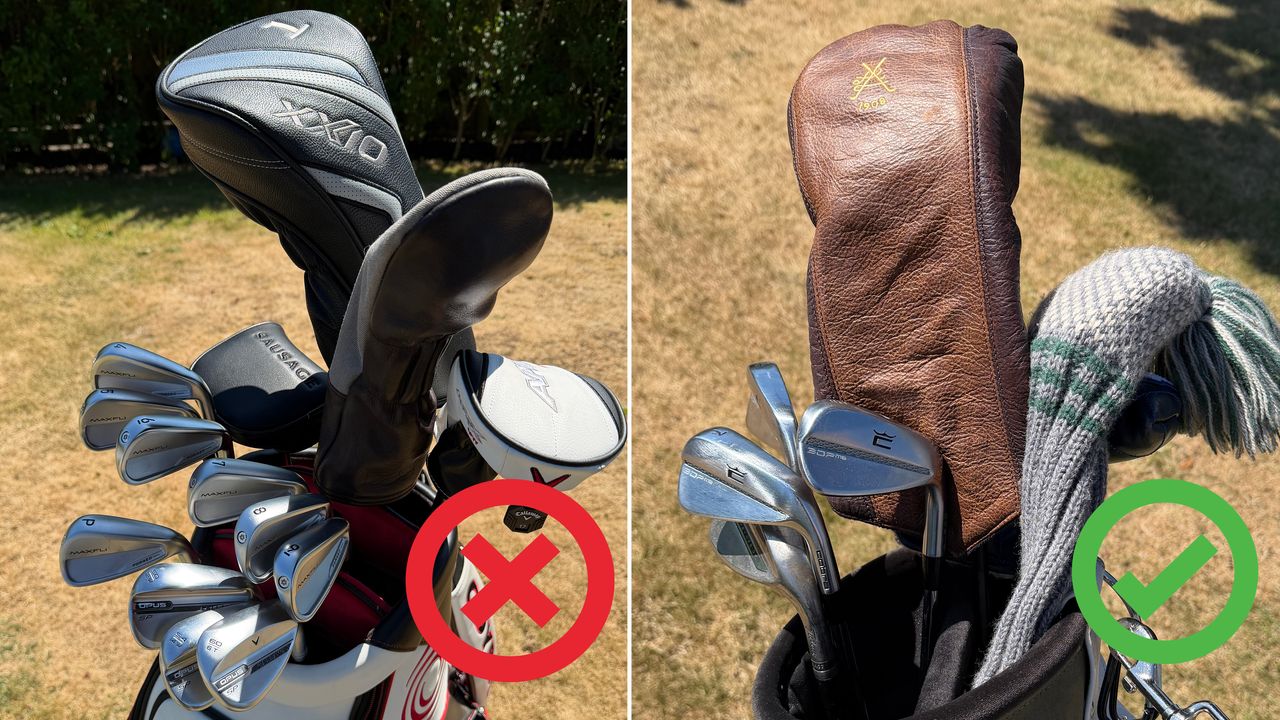
For decades, amateur golfers have treated the 14-club limit not as a maximum cap, but as a mandatory requirement. We pack our bags until the zippers strain, stuffing every available slot with low-profile hybrids, utility irons, and an endless array of specialized wedges.
The logic seems sound: if the Rules of Golf allow us 14 tools to solve a complex puzzle, why leave any in the shed?

Yet, for many players, I believe this abundance of choice does more harm than good. Maximizing your club count can quietly stifle your natural feel, paralyze your decision-making, and strip away the very element that makes golf an art form: creativity.
Modern golf culture is obsessed with data and hyper-precise yardages. We shoot a pin at 152 yards, check a chart, and automatically pull the 8-iron designed to carry exactly 152 yards. But golf is rarely played in a vacuum. Wind, elevation, turf interaction, and even a sore back (in my case!) constantly shift the equation.
When you have a club for every possible distance, your mindset becomes purely robotic. You expect the equipment to do all the heavy lifting.
Conversely, when you find yourself between clubs - say, standing 145 yards out with only a 160-yard 7-iron and a 135-yard 9-iron - you are forced to react rather than just compute. To bridge that gap, you have to fashion an answer.
You might grip down on the 7-iron to play a low, flighted knockdown, or open the face slightly to hit a high, soft cut that takes five yards off the carry. Alternatively, you might step up to the 9-iron, move it back in your stance, and turn through aggressively to squeeze out extra yardage. This process shifts your focus from a simple outcome to deliberate execution, reconnecting your hands and brain to the feel of the clubhead.
Nowhere is this over-specialization more obvious than in the modern short game. It is not uncommon to see amateur bags featuring four or even five wedges, each meticulously gapped by loft and customized with specific bounce and grind profiles.
While custom fitting has its place, for me, relying on specialized equipment to dictate trajectory often comes at the expense of genuine technique.
If you carry a single wedge instead of three, four, or five, you are forced to learn how to manipulate the face and your delivery. You discover how opening the blade adds effective bounce, how leaning the shaft can lower launch, or how striking the ball lower on the face generates check-spin. Learning to get five different trajectories and spin profiles out of one wedge builds an intuitive grasp of face control that no custom-ground lob wedge can ever replace. Just ask Shane Lowry.
This isn't just romantic nostalgia for a bygone era; it is a proven method for elite skill development. I recently interviewed six-time Major champion Sir Nick Faldo, who highlighted this exact philosophy as a crucial part of his learning and progression in the game.
He revealed that even when he was at the absolute peak of his career in the early nineties, he would frequently go out for a practice round with just 6 or 7 clubs in the bag to test himself, force creative thinking, and sharpen his shot-making abilities.
The next time you head out for a practice round, try leaving half your set in the trunk of your car. Carry an odd-or-even set- a driver, a hybrid, a 5-iron, 7-iron, 9-iron, a single wedge, and a putter.
You might miss a specific distance gap once or twice, but you will quickly notice a newfound freedom in your swing. You will stop overthinking, start shaping shots, and remember what it feels like to truly play golf rather than just manage inventory.






